

This article is for general education and research information. It does not provide medical advice or instructions for personal use.
Peptides are everywhere in modern health discussions. A person researching diabetes treatments may come across FDA-approved peptide medicines such as insulin analogs or GLP-1 receptor agonists. Someone searching for recovery, longevity, or performance-related compounds may find experimental peptides like BPC-157 or CJC-1295 being discussed online.
The confusing part is that both groups are often called “peptides,” even though they exist in very different regulatory categories.
A peptide approved by the U.S. Food and Drug Administration (FDA) has passed a long evaluation process. It involves laboratory research, human clinical trials, manufacturing inspections, and benefit-risk reviews. An experimental peptide may have interesting laboratory findings, but it does not have the same level of evidence or regulatory approval.
This difference matters because a promising result in a research setting does not automatically mean a compound is proven safe or effective for treating people.
Before considering any peptide therapy, readers often ask:
- Which peptides are actually FDA-approved?
- What makes prescription peptide medicines different from research peptides?
- Are experimental peptides safe for human use?
- Why can some peptides be studied in laboratories but not prescribed by doctors?
Understanding the difference helps separate established medicines from compounds that are still being investigated.
Quick Comparison of FDA-approved Peptides and Experimental Peptides
| Category | FDA-approved peptides | Experimental peptides |
|---|---|---|
| Regulatory status | Approved by the FDA for specific medical uses | Not approved by the FDA as human treatments |
| Evidence level | Supported by clinical research and regulatory review | May rely on laboratory, animal, or early human research |
| Medical use | Can be prescribed according to approved labeling | Not authorized for routine medical treatment |
| Safety information | Known risks, warnings, and dosing guidance available | Long-term safety and dosing may remain uncertain |
| Manufacturing standards | Produced under pharmaceutical quality requirements | Standards vary depending on source and purpose |
The most important distinction is simple:
FDA approval means a peptide has passed a regulatory evaluation for a defined medical use. Experimental status means research is still ongoing.
What FDA Approval Means For Peptide Medicines
The FDA does not approve peptides simply because they produce a biological effect. A peptide becomes an approved medicine only after researchers demonstrate that it provides a meaningful medical benefit and that its risks are understood.
According to the FDA drug approval process, pharmaceutical companies must provide evidence about a drug’s safety, effectiveness, quality, and manufacturing process before approval.
For peptide medicines, regulators evaluate several areas:
- How the peptide works in the body
- Whether it produces the intended medical effect
- Whether benefits outweigh potential risks
- Whether the product can be manufactured consistently
- Whether patients can use it safely according to approved instructions
FDA approval also applies to a specific use. A peptide approved for one medical condition does not automatically become approved for every possible application.
For example, a peptide medicine approved for diabetes treatment cannot be marketed as an approved treatment for muscle growth, anti-aging, or other unrelated purposes unless regulators specifically approve those uses.
How The FDA Evaluates Peptide Medicines
The journey from a laboratory discovery to an approved peptide medicine can take many years.
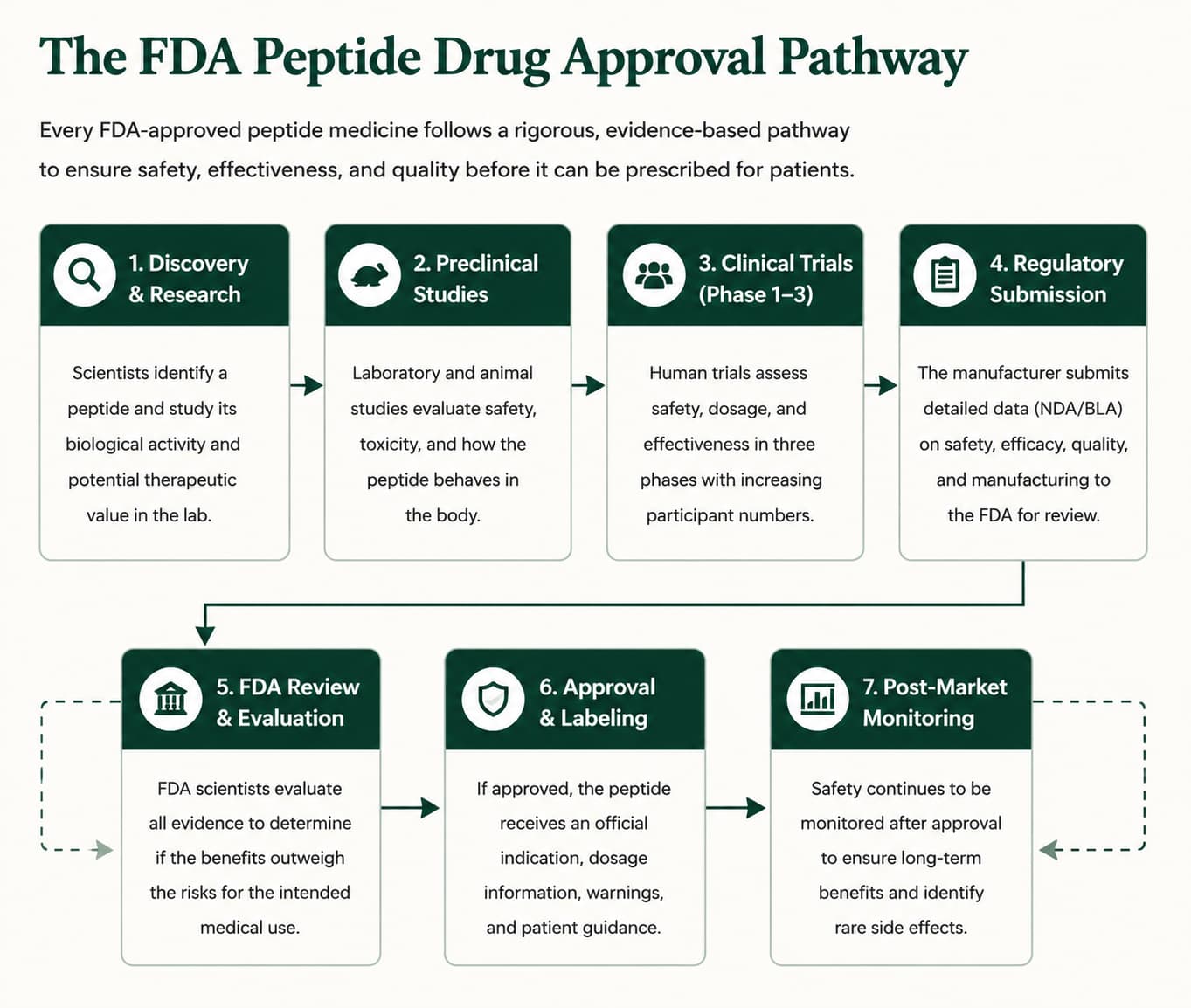
Figure: The FDA Peptide Drug Approval Pathway showing the key stages from peptide discovery and preclinical research to clinical trials, regulatory review, approval, and post-market safety monitoring.
Researchers first identify a biological target and study whether a peptide can influence that target. If early findings suggest potential therapeutic value, the compound moves through increasingly detailed testing.
Preclinical Research
Before testing in humans, scientists conduct laboratory and animal studies.
These studies help researchers understand:
- How the peptide interacts with biological systems
- Potential toxicity risks
- How the body absorbs and processes the compound
- Appropriate starting doses for human studies
However, promising preclinical results do not guarantee that a peptide will become a successful medicine.
Many compounds show activity in early research but fail later because they may not produce enough benefit, may have safety concerns, or may not work effectively in humans.
Human Clinical Trials
If a peptide shows sufficient potential, researchers begin clinical trials.
The main stages include:
Phase 1
Phase 1 trials primarily evaluate safety, dosage ranges, and how the human body responds to the peptide.
Phase 2
Phase 2 studies examine whether the peptide produces the intended therapeutic effect while continuing safety monitoring.
Phase 3
Phase 3 trials involve larger patient populations to confirm effectiveness and identify additional safety information.
Clinical trial information is publicly available through ClinicalTrials.gov, a database operated by the U.S. National Library of Medicine.
After successful trials, manufacturers submit applications containing clinical data, manufacturing details, and safety information for FDA review.
Examples Of FDA-approved Peptide Medicines
Several peptide-based medicines have become important treatments in modern healthcare.
Insulin And Insulin Analogs
Insulin is one of the most established peptide medicines.
It is essential for many people with diabetes because it helps regulate blood glucose levels. Over time, researchers developed insulin analogs that modified insulin characteristics, such as how quickly it begins working and how long its effects last.
GLP-1 Receptor Agonists
GLP-1 receptor agonists are among the most discussed peptide medicines today.
Examples include:
- Semaglutide
- Liraglutide
These medicines are designed to mimic the effects of naturally occurring GLP-1, a hormone involved in glucose regulation and appetite signaling.
Their approval was based on human clinical trials evaluating effectiveness and safety.
Other FDA-approved Peptide Medicines
Other examples include:
- Teriparatide, used for osteoporosis treatment
- Leuprolide, used for hormone-related medical conditions
- Desmopressin, used for specific water balance disorders and bleeding conditions
Each peptide medicine has its own evidence base, approved indication, dosage information, and safety profile.
What “Not FDA Approved” Actually Means
The phrase “not FDA approved” is often misunderstood.
It does not automatically mean that a compound has no scientific value. Many important medicines started as experimental compounds before completing clinical development.
Instead, “not FDA approved” means the FDA has not authorized that product for a specific medical use.
A peptide without FDA approval may be:
- A laboratory research compound
- An investigational drug being studied in clinical trials
- A substance without sufficient evidence for approval
- A product marketed outside approved medical pathways
The difference comes down to evidence.
A peptide may have promising laboratory findings but still lack the human clinical data required for approval.
This distinction is especially important with peptides discussed online for areas such as recovery, performance, or longevity.
What Experimental Peptides Are And Why They Remain Different
Experimental peptides are compounds researchers investigate to understand their possible biological effects.
They can help scientists explore new treatments, but they have not completed the same regulatory pathway as approved medicines.
Some experimental peptides are studied because they interact with important biological pathways.
BPC-157
BPC-157 has received attention because of research examining its possible effects on tissue-related pathways and inflammation.
However, most available research remains limited compared with approved medicines, and BPC-157 is not an FDA-approved human treatment.
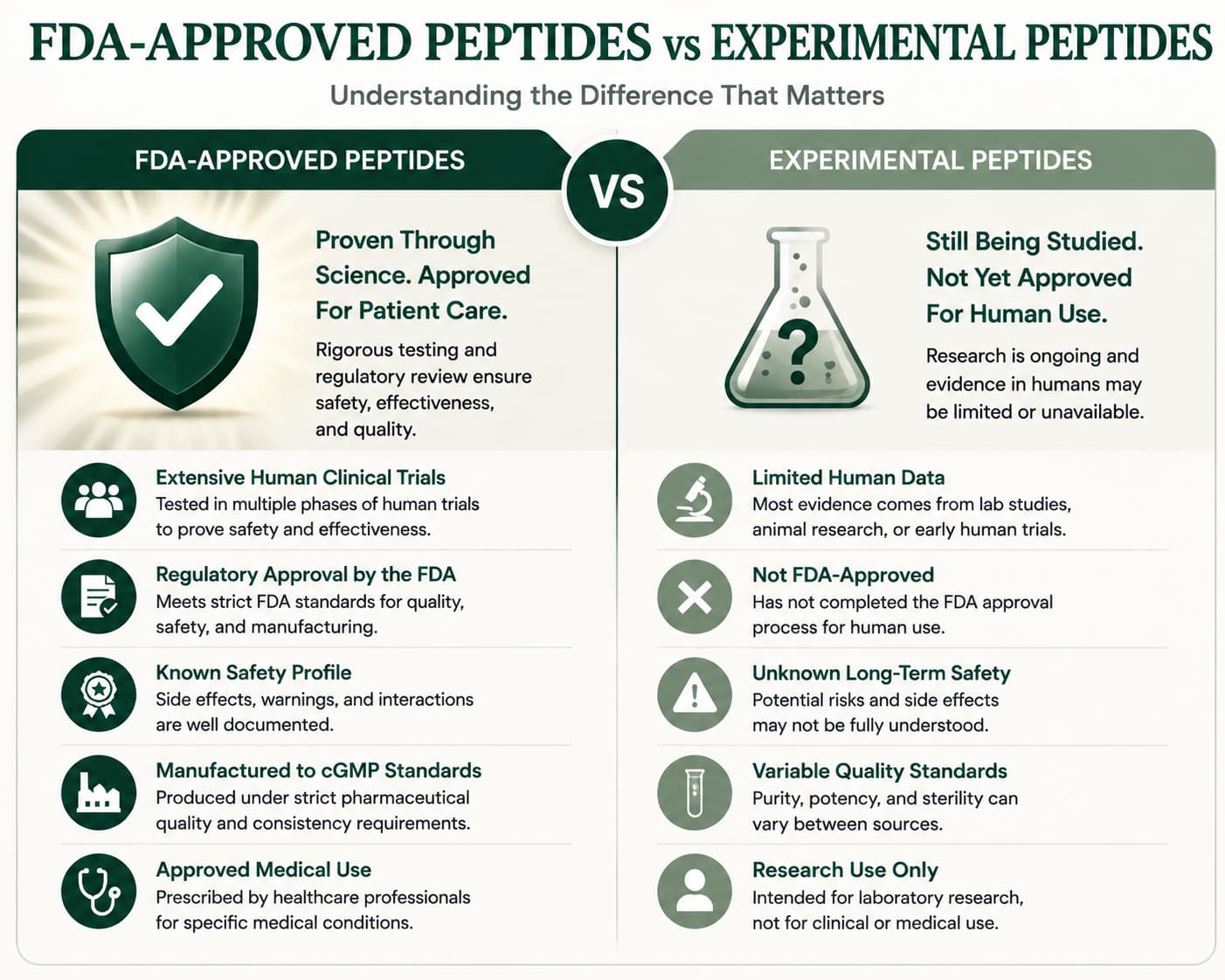
Figure 2: FDA-approved peptides vs experimental peptides comparison showing differences in clinical evidence, FDA oversight, manufacturing standards, safety information, and approved medical use.
CJC-1295
CJC-1295 is a peptide related to growth hormone-releasing hormone signaling.
Researchers have studied its effects on growth hormone pathways, but it does not have FDA approval as a medical therapy.
TB-500 And Thymosin-related Peptides
TB-500 and related thymosin peptides have been investigated for biological activity connected with cellular processes.
Although these compounds are discussed in some performance and recovery communities, research interest does not equal regulatory approval.
A peptide can be scientifically interesting while still requiring years of additional research before doctors can use it as a validated treatment.
Why Research Use Only Does Not Mean Approved Or Safe For Human Use
Many experimental peptide products are labeled “research use only.”
This phrase means the product is intended for laboratory investigation rather than human treatment.
A common misunderstanding is that high purity automatically means medical safety.
It does not.
A pharmaceutical medicine requires more than identifying a peptide sequence. Manufacturers must demonstrate consistent quality through controlled production systems.
Important quality factors include:
- Accurate concentration
- Identity verification
- Sterility testing
- Contamination control
- Batch consistency
- Storage stability
A research product may contain the expected compound but still lack the clinical evidence and manufacturing controls required for medical use.
Manufacturing Standards: Approved Medicines Vs Research Products
Manufacturing quality is one of the major differences between pharmaceutical peptide medicines and many research products.
FDA-approved medicines are produced under Current Good Manufacturing Practice (cGMP) regulations.
These requirements help ensure that medicines are consistently produced according to established quality standards.
Manufacturers must control factors such as:
- Raw material quality
- Production processes
- Testing procedures
- Product stability
- Contamination risks
This is especially important for injectable medicines because contamination or incorrect dosing can create significant health risks.
Compounded Peptides Vs Approved Medicines
Compounding is another area where confusion often occurs.
A compounded peptide product is not automatically the same as an FDA-approved medicine.
503A Compounding Pharmacies
503A pharmacies generally prepare medications based on individual patient prescriptions.
They operate mainly under state pharmacy regulations.
503B Outsourcing Facilities
503B outsourcing facilities are registered with the FDA and can produce larger batches of compounded medications under specific requirements.
However, compounded medications do not go through the same approval process as FDA-approved drugs.
The difference is:
- FDA-approved medicines have completed regulatory review for a specific product and use.
- Compounded medicines are prepared under pharmacy regulations for specific situations.
For a deeper understanding, see our guide on Compounded Peptides Vs Approved Medicines.
FDA, EMA, And MHRA: How Peptide Regulation Differs Globally
Peptide regulation is not identical worldwide.
Different regions have their own regulatory authorities.
FDA
The U.S. Food and Drug Administration regulates medicines in the United States.
It evaluates safety, effectiveness, manufacturing quality, and labeling before approving medicines.
EMA
The European Medicines Agency (EMA) coordinates scientific evaluation and safety monitoring of medicines across the European Union.
MHRA
The Medicines and Healthcare products Regulatory Agency (MHRA) regulates medicines and healthcare products in the United Kingdom.
Although these agencies have different systems, they share a similar goal: ensuring medicines meet evidence-based safety and effectiveness standards.
A peptide approved in one region may still require separate regulatory approval elsewhere.
Peptides In Sports: Why Regulation Matters
Some peptides receive attention outside medicine, especially in competitive sports.
Certain peptide hormones and growth factors are restricted because they may affect biological processes related to performance.
The World Anti-Doping Agency (WADA) maintains a prohibited list that includes certain peptide hormones, growth factors, and related substances.
Athletes need to understand that a substance does not need to be an FDA-approved medicine to fall under sports regulations.
Sports organizations evaluate substances based on potential performance-enhancing effects and health concerns.
How To Evaluate Peptide Claims Before Trusting Them
When researching any peptide, focus on evidence rather than popularity.
Ask these questions:
- Is the peptide FDA-approved?
- What medical condition is it approved for?
- Are there human clinical trials?
- Is the evidence based on humans or only laboratory studies?
- Are manufacturing standards clearly documented?
Be cautious with claims promising:
- Guaranteed results
- Immediate healing
- Anti-aging effects without evidence
- Risk-free performance enhancement
Reliable medical information usually includes limitations, not only potential benefits.
Final Thoughts
FDA-approved peptides and experimental peptides represent different stages of scientific development.
Approved peptide medicines have passed clinical testing, regulatory review, and manufacturing evaluation for defined medical purposes.
Experimental peptides may contribute valuable information to research, but they do not have the same level of evidence or regulatory oversight.
When evaluating any peptide, consider:
- Regulatory status
- Human clinical evidence
- Manufacturing quality
- Approved medical purpose
The most reliable decisions come from understanding the difference between scientific potential and proven medical use.
FAQs
What Are FDA-approved Peptides?
FDA-approved peptides are peptide-based medicines that have completed FDA review and are authorized for specific medical uses. Examples include insulin analogs, GLP-1 receptor agonists, teriparatide, and other therapeutic peptides.
What Is The Difference Between FDA-approved And Experimental Peptides?
FDA-approved peptides have completed clinical development and regulatory review. Experimental peptides are still being researched and do not have FDA approval for human treatment.
Are Experimental Peptides Safe For Human Use?
Safety depends on the specific peptide, available evidence, and manufacturing quality. Many experimental peptides lack the human clinical data required for medical approval.
Is BPC-157 FDA Approved?
No. BPC-157 is not FDA approved as a human medicine. Current research does not match the evidence level required for regulatory approval.
Does FDA Approval Mean A Peptide Has No Risks?
No. Approved medicines can still cause side effects. FDA approval means the known benefits and risks have been evaluated for a specific medical use.
Why Are Some Peptides Restricted?
Some peptides remain restricted because of limited safety data, insufficient clinical evidence, manufacturing concerns, or possible performance-enhancing effects.
Related reading

Regulation & status
How the FDA Evaluates Peptide Medicines
Learn how the FDA evaluates peptide medicines through clinical trials, IND and NDA reviews, manufacturing standards, purity testing, and safety assessments

Regulation & status
What Does “Not FDA Approved” Mean?
Understand what “Not FDA Approved” means for peptides and medicines. Learn about FDA approval status, investigational drugs, compounded products, research chemicals, and regulatory differences.

Regulation & status
Peptide Regulation in the UK: A General Overview
Understanding peptide regulation in the UK, including MHRA approval rules, Human Medicines Regulation 2012, licensed peptide medicines, research peptides, Specials, and legal supply requirements.