

This article is for general education and research information. It does not provide medical advice or instructions for personal use.
A peptide or medicine labeled “not FDA approved” often creates confusion because the phrase can describe very different situations. Some people assume it means a product is unsafe, while others believe it simply means the treatment is new. Neither assumption is always correct.
The FDA approval status tells whether a product has completed the regulatory review process required for a specific medical use. This process evaluates available evidence on safety, effectiveness, manufacturing quality, and appropriate labeling before a medicine can be marketed as an approved treatment.
Understanding what “not FDA approved” means helps patients, researchers, and healthcare professionals distinguish between approved medicines, investigational drugs, compounded products, and research compounds.
Key Points About “Not FDA Approved”
- Not FDA approved does not automatically mean illegal or unsafe. The meaning depends on the product category, intended use, and regulatory pathway.
- FDA approval applies to a specific medical use. A medicine approved for one condition is not automatically approved for every possible application.
- Investigational drugs and research chemicals are different categories. One may be studied under FDA oversight, while the other may exist only for laboratory research.
- Compounded medicines can be legally prepared but are still not FDA-approved drugs.
- Scientific evidence and FDA approval are separate stages. Early research findings do not replace the clinical evidence required for regulatory approval.
What “Not FDA Approved” Means Under FDA Regulations
The U.S. Food and Drug Administration (FDA) regulates prescription medicines through laws such as the Federal Food, Drug, and Cosmetic Act (FD&C Act). Within the FDA, the Center for Drug Evaluation and Research (CDER) reviews many drug applications before approval.
According to the FDA’s Drug Development and Approval Process, manufacturers must provide evidence showing that a medicine is safe and effective for its intended use before receiving approval.
When a product is FDA approved, regulators have reviewed:
- Clinical evidence supporting the medical benefit
- Known risks and possible side effects
- Manufacturing quality standards
- Dosage instructions
- Patient safety information
A product described as not FDA approved means the FDA has not authorized that product for the specific medical purpose being promoted.
This may happen because:
- The product has never entered the FDA approval pathway.
- Clinical studies are incomplete.
- The available evidence is insufficient for approval.
- The product is intended for research rather than human treatment.
- The product is compounded rather than commercially approved.
The phrase does not describe one single category. Instead, it covers several different regulatory situations.
Understanding The FDA Approval Status Spectrum
The difference between approved and unapproved products becomes clearer when looking at the full regulatory spectrum.
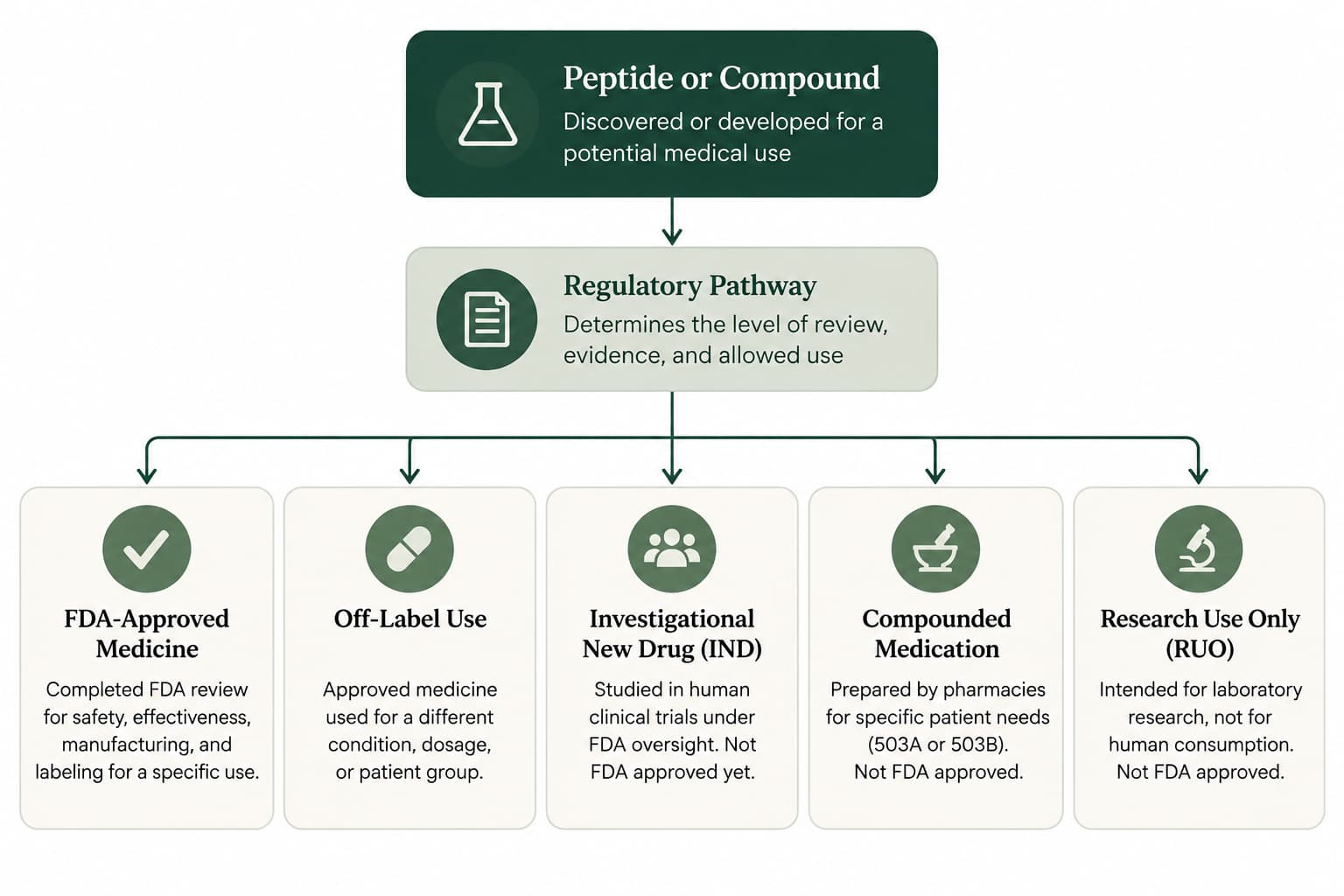
Figure 1: FDA approval status pathway showing how peptides and compounds progress through regulatory categories, from research and clinical trials to compounded medications, approved medicines, and off-label use.
| Product Category | FDA Status | What It Means |
|---|---|---|
| FDA-approved medicine | Approved | Completed FDA review for a specific medical indication |
| Off-label use | Approved drug used differently | Approved medicine prescribed for a non-listed use by a healthcare provider |
| Investigational New Drug (IND) | Not approved | Studied in humans under a regulated clinical research process |
| Compounded medication | Not FDA approved | Prepared by pharmacies under specific compounding regulations |
| Research Use Only (RUO) compound | Not approved | Intended for laboratory research and not human treatment |
FDA-approved medicines
FDA-approved medicines have completed the required regulatory process. Drug manufacturers submit detailed applications, including clinical trial data, manufacturing information, and safety findings.
For many drugs, approval occurs through a New Drug Application (NDA). Biological products may require a Biologics License Application (BLA).
Approval means the FDA has determined that the medicine’s benefits outweigh known risks for a specific approved use.
For example, a peptide medicine approved for diabetes treatment cannot automatically be marketed as an approved therapy for muscle growth, anti-aging, or athletic performance.
The approval is linked to the condition, dosage, formulation, and instructions reviewed by regulators.
Off-label use of approved medicines
Off-label use is often confused with using an unapproved drug.
The difference is that off-label use involves an FDA-approved medicine.
A physician may prescribe an approved medicine for a different condition, dosage, or patient group than what appears on the official label when they determine it is medically appropriate.
The drug itself has already completed FDA review.
This is different from using a compound that has never received FDA approval.
Investigational New Drugs (INDs)
An Investigational New Drug (IND) is a compound being studied through a formal clinical development process.
Before human trials begin, sponsors generally submit an IND application to the FDA. This allows researchers to investigate the compound under controlled conditions.
An IND does not mean the FDA has approved the drug as a treatment.
Instead, it means researchers are allowed to study the product while collecting information about:
- Safety
- Dosage
- Effectiveness
- Pharmacological effects
Clinical trials usually include oversight from ethics committees, patient monitoring, and structured research protocols.
Why Research Interest Does Not Equal FDA Approval
A compound can generate scientific interest without becoming an approved medicine.
Drug development requires more than showing that a molecule interacts with a biological pathway. Researchers must determine whether the compound provides meaningful benefits in humans and whether those benefits justify potential risks.
A promising laboratory result may fail during later stages because:
- The effect is not strong enough in humans.
- Safety concerns appear during clinical testing.
- The compound cannot be manufactured consistently.
- The risks outweigh potential benefits.
This difference is especially relevant for peptides discussed online.
For example, compounds such as BPC-157 and CJC-1295 are frequently discussed in research and wellness communities. However, they do not have FDA approval as human medicines.
Research findings can help scientists understand biological mechanisms, but they do not replace the evidence required for regulatory approval.
Investigational Drugs Vs Unapproved Products Sold Online
One of the most common misunderstandings is treating all unapproved compounds as the same.
A peptide being studied in an FDA-regulated clinical trial is different from a product sold online as a research chemical.
| Investigational Drug | Online Unapproved Product |
|---|---|
| Studied through controlled clinical research | May be sold outside approved medical pathways |
| Uses defined research protocols | Often lacks human safety monitoring |
| Data collected on safety and effectiveness | Limited clinical information may exist |
| Development follows regulatory requirements | Quality and consistency may vary |
An investigational drug may eventually become an approved medicine if clinical evidence supports its use.
By contrast, a research product marketed directly to consumers has not completed the same evaluation process.
The FDA explains that drugs intended for human use generally require approval before commercial distribution. More information is available through the FDA’s Investigational New Drug Application guidance.
For a detailed explanation of the approval pathway, see How The FDA Evaluates Peptide Medicines.
Are Compounded Peptides FDA Approved?
Compounding is another area where people often misunderstand FDA status.
Compounded medications are prepared by pharmacies to meet specific patient needs. They can play an important role when an approved commercial product does not meet an individual requirement.
However, compounded medications are not FDA-approved drugs.
The Drug Quality and Security Act (DQSA) established two major categories of compounding.
503A Compounding Pharmacies
503A pharmacies generally prepare medications based on individual patient prescriptions.
They are primarily regulated through state pharmacy boards.
These products are not reviewed by the FDA through the same approval process used for commercially manufactured medicines.
503B Outsourcing Facilities
503B outsourcing facilities are registered with the FDA and may produce larger batches of compounded medications.
They must follow additional federal requirements, including applicable manufacturing standards.
However, FDA registration does not mean every compounded medication receives FDA approval.
The distinction is:
- FDA-approved medicines are reviewed for a specific product, formulation, and medical indication.
- Compounded medicines are prepared under pharmacy regulations for individual clinical needs.
The FDA provides additional information about compounding categories through its Compounding and the FDA: Questions and Answers.
Why Research Chemicals Are Labeled “Not For Human Consumption”
Research compounds often include labels such as:
- Research Use Only
- For Laboratory Use
- Not For Human Consumption
These labels indicate that the product is intended for scientific investigation rather than medical treatment.
A research chemical may be used for:
- Laboratory analysis
- Biological experiments
- Scientific research
It does not mean the compound has been evaluated as a medicine.
Research products may lack:
- Approved dosing guidelines
- Clinical safety information
- Human effectiveness data
- Pharmaceutical manufacturing validation
A product’s purity percentage alone does not determine whether it is suitable for medical use.
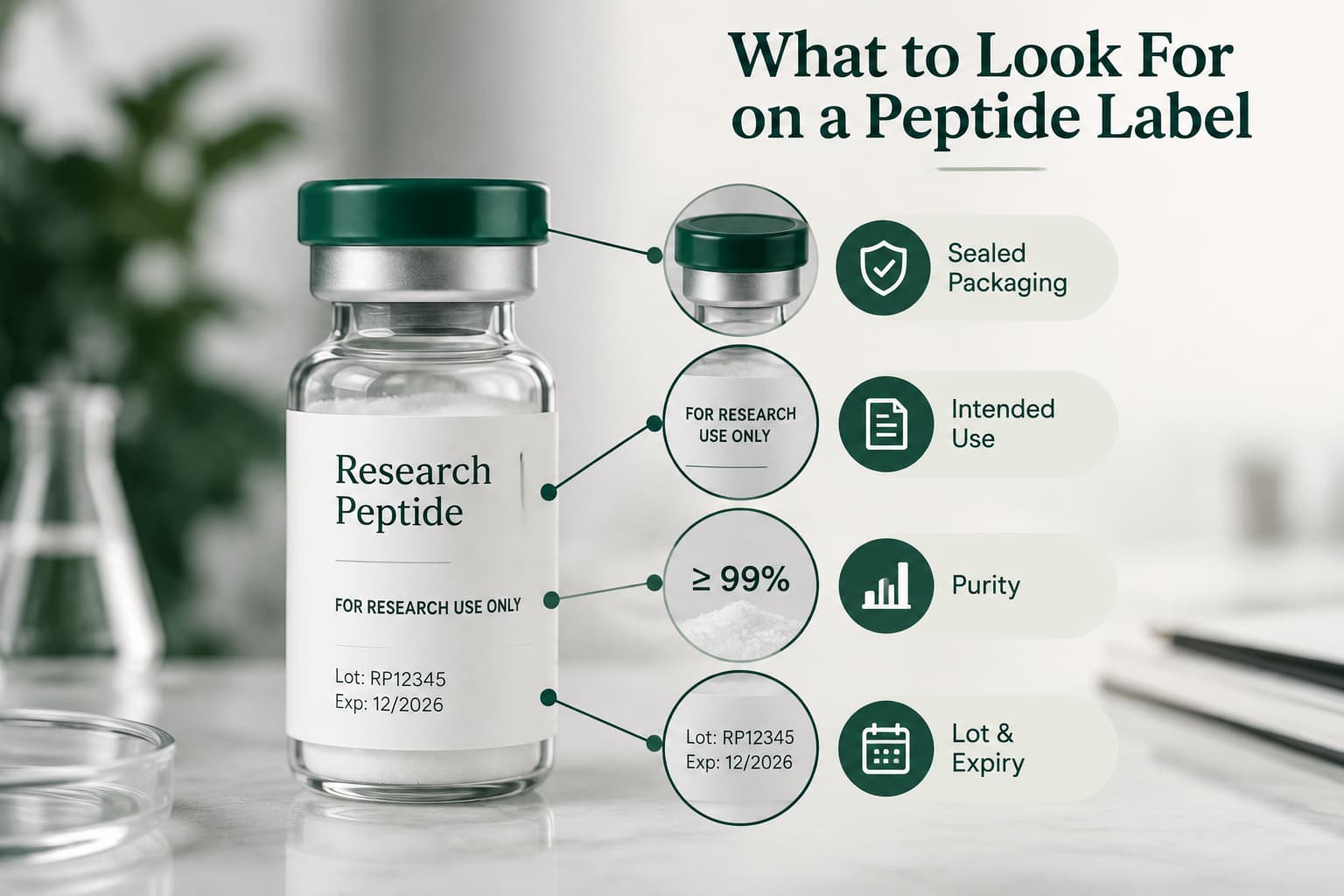
Figure 2: Understanding peptide product labels by checking intended use, research-only warnings, product details, traceability information, and factors that separate research compounds from approved medicines.
Pharmaceutical medicines require additional controls, including:
- Identity verification
- Sterility testing
- Stability testing
- Batch consistency
- Manufacturing quality systems
Health Risks Associated With Unapproved Compounds
The risks of unapproved compounds depend on the specific product, available evidence, and manufacturing practices.
Several concerns commonly arise.
Limited Human Safety Data
Without completed clinical trials, researchers may not fully understand:
- Long-term effects
- Drug interactions
- Appropriate dosing
- Rare adverse reactions
Manufacturing Quality Concerns
Approved medicines are manufactured under controlled quality systems, including Current Good Manufacturing Practice (cGMP) requirements.
These standards help control:
- Raw materials
- Production processes
- Contamination risks
- Product consistency
Products outside approved pharmaceutical pathways may have less publicly available information about manufacturing controls.
Missing Medical Guidance
Approved medicines include official labeling that explains:
- Dosage
- Warnings
- Contraindications
- Storage requirements
Unapproved compounds may not have equivalent medical guidance.
How FDA, MHRA, And EMA Handle Drug Approval
Drug approval systems differ between countries.
In the United States, the FDA evaluates medicines before they can receive approval.
In the United Kingdom, the Medicines and Healthcare products Regulatory Agency (MHRA) regulates medicines through national licensing requirements.
In the European Union, the European Medicines Agency (EMA) coordinates scientific evaluation and safety monitoring.
| Agency | Region | Main Role |
|---|---|---|
| FDA | United States | Reviews and approves medicines |
| MHRA | United Kingdom | Regulates medicines and healthcare products |
| EMA | European Union | Coordinates medicine evaluation |
A medicine approved in one region may require separate approval elsewhere because regulatory systems operate independently.
For more information about UK requirements, see Peptide Regulation In The UK: A General Overview.
How To Check A Peptide’s FDA Approval Status
Before trusting claims about a peptide product, evaluate:
- Whether the FDA has approved it for a medical condition.
- Whether human clinical trials support the claimed benefits.
- Whether the product has official prescribing information.
- Whether it is marketed as a medicine or a research compound.

Figure 3: Checklist for evaluating peptide claims by reviewing FDA approval status, clinical evidence, manufacturing quality, medical supervision, and available safety information.
A useful question is:
“Is this peptide FDA-approved?”
But an even better question is:
“What is it approved for, and what evidence supports that use?”
FDA approval status provides important information about the level of regulatory review behind a product.
Beyond The Label: Understanding What FDA Approval Really Means
“Not FDA Approved” does not represent one single category. It describes products that have not received FDA authorization for a specific medical use.
Some may be investigational drugs being studied through clinical trials. Others may be compounded medications or research compounds intended only for laboratory work.
Understanding FDA approval status helps separate scientific investigation from approved medical treatment. When evaluating any peptide or therapeutic compound, consider the available evidence, regulatory pathway, manufacturing standards, and intended use.
The difference between research potential and approved medical use underpins informed decisions about peptide-related products.
FAQs
What does not FDA approved mean for peptides?
It means the FDA has not authorized that peptide as a medical treatment for a specific condition. The peptide may be under research, compounded, or intended only for laboratory use.
Does not FDA-approved mean a product is illegal?
Not necessarily. The classification depends on how the product is manufactured, marketed, and used. An investigational drug in a clinical trial is different from an unapproved product marketed as a treatment.
Can doctors prescribe non-FDA-approved peptides?
Doctors may prescribe FDA-approved medicines for off-label uses when medically appropriate. Prescribing unapproved research chemicals as treatments involves different regulatory and professional considerations.
Are compounded peptides FDA approved?
No. Compounded peptides are not FDA-approved medicines, even when they are prepared by regulated pharmacies.
What is the difference between off-label and unapproved drugs?
Off-label use involves an FDA-approved medicine used for a different purpose. An unapproved drug has not received FDA authorization for human treatment.
Why do research peptides say not for human consumption?
The label indicates that the product is intended for laboratory research and has not been approved as a human medicine.
Related reading

Regulation & status
FDA-Approved Peptides vs Experimental Peptides
Learn the difference between FDA-approved peptides and experimental peptides. It includes clinical evidence, drug approval, manufacturing standards, safety risks, and peptide regulation.

Regulation & status
How the FDA Evaluates Peptide Medicines
Learn how the FDA evaluates peptide medicines through clinical trials, IND and NDA reviews, manufacturing standards, purity testing, and safety assessments

Regulation & status
Peptide Regulation in the UK: A General Overview
Understanding peptide regulation in the UK, including MHRA approval rules, Human Medicines Regulation 2012, licensed peptide medicines, research peptides, Specials, and legal supply requirements.