

This article is for general education and research information. It does not provide medical advice or instructions for personal use.
Peptides are increasingly discussed in healthcare, biomedical research, metabolic treatments, and online wellness communities, but their legal status in the UK is often misunderstood.
A peptide used as an approved medicine exists in a completely different regulatory category from a research compound sold for laboratory investigation. The difference depends on factors such as intended use, clinical evidence, manufacturing standards, and approval status.
In the UK, the Medicines and Healthcare products Regulatory Agency (MHRA) oversees medicines regulation, while laws such as the Human Medicines Regulations 2012 define how medicinal products can be developed, supplied, and marketed.
Understanding these rules helps healthcare professionals, researchers, and consumers distinguish authorised peptide medicines from experimental products.
Key Points About Peptide Regulation in the UK
- The MHRA regulates authorised peptide medicines and evaluates their safety, quality, and effectiveness.
- A peptide presented as a medicine generally requires regulatory approval before being marketed for human use.
- Research peptides are not the same as licensed medicines and do not have the same level of clinical evidence.
- “Research use only” indicates laboratory purposes, not approval for human treatment.
- Legal status depends on the peptide itself, intended use, marketing claims, and supply pathway.
How Peptide Regulation Works Under UK Medicine Laws
The UK regulatory system does not classify peptides based only on their chemical structure. Instead, regulators consider how a product is presented and supplied.
A peptide developed as a laboratory research tool may fall under different rules from the same compound marketed as a treatment for a medical condition.
For example, a company selling a peptide with claims that it improves disease symptoms, repairs injuries, or changes human physiology may bring that product within medicines legislation. In contrast, a research product intended only for laboratory analysis does not automatically follow the same pathway.
The main regulatory framework includes the Medicines and Healthcare products Regulatory Agency (MHRA), the Human Medicines Regulations 2012, and, for specific substances, controlled drug legislation.
Medicines and Healthcare products Regulatory Agency (MHRA)
The Medicines and Healthcare products Regulatory Agency (MHRA) is the UK authority responsible for regulating medicines and healthcare products.
For peptide medicines, the MHRA evaluates:
- clinical evidence supporting effectiveness,
- manufacturing quality,
- product consistency,
- safety information,
- approved medical indications.
A peptide does not become an approved medicine simply because laboratory research shows biological activity. Regulators require evidence demonstrating that the medicine provides a meaningful benefit while maintaining an acceptable safety profile.
The MHRA also monitors medicines after approval through pharmacovigilance systems to identify potential safety concerns that may appear after wider use.
Human Medicines Regulations 2012 and peptide medicines
The Human Medicines Regulations 2012 guidance provides the main legal framework for human medicines in the UK.
Under these regulations, products that are presented as treating or preventing disease, or modifying physiological functions in humans, may be considered medicinal products.
This means a peptide’s regulatory status depends heavily on how it is marketed.
A peptide that is promoted as a treatment requires the appropriate regulatory pathway. It cannot simply be sold as a medicine without evidence, licensing, and quality controls.
The Different Legal Categories of Peptides in the UK
Peptides in the UK generally fall into several regulatory categories depending on their approval status and intended purpose.

Figure 1: UK peptide regulation categories showing how licensed medicines, unlicensed Specials, clinical trial peptides, controlled peptides, and research peptides differ by regulatory status and intended use.
| Peptide category | Regulatory position | Examples | Human use status |
|---|---|---|---|
| Licensed peptide medicines | Approved through MHRA regulatory review | Insulin, semaglutide, liraglutide | Available through authorised healthcare pathways |
| Unlicensed Specials | Allowed under specific clinical circumstances | Patient-specific formulations | May be supplied when requirements are met |
| Clinical trial peptides | Under investigation | Investigational peptide therapies | Requires MHRA approval and ethical oversight |
| Controlled peptides | Subject to additional restrictions | Certain hormone-related substances | Requires legal authorisation |
| Research peptides | Laboratory investigation products | BPC-157, TB-500 | Not approved human medicines |
This distinction is essential because scientific research and medical approval represent different stages of development.
A peptide can show promising results in laboratory studies but still require years of clinical research before regulators consider it suitable for patient treatment.
Licensed Peptide Medicines Approved for Medical Use
Several peptide medicines have completed clinical development and received regulatory approval for specific medical conditions.
Insulin and insulin analogues
Insulin is one of the most established peptide-based medicines.
It is essential for many people with diabetes because it helps regulate blood glucose levels. Modern insulin analogues were developed to improve characteristics such as absorption rate and duration of action.
These medicines are available because they have undergone extensive evaluation of:
- effectiveness,
- dosing,
- manufacturing quality,
- safety risks.
GLP-1 receptor agonists
GLP-1 receptor agonists are another important group of approved peptide medicines.
Examples include:
- semaglutide,
- liraglutide.
These medicines replicate aspects of naturally occurring GLP-1 signalling, which plays a role in glucose regulation and appetite control.
Their approved uses are based on human clinical trial evidence rather than laboratory findings alone.
However, approval applies only to specific conditions listed by regulators. A peptide authorised for one purpose does not automatically become approved for unrelated uses.
Other approved peptide medicines
Other examples include:
- Teriparatide, used for osteoporosis treatment.
- Leuprorelin, used for hormone-related conditions.
- Desmopressin, used for certain water balance disorders and bleeding conditions.
Each medicine has its own approved indications, prescribing information, and safety requirements.
For a comparison between authorised medicines and experimental compounds, read FDA-Approved Peptides vs Experimental Peptides.
How the MHRA Approves Peptide Medicines in the UK
Developing a peptide medicine requires multiple stages of evaluation before it can reach patients.
The process usually follows this pathway:
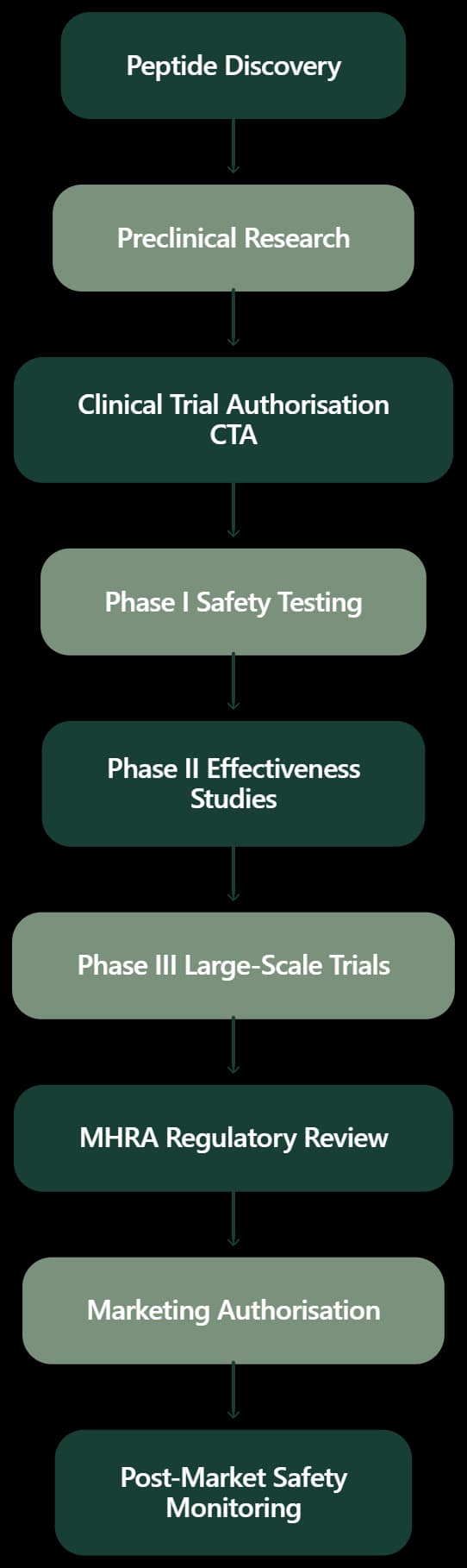
Figure 2: MHRA peptide medicine approval pathway showing the regulatory stages from peptide discovery and preclinical research through clinical trials, Marketing Authorisation, and post-market safety monitoring in the UK.
Preclinical research
Before human testing begins, researchers study:
- biological activity,
- toxicity risks,
- absorption and metabolism,
- possible therapeutic effects.
These studies help determine whether a peptide is suitable for clinical investigation.
However, positive laboratory results do not guarantee approval. Many compounds fail during development because they do not demonstrate enough benefit or raise safety concerns during human testing.
Clinical Trial Authorisation
Human peptide trials in the UK require approval through the MHRA Clinical Trial Authorisation (CTA) process.
Clinical studies generally progress through several phases:
- Phase 1: Focuses on safety, dosage, and how the body responds to the peptide.
- Phase 2: Examines whether the treatment produces the intended medical effect while continuing safety monitoring.
- Phase 3: Uses larger patient populations to confirm effectiveness and collect additional safety information.
Researchers must also obtain appropriate ethical approval before conducting human studies.
Marketing Authorisation
If clinical evidence supports the medicine’s safety and effectiveness, manufacturers can apply for Marketing Authorisation.
Approved peptide medicines include official regulatory information such as:
- approved indications,
- dosage instructions,
- contraindications,
- safety warnings.
The Summary of Product Characteristics (SmPC) provides detailed information for healthcare professionals about the approved medicine.

Figure 3: How MHRA regulation supports peptide medicine quality through evidence-based evaluation, manufacturing standards, and patient safety requirements in the UK.
What Research Use Only Peptides Mean Under UK Regulation
The term “research use only” is frequently misunderstood.
A research-use-only peptide is intended for scientific investigation rather than medical treatment.
It does not mean the product has:
- human treatment approval,
- established clinical dosing,
- proven safety for patients.
Examples of peptides commonly discussed in research communities include:
- BPC-157,
- TB-500,
- CJC-1295.
These compounds may be investigated for biological effects, but research interest does not equal regulatory approval.
For example, BPC-157 has been studied in experimental settings, but it does not have an authorised indication as a licensed human medicine in the UK.
Understanding approval status is also important when comparing international terminology. For more detail, read the FDA approval status of how non-approved compounds are classified.
Compounded Peptides and the Specials Pathway in the UK
Compounded medicines create another area of confusion because they may be supplied without having the same approval route as licensed medicines.
Under the Human Medicines Regulations 2012, certain unlicensed medicines known as “Specials” can be supplied when there is an individual patient need and no suitable licensed alternative exists.
These products are not the same as approved medicines.
| Approved medicine | Specials medicine |
|---|---|
| Completed regulatory assessment | Not individually approved by MHRA |
| Available for authorised indications | Used for specific patient needs |
| Standardised commercial product | Prepared under specific requirements |
Manufacturers producing Specials must meet relevant quality standards, and healthcare professionals remain responsible for appropriate clinical use.
For a detailed comparison, see Compounded Peptides Vs Approved Medicines.
Research Peptide Supply Chains and Legal Considerations
The supply route of a peptide is an important part of its regulatory status.
Licensed peptide medicines are distributed through regulated healthcare systems with strict manufacturing and quality controls.
Research peptide suppliers operate in a different category. A product may include information about chemical identity or purity, but those details do not mean it meets pharmaceutical standards required for human medicines.
Important differences include:
| Licensed medicine supply | Research peptide supply |
|---|---|
| Regulated healthcare pathway | Laboratory-focused supply |
| GMP manufacturing requirements | Quality standards may vary |
| Approved medical use | No authorised treatment indication |
| Prescription and pharmacy controls | Intended for research purposes |
Marketing claims are particularly important. A product labelled for research purposes may create regulatory concerns if it is promoted as a treatment.
Controlled Peptides and UK Restrictions
Some peptides are affected by additional legislation beyond standard medicines regulation.
The Misuse of Drugs Act 1971 controls certain substances in the UK.
Human growth hormone (somatropin), for example, is regulated differently from ordinary research peptides because of its medical and legal classification.
The rules depend on the specific substance, its classification, and how it is supplied.
Researchers and healthcare professionals working with regulated compounds must consider both medicines legislation and controlled substance requirements.
UK Peptide Regulation Compared with FDA and EMA Systems
The UK approach shares similar principles with other major regulatory systems, including the US Food and Drug Administration (FDA) and the European Medicines Agency (EMA).
| Regulatory area | UK MHRA | US FDA | EMA |
|---|---|---|---|
| Main regulator | MHRA | FDA | EMA |
| Approval pathway | Marketing Authorisation | Drug approval applications | EU medicine authorisation procedures |
| Quality standards | British Pharmacopoeia and GMP | GMP and US standards | European pharmacopoeia standards |
Each regulator evaluates whether medicines have sufficient evidence, reliable manufacturing processes, and acceptable safety profiles.
Approval in one region does not automatically create approval in another. A peptide authorised in the UK may still require separate approval before it can be marketed elsewhere.
How to Check Whether a Peptide is Legally Approved in the UK
Before trusting claims about a peptide product, check:
- Does it have MHRA Marketing Authorisation?
- Is it approved for the stated medical purpose?
- Is there official prescribing information?
- Is it supplied through an appropriate healthcare route?
- Is there human clinical evidence supporting its use?
Regulatory status provides a clearer picture than online popularity or anecdotal reports.
Safety also depends on the specific compound, evidence quality, and manufacturing standards.
Understanding Peptide Regulation Before Using or Researching Peptides
Peptide regulation in the UK depends on evidence, intended purpose, manufacturing standards, and legal classification.
Approved peptide medicines have completed clinical development and regulatory review. Research peptides may contribute to scientific investigation, but they do not have the same evidence requirements or regulatory oversight.
Before evaluating any peptide, the most reliable approach is to check its approval status, authorised use, clinical evidence, and supply pathway. A peptide can have scientific interest without being an approved medicine.
FAQs
Are peptides legal in the UK?
Some peptides are legal when used through approved medical, research, or regulatory pathways. Licensed medicines can be prescribed, while research peptides have different restrictions and cannot be marketed as human treatments without approval.
Are research peptides legal to buy in the UK?
Some research peptides may be supplied for legitimate laboratory purposes, but their legal status depends on the specific substance, intended use, and marketing claims.
What peptide medicines are approved in the UK?
Examples of approved peptide medicines include insulin, semaglutide, liraglutide, teriparatide, leuprorelin, and desmopressin. Each has specific authorised medical uses.
Does MHRA approve every peptide?
No. MHRA approval applies only to medicines that complete the required regulatory process and receive authorisation for specific uses.
Can doctors prescribe unlicensed peptides in the UK?
Certain unlicensed medicines may be prescribed under the Specials pathway when there is a specific clinical need and regulatory requirements are met.
Is BPC-157 approved in the UK?
No. BPC-157 does not have an MHRA Marketing Authorisation as a licensed human medicine in the UK.
Related reading

Regulation & status
FDA-Approved Peptides vs Experimental Peptides
Learn the difference between FDA-approved peptides and experimental peptides. It includes clinical evidence, drug approval, manufacturing standards, safety risks, and peptide regulation.

Regulation & status
How the FDA Evaluates Peptide Medicines
Learn how the FDA evaluates peptide medicines through clinical trials, IND and NDA reviews, manufacturing standards, purity testing, and safety assessments

Regulation & status
What Does “Not FDA Approved” Mean?
Understand what “Not FDA Approved” means for peptides and medicines. Learn about FDA approval status, investigational drugs, compounded products, research chemicals, and regulatory differences.