
This article is for general education and research information. It does not provide medical advice or instructions for personal use.
An athlete researching recovery may encounter BPC-157 and TB-500 on the same website and assume they have the same anti-doping status. Under WADA rules, they do not. BPC-157 sits in Section S0 for non-approved substances, while TB-500 is classified under Section S2.3 with growth factors and growth factor modulators.
The distinction matters because WADA regulates peptide-related substances by regulatory status, biological class, and effect, rather than by marketing category. The 2026 WADA Prohibited List has been in force since January 1, 2026, and its S0 and S2 categories apply both in and out of competition.
How WADA Decides Which Substances Are Prohibited
The World Anti-Doping Agency does not build its Prohibited List by collecting drug names that happen to be associated with athletes. Its framework starts with evidence and defined anti-doping criteria.
Under Article 4.3 of the World Anti-Doping Code, WADA considers a substance or method for inclusion when it determines that at least two of three criteria are met. The first is actual or potential enhancement of sports performance. The second is an actual or potential health risk. The third is a determination that its use violates the spirit of sport described in the Code. WADA can also include substances or methods capable of masking other prohibited substances or methods.
That framework explains why anti-doping status should not be confused with pharmaceutical approval. An FDA-approved medicine may still be prohibited in competitive sport. Likewise, a substance may fall under WADA rules before it has become an approved human medicine.
For readers comparing those regulatory systems, our discussion of FDA-approved and experimental peptides explains the medical approval distinction separately.
Another important feature of the Code is class-based regulation. WADA says prohibited substances may be identified by a general category or by specific reference to a substance. The 2026 List also uses language covering certain compounds with similar chemical structures or biological effects. Searching the document for one product name is therefore not always enough to determine status.
How Section S2 Classifies Peptide Hormones And Growth Factors
Section S2 is titled Peptide Hormones, Growth Factors, Related Substances, and Mimetics. Under the 2026 List, substances in this section are prohibited at all times, which WADA defines as both in-competition and out-of-competition. S2 substances are classified as non-Specified Substances. WADA specifically cautions that the Specified and non-Specified distinction should not be interpreted simply as one category being less important or less dangerous than another.
S2 is organized around three main biological and regulatory groups.
S2.1 Covers EPO And Agents Affecting Erythropoiesis
S2.1 deals with compounds that affect erythropoiesis, the process involved in producing red blood cells.
The section includes erythropoietin receptor agonists such as erythropoietins, darbepoetins and methoxy polyethylene glycol-epoetin beta. Pegmolesatide is also included, and WADA identified its addition as an example of a new EPO-mimetic agent among the changes introduced for the 2026 List.
The category extends beyond conventional EPO products. It also covers hypoxia-inducible factor activating agents, GATA inhibitors, TGF-β signalling inhibitors such as luspatercept and sotatercept, and innate repair receptor agonists.
This structure is useful for understanding WADA classification. The rule is concerned with the pathway and physiological effect, rather than treating erythropoietin as the only relevant substance.
S2.2 Covers Peptide Hormones And Their Releasing Factors
S2.2 contains several groups that appear frequently in discussions about peptide hormones.
S2.2.1 covers testosterone-stimulating peptides in males. Examples in the 2026 List include chorionic gonadotrophin, luteinizing hormone, gonadotrophin-releasing hormone and its agonist analogues, plus kisspeptin and related agonist analogues.
S2.2.2 covers corticotrophins and their releasing factors.
S2.2.3 covers growth hormone itself, its analogues, and its fragments. WADA gives examples of GH fragments including AOD-9604 and hGH 176-191.
For many athletes researching peptides online, S2.2.4 Growth Hormone Releasing Factors is the most relevant subsection.
WADA places CJC-1293, CJC-1295, sermorelin and tesamorelin among growth hormone-releasing hormone analogues. Growth hormone secretagogues include ipamorelin, anamorelin, capromorelin, ibutamoren, lenomorelin and macimorelin. The same subsection includes GH-releasing peptides such as GHRP-2, GHRP-6 and hexarelin.
As a result, CJC-1295 and ipamorelin do not sit in a regulatory grey area merely because they are sometimes marketed as research or wellness compounds. WADA names their classes directly within S2.2.4.
S2.3 Covers Growth Factors And Growth Factor Modulators
S2.3 addresses growth factors and modulators that can influence processes involving muscle, tendon or ligament biology.
The 2026 List includes fibroblast growth factors, hepatocyte growth factor, IGF-1 and its analogues, mechano growth factors, platelet-derived growth factor and vascular endothelial growth factor.
It also explicitly includes thymosin-β4 and derivatives such as TB-500. WADA's wording further covers other growth factors or modulators affecting protein synthesis or degradation, vascularisation, energy use, regenerative capacity or muscle fibre-type switching.
That last point matters. A substance does not necessarily need its own separate subsection if it falls within a broader prohibited biological class.
Why Section S0 Matters For Experimental Peptides
A common mistake is to look through S2, fail to find a research peptide there, and conclude that it is permitted.
Section S0 prevents that assumption.
Under the 2026 List, S0 Non-Approved Substances covers pharmacological substances that are not addressed by a subsequent section of the List and do not have current approval from a governmental regulatory health authority for human therapeutic use. WADA states that this category can include substances in preclinical or clinical development, discontinued compounds, designer drugs, and products approved only for veterinary use.
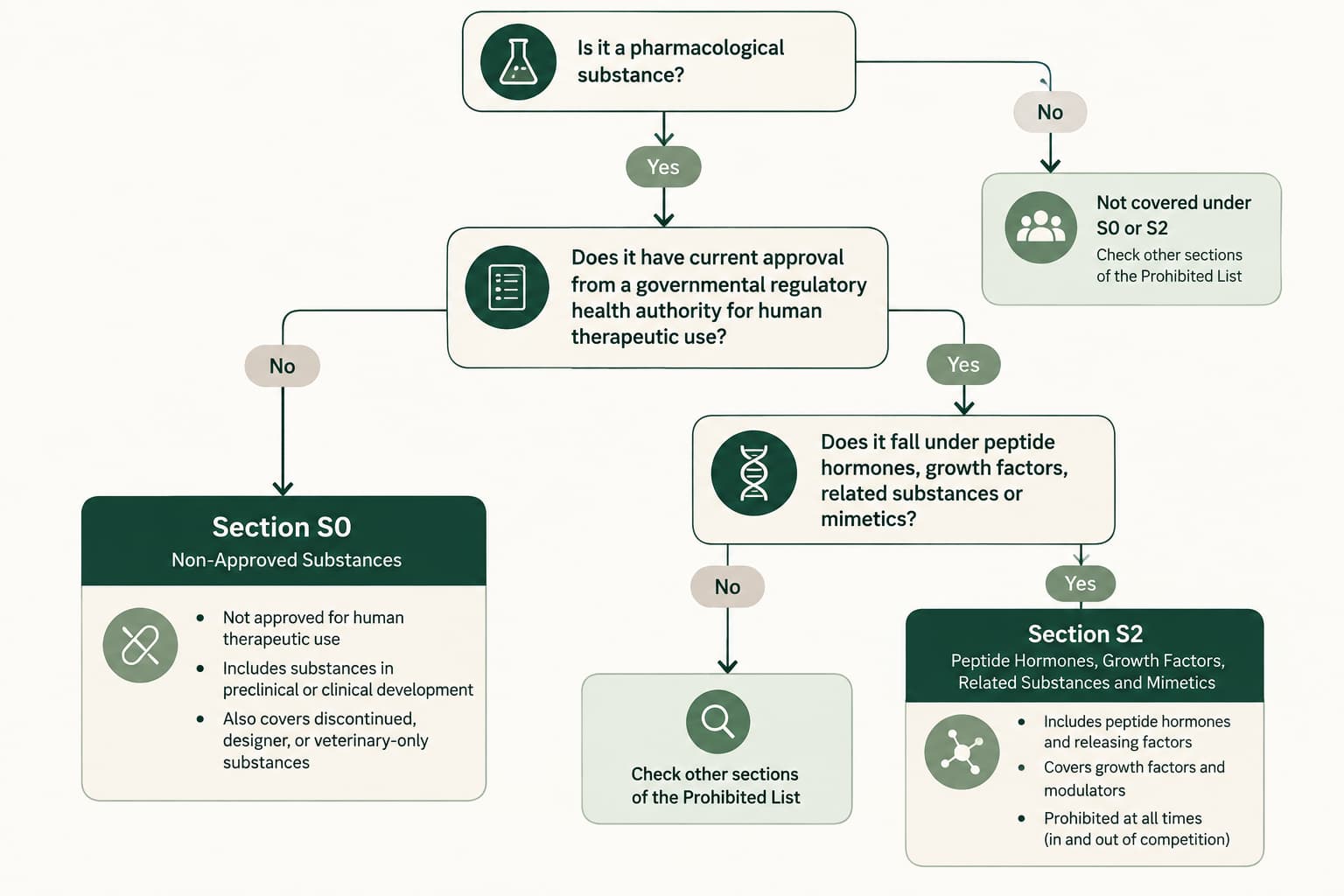
Figure 1: WADA peptide classification flow showing how non-approved substances may fall under Section S0, while peptide hormones, growth factors, and related mimetics are classified under Section S2.
BPC-157 provides the clearest peptide-related example. The 2026 List explicitly names BPC-157 under S0. It is therefore inaccurate to classify BPC-157 as an S2.3 growth factor simply because experimental research or marketing discussions associate it with tissue-repair pathways.
TB-500 is different because WADA already addresses it under S2.3.
| Substance or class | 2026 WADA section | How WADA classifies it |
|---|---|---|
| BPC-157 | S0 | Explicit example of a non-approved substance |
| EPO | S2.1 | Erythropoietin receptor agonist |
| CJC-1295 | S2.2.4 | GHRH analogue |
| Ipamorelin | S2.2.4 | Growth hormone secretagogue |
| GHRP-2 | S2.2.4 | GH-releasing peptide |
| IGF-1 | S2.3 | Growth factor |
| TB-500 | S2.3 | Thymosin-β4 derivative |
The distinction between S0 and medical approval terminology deserves care. WADA's rule asks whether an otherwise unaddressed pharmacological substance has current approval for human therapeutic use from a governmental regulatory health authority. That is an anti-doping classification test, not a substitute for the detailed regulatory standards used by the FDA, EMA or MHRA.
Our explanation of what not FDA-approved means covers that distinction, while the guide to UK peptide regulation addresses the role of the MHRA and the separate UK medicines framework.
A real enforcement action shows why these categories matter in practice. In September 2025, USADA reported the Anthony McCauley anti-doping case. USADA said its investigation found evidence that the triathlete possessed and used BPC-157 and TB-500. It separately determined that he promoted several prohibited substances on social media, including BPC-157, TB-500, CJC-1295, ipamorelin and tesamorelin.
USADA described BPC-157 as a Specified Substance in the Non-Approved Substances class, while TB-500, CJC-1295, ipamorelin, and tesamorelin were identified as non-Specified substances within the peptide hormone and growth-factor class. The example shows how compounds promoted together online can fall under different sections of anti-doping regulation.
How Anti-Doping Testing Applies To Peptide-Related Substances
Peptide testing is not based on one universal laboratory method. The appropriate analytical approach depends on the substance, its metabolites and, in some cases, the biological response it produces.
For human growth hormone, WADA's Athlete Biological Passport Endocrine Module guidelines describe measurements of two markers of hGH biological activity: IGF-I and N-terminal pro-peptide of type III collagen, known as P-III-NP. Their measured concentrations contribute to the GH-2000 score used within the Endocrine Module. WADA states that this approach can detect hGH doping and may also have utility for GH secretagogues and IGF-I abuse.
Mass spectrometry is also used in peptide-related anti-doping science. WADA laboratory guidance specifies LC-MS-based measurement of IGF-I for the Endocrine Module, while separate WADA-sponsored research has examined mass-spectrometric methods for compounds including CJC-1295 and peptide-screening methods involving TB-500 metabolites.
Those sources should be distinguished carefully. WADA laboratory guidelines set analytical requirements for relevant accredited laboratory procedures. WADA-sponsored research projects explore and develop detection capabilities but should not automatically be treated as proof that one method is used universally for every peptide.
For an athlete, the practical point is simpler. A short half-life, unfamiliar product name or "research use" label does not determine whether anti-doping rules apply.
How TUE Rules And Athlete Checks Work
Some S2 substances also have recognized medical uses. Anti-doping rules therefore include a Therapeutic Use Exemption, or TUE, process for athletes who genuinely require a prohibited substance or method for treatment.
During 2026, WADA's 2023 International Standard for Therapeutic Use Exemptions remains the applicable standard. WADA has approved a revised standard for 2027, but that version does not take effect until January 1, 2027.
Under the current standard, an athlete generally needs to obtain a TUE before using or possessing the prohibited substance unless the rules allow a retroactive application. A TUE can be granted only when the required conditions are satisfied. These include a diagnosed medical condition supported by clinical evidence, no additional performance enhancement beyond return to the athlete's normal state of health, no reasonable permitted therapeutic alternative, and a medical need that is not caused by prior prohibited use without a TUE.
A prescription alone therefore does not automatically make a WADA-prohibited substance permissible in sport.
The same caution applies when athletes research peptide products themselves. They should identify the exact active substance, check the current Prohibited List, determine whether a class-based rule applies, and confirm requirements with their relevant anti-doping organization before use.
That process also separates anti-doping compliance from medical safety. Our guide to peptide safety by compound explains why evidence quality, approved use, manufacturing controls, and adverse-effect data still need to be assessed independently.
WADA updates the Prohibited List annually. For 2026, the clearest regulatory distinction is that Section S2 covers defined peptide hormones, releasing factors, growth factors, and related mimetics, while Section S0 captures qualifying non-approved pharmacological substances that are not already addressed elsewhere. That is why BPC-157 and TB-500 can both be prohibited while belonging to different WADA categories.
FAQs
Are peptide hormones banned by WADA?
Many peptide hormones and related compounds are prohibited under Section S2 of the 2026 WADA Prohibited List. The section includes peptide hormones, growth hormone-releasing factors, growth factors, related substances and mimetics, and it applies in and out of competition.
Is BPC-157 prohibited by WADA in 2026?
Yes. BPC-157 is explicitly identified in Section S0 Non-Approved Substances of the 2026 List. It should not be described as an S2.3 substance.
Is TB-500 banned by WADA?
Yes. WADA lists thymosin-β4 and its derivatives, including TB-500, under Section S2.3 Growth Factors and Growth Factor Modulators.
Are CJC-1295 and ipamorelin prohibited?
Yes. CJC-1295 appears under S2.2.4 as a GHRH analogue, while ipamorelin is listed as a growth hormone secretagogue. Both fall within the S2 peptide-hormone framework.
What is the difference between WADA Section S0 and S2?
S0 covers qualifying non-approved pharmacological substances that are not addressed elsewhere in the Prohibited List. S2 specifically covers peptide hormones, growth factors, related substances and mimetics. BPC-157 is an S0 example, while CJC-1295, ipamorelin, IGF-1 and TB-500 fall within S2.
Can a prescription make a prohibited peptide permitted in sport?
Not by itself. An athlete who needs a prohibited substance for legitimate treatment generally must meet the applicable TUE requirements. The current standard requires clinical evidence and satisfaction of specific therapeutic criteria before a TUE can be granted.
Related reading

Regulation & status
FDA-Approved Peptides vs Experimental Peptides
Learn the difference between FDA-approved peptides and experimental peptides. It includes clinical evidence, drug approval, manufacturing standards, safety risks, and peptide regulation.

Regulation & status
How the FDA Evaluates Peptide Medicines
Learn how the FDA evaluates peptide medicines through clinical trials, IND and NDA reviews, manufacturing standards, purity testing, and safety assessments

Regulation & status
What Does “Not FDA Approved” Mean?
Understand what “Not FDA Approved” means for peptides and medicines. Learn about FDA approval status, investigational drugs, compounded products, research chemicals, and regulatory differences.