

This article is for general education and research information. It does not provide medical advice or instructions for personal use.
A medicine does not become available to patients simply because researchers discover that a compound produces promising results in a laboratory. Before a new therapy reaches hospitals or pharmacies, regulatory agencies evaluate whether it provides meaningful medical benefits, whether its risks are understood, and whether it can be manufactured consistently.
This process becomes complicated when medicines cross international borders. A peptide therapy approved by the U.S. Food and Drug Administration (FDA) is not automatically approved in Europe or the United Kingdom. Each region has its own regulatory authority, legal framework, approval pathway, and safety monitoring system.
For example, a pharmaceutical company developing a peptide-based medicine may need to prepare different submissions depending on whether it wants approval in the United States, European Union, or United Kingdom. The scientific principles are similar, but the regulatory route is different.
Three agencies play a major role in global medicine regulation:
- The U.S. Food and Drug Administration (FDA)
- The European Medicines Agency (EMA)
- The Medicines and Healthcare products Regulatory Agency (MHRA)
All three organizations evaluate medicine quality, safety, and effectiveness, but their responsibilities are not identical. The FDA operates as a direct U.S. federal regulator, the EMA coordinates scientific assessments across the European Union, and the MHRA manages medicine regulation for the United Kingdom.
Understanding these differences helps researchers, healthcare professionals, and patients interpret what a medicine approval actually means.
FDA, EMA, and MHRA comparison at a glance
| Category | FDA | EMA | MHRA |
|---|---|---|---|
| Primary region | United States | European Union and associated markets | United Kingdom |
| Regulatory role | Direct medicine approval authority | Scientific evaluation and EU coordination | Independent UK medicine regulator |
| Main application | New Drug Application (NDA), Biologics License Application (BLA) | Marketing Authorisation Application (MAA) | UK Marketing Authorisation |
| Clinical trial system | Investigational New Drug (IND) | Clinical Trials Information System (CTIS) | Clinical Trial Authorisation (CTA) |
| Final approval authority | FDA decision | European Commission decision after EMA recommendation | MHRA decision |
| Key focus | Safety, effectiveness, quality, labeling | Scientific assessment, EU-wide access, pharmacovigilance | UK approval, safety monitoring, innovation pathways |
The biggest difference is not the goal of these agencies. Their purpose is similar. The difference is how they are structured and how legal approval decisions are made.
How the FDA regulates medicines in the United States
The FDA is a centralized regulatory authority responsible for approving medicines in the United States. Within the agency, the Center for Drug Evaluation and Research (CDER) evaluates most human prescription medicines before they can enter the market.
The FDA approval process begins long before a company submits a final application. Drug developers first conduct laboratory studies and animal research to understand how a compound behaves, whether it shows potential therapeutic value, and whether early safety concerns exist.
If the results support human testing, the sponsor submits an Investigational New Drug (IND) application. This allows clinical trials to begin under regulatory oversight.
The clinical development process generally includes:
- Phase 1 trials to evaluate safety and dosage
- Phase 2 trials to examine effectiveness and continued safety
- Phase 3 trials involving larger patient groups
After successful trials, companies submit either a New Drug Application (NDA) or a Biologics License Application (BLA), depending on the type of product.
The FDA reviews:
- Clinical trial data
- Drug chemistry and manufacturing information
- Quality control systems
- Proposed labeling
- Benefit-risk balance
FDA approval means the available evidence shows that the medicine’s benefits outweigh its known risks for the approved use. It does not mean the medicine is risk-free or approved for every possible application.
For peptide medicines, manufacturing quality is especially important because biological molecules require strict control over purity, stability, and production consistency.
How the EMA evaluates medicines across Europe
The European Medicines Agency operates differently from the FDA because it is built around cooperation between European regulatory authorities.
The EMA does not directly grant marketing authorization itself. Instead, its scientific committees assess medicine applications and provide recommendations. For centrally authorized medicines, the European Commission makes the final legally binding decision.
The key scientific committee for human medicines is the Committee for Medicinal Products for Human Use (CHMP).
When a pharmaceutical company applies through the centralized procedure, it submits one Marketing Authorisation Application (MAA). The EMA coordinates the scientific review, and approval can allow access across EU member states after authorization.
The centralized procedure is commonly used for:
- Biotechnology medicines
- Advanced therapies
- Certain treatments for rare diseases
- Medicines requiring EU-wide authorization
However, not every medicine follows the same route. Other pathways include:
Decentralized procedure
This allows companies to apply for approval in several European countries at the same time when the medicine has not yet received authorization elsewhere in the EU.
Mutual recognition procedure
This allows one EU country’s existing authorization to be recognized by other participating countries.
National procedure
A company may apply directly to an individual country’s national regulator when EU-wide authorization is not required.
The EMA system reflects the structure of the European healthcare environment. Instead of one single national authority, it coordinates scientific evaluation across multiple countries with shared regulatory standards.
How MHRA regulates medicines in the United Kingdom
The Medicines and Healthcare products Regulatory Agency became an independent UK medicine regulator after Brexit.
Before the UK left the European Union, British medicine regulation was connected with the European regulatory network. Today, the MHRA operates under UK legislation, including the Human Medicines Regulations 2012.
The agency evaluates medicines, monitors safety after approval, and oversees clinical research conducted in the UK.
One major difference between MHRA and EMA is that the MHRA has direct national authority over UK medicine approvals.
The MHRA also created pathways designed to support innovative therapies.
One example is the Innovative Licensing and Access Pathway (ILAP), which provides developers with regulatory support during medicine development.
ILAP can include:
- Early scientific advice
- Regulatory guidance
- Innovation Passport designation
- Support for development planning
The MHRA also operates the International Recognition Procedure, which can use assessments from trusted international regulators to support UK authorization processes.
A medicine approved by the FDA or EMA may provide useful regulatory information, but it still requires UK-specific authorization before being marketed in the United Kingdom.
How FDA, EMA, and MHRA approval pathways differ
The regulatory pathway depends on where a company wants to make its medicine available.
A developer creating a new peptide therapy may follow different routes depending on whether the target market is the United States, Europe, or the UK.
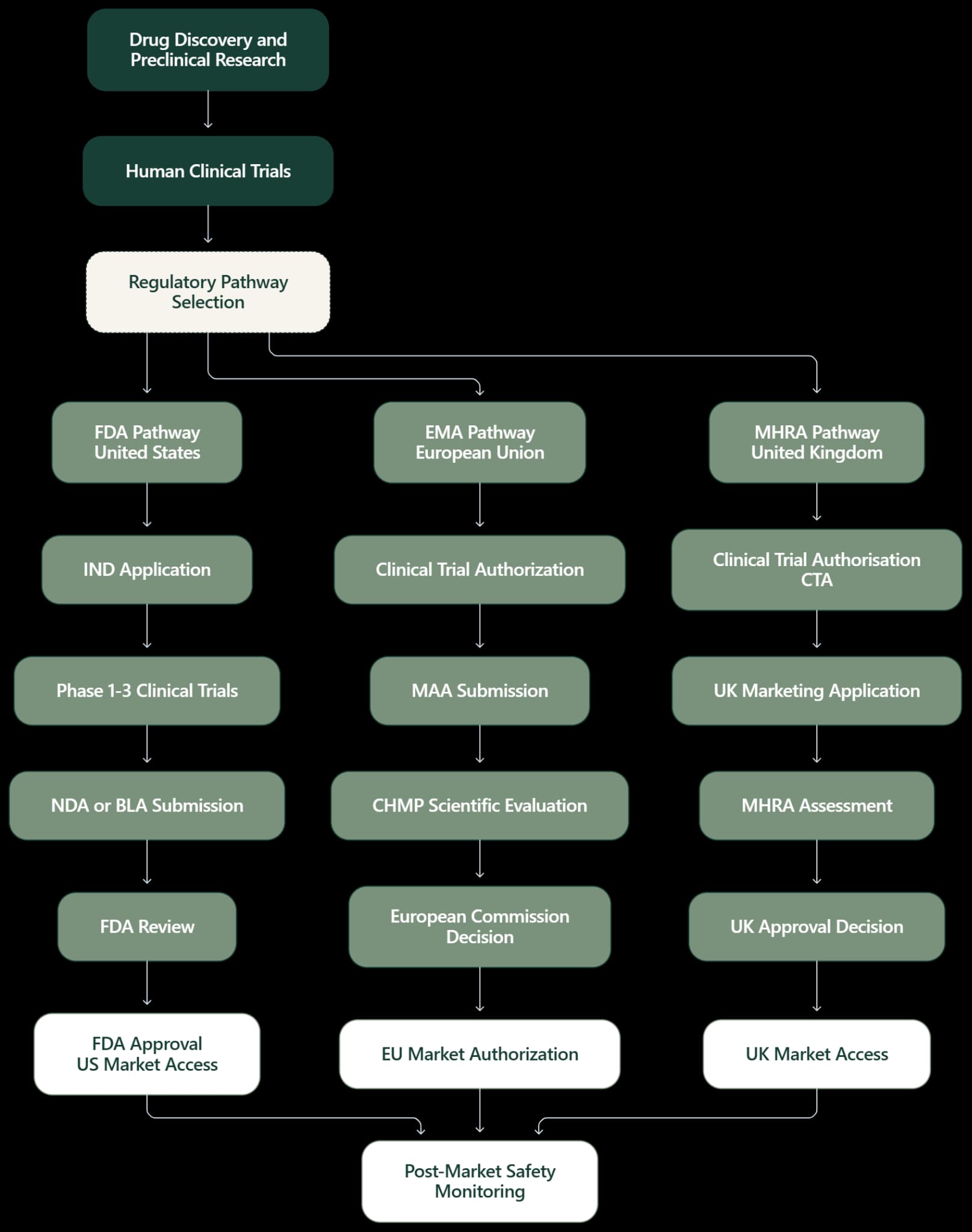
Figure 1: FDA, EMA, and MHRA approval pathways compared from clinical trials to market authorization and safety monitoring.
FDA approval pathway
The U.S. pathway generally follows:
- Preclinical research
- IND submission
- Clinical trials
- NDA or BLA submission
- FDA review
The FDA also has accelerated programs for certain medicines addressing serious conditions when specific requirements are met. These pathways can shorten review timelines but still require evidence supporting safety and effectiveness.
EMA approval pathway
The European pathway usually involves:
- Clinical trial authorization
- Marketing Authorisation Application
- CHMP scientific evaluation
- European Commission authorization
For centrally approved medicines, one authorization can provide access throughout the EU market.
MHRA approval pathway
The UK pathway includes:
- Clinical Trial Authorisation
- Clinical evidence collection
- Marketing authorization submission
- MHRA review
The MHRA also provides specialized routes for innovative medicines.
Clinical trial oversight differs between FDA, EMA, and MHRA
Before researchers can test a peptide medicine in humans, regulators must review the proposed study.
Each region uses a different clinical trial authorization system.
FDA and Investigational New Drug applications
In the United States, sponsors submit an IND application containing information about:
- Preclinical studies
- Manufacturing details
- Clinical trial design
- Safety monitoring plans
The FDA reviews this information before human trials begin.
EMA and Clinical Trials Information System
European clinical trials use the Clinical Trials Information System (CTIS), which provides a centralized platform for applications, assessments, and public information.
MHRA and Clinical Trial Authorisation
UK researchers submit a Clinical Trial Authorisation application to the MHRA. The process also involves ethics review to protect trial participants.
Although these systems use different procedures, the purpose remains the same: ensuring that human research is scientifically justified and conducted safely.
How FDA, EMA, and MHRA regulate compounded and unapproved peptides
Compounded and unapproved peptides create another area where regulations differ.
A compounded product is not automatically equivalent to an approved medicine.
In the United States, pharmaceutical compounding is regulated through frameworks including sections 503A and 503B of the Federal Food, Drug, and Cosmetic Act.
These categories address different types of pharmacy compounding, but compounded products do not undergo the same FDA approval process as commercially approved medicines.
In the United Kingdom, some unlicensed medicines may be supplied as “Specials” when a suitable licensed medicine is unavailable.
Across Europe, pharmacy compounding is generally managed through national laws rather than direct EMA regulation.
This distinction matters for peptide products discussed online. A peptide may have scientific research behind it, but research interest does not automatically mean it has completed regulatory review.
Why the same peptide medicine can have different approval timelines
A common misunderstanding is that regulatory approval works like a single global process. In reality, companies often experience different timelines because agencies review submissions independently.
Factors that can affect approval timing include:
- Quality of submitted evidence
- Additional questions from regulators
- Manufacturing information requirements
- Local healthcare considerations
- Differences in review procedures
For example, a company may submit a medicine to the FDA first and later provide additional regional information for EMA or MHRA review.
The scientific evidence may overlap, but regulatory decisions remain separate.
Where FDA, EMA, and MHRA follow the same standards
Although their structures differ, the FDA, EMA, and MHRA follow many internationally recognized principles.

Figure 2: FDA, EMA, and MHRA work through different regulatory systems while maintaining shared standards for medicine safety and quality.
These include:
- Good Manufacturing Practice (GMP)
- Clinical trial standards
- Pharmacovigilance requirements
- Quality control expectations
The International Council for Harmonisation (ICH) develops guidelines that support consistency in medicine development, quality, safety, and effectiveness standards.
This cooperation allows regulators to share scientific knowledge while maintaining their own legal authority.
Is the FDA, EMA, or MHRA stricter than the others?
There is no simple answer.
Each agency evaluates medicines using its own legal framework and scientific review process. Calling one regulator “stricter” oversimplifies how medicine evaluation works.
The FDA may use certain accelerated pathways for serious conditions. The EMA may emphasize EU-wide scientific coordination, while the MHRA manages a national UK system with its own regulatory pathways.
The important factor is not which agency is stricter. The important factor is whether the evidence supports the medicine’s approved use.
What peptide researchers and patients should understand
For researchers, regulatory planning is essential. Approval in one market does not automatically provide access to another.
For patients, regulatory status provides useful information when evaluating peptide-related claims.
Important questions include:
- Has the peptide been approved by a recognized regulator?
- What condition is it approved to treat?
- Are claims based on human clinical evidence?
- Does the product follow appropriate manufacturing standards?
A peptide studied in a laboratory is different from a medicine that has completed clinical trials and regulatory review.
FAQs
Does FDA approval automatically allow a medicine to be sold in Europe or the UK?
No. FDA approval applies to the United States. Medicines require separate authorization from European or UK regulators.
Is the EMA the European version of the FDA?
Not exactly. The EMA coordinates scientific evaluation, while the European Commission provides legal authorization for centrally approved medicines.
Did Brexit change MHRA drug regulation?
Yes. The MHRA now operates independently from the EU regulatory system and manages UK medicine approvals.
Which agency approves peptide medicines?
The FDA, EMA, and MHRA can each approve medicines within their own jurisdictions after reviewing safety, effectiveness, and quality evidence.
Are experimental peptides regulated the same way as approved medicines?
No. Experimental peptides have not completed the same regulatory pathway as approved medicines and may not have sufficient clinical evidence for medical use.
Final thoughts
The FDA, EMA, and MHRA all work toward the same objective: ensuring medicines meet safety and effectiveness standards before reaching patients.
Their differences come from legal structures, geographic responsibilities, and approval systems. For peptide medicines, understanding these differences helps separate approved therapies from experimental compounds and makes it easier to evaluate medical claims based on evidence rather than assumptions.
Related reading

Regulation & status
FDA-Approved Peptides vs Experimental Peptides
Learn the difference between FDA-approved peptides and experimental peptides. It includes clinical evidence, drug approval, manufacturing standards, safety risks, and peptide regulation.

Regulation & status
How the FDA Evaluates Peptide Medicines
Learn how the FDA evaluates peptide medicines through clinical trials, IND and NDA reviews, manufacturing standards, purity testing, and safety assessments

Regulation & status
What Does “Not FDA Approved” Mean?
Understand what “Not FDA Approved” means for peptides and medicines. Learn about FDA approval status, investigational drugs, compounded products, research chemicals, and regulatory differences.