

This article is for general education and research information. It does not provide medical advice or instructions for personal use.
An athlete dealing with a stubborn tendon injury may hear about a peptide that is promoted online for faster recovery. The compound might be described as a “research peptide,” discussed in fitness communities, or even offered through a wellness provider. From the athlete’s perspective, the obvious question is simple: if a peptide is being researched for recovery, why would using it create an anti-doping problem?
The answer is that medical research, drug approval, and eligibility in competitive sport are separate issues.
Some peptides influence growth hormone signaling, blood formation, tissue growth, or other biological processes that could affect athletic performance. Others are restricted because they are experimental substances without approval for human therapeutic use. Under the 2026 anti-doping framework, athletes therefore need to look beyond whether a product is described as a peptide, medicine, or recovery aid.
The World Anti-Doping Agency (WADA) maintains the Prohibited List used across sports operating under the World Anti-Doping Code. The list is updated annually, and the prohibited status of a compound can depend on its classification, timing, and, for some substances, route of administration.
Understanding those distinctions explains why BPC-157, CJC-1295, TB-500, and several growth hormone compounds receive so much attention in competitive sport.
How Anti-Doping Rules Decide Which Substances Are Restricted
WADA does not prohibit a substance simply because it has a biological effect.
Article 4.3 of the World Anti-Doping Code states that a substance or method can be considered for inclusion when WADA determines that it satisfies at least two of three criteria: it has the potential to enhance or actually enhances sports performance, presents an actual or potential health risk, or violates what the Code calls the “spirit of sport.”
That framework matters because peptides are a broad group. Calling something a peptide does not tell an athlete whether it is prohibited.
The 2026 WADA rules place relevant compounds in different categories. One important category is S0 Non-Approved Substances. It covers pharmacological substances that are not addressed elsewhere on the list and lack current approval by a governmental regulatory health authority for human therapeutic use. This category is prohibited at all times.
Another important category is S2 Peptide Hormones, Growth Factors, Related Substances and Mimetics. It captures several biologically active substances associated with hormone production, erythropoiesis, growth signaling, and tissue adaptation.
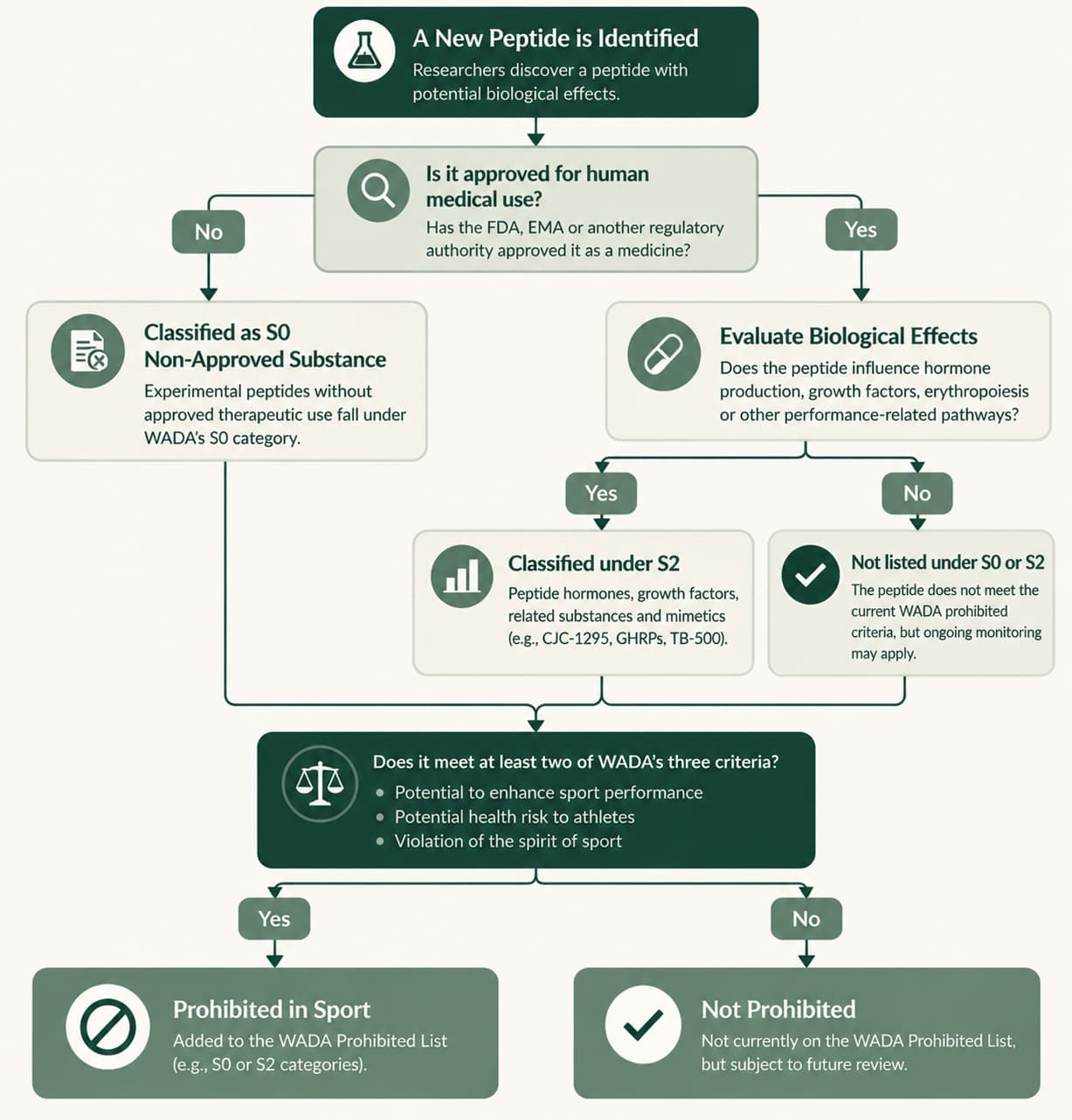
Figure 1: How WADA evaluates peptides for competitive sport eligibility, from regulatory status and biological effects to prohibited substance classification.
The distinction becomes clearer with actual compounds.
BPC-157 is prohibited under S0 as a non-approved substance. CJC-1295 belongs to the growth hormone-releasing factor group covered by S2. TB-500 is listed as a thymosin-β4 derivative within the S2 growth-factor provisions. WADA's recent lists also identify substances such as GHRP-2, GHRP-6, and ipamorelin within growth hormone-related categories.
This is also why “not FDA approved” and “banned by WADA” should not be treated as interchangeable statements. FDA approval concerns authorization of a medicine in the United States. WADA rules determine what athletes subject to anti-doping regulations may use.
| Peptide or category | Relevant anti-doping classification | Why it matters to athletes |
|---|---|---|
| BPC-157 | S0 Non-Approved Substances | Experimental compound without approved human therapeutic status |
| CJC-1295 | S2 Peptide Hormones and releasing factors | Growth hormone-releasing factor |
| GHRP-2 and GHRP-6 | S2 Peptide Hormones and releasing factors | GH-releasing peptides |
| Ipamorelin | S2 Peptide Hormones and releasing factors | Growth hormone secretagogue |
| TB-500 | S2 Growth Factors and Growth Factor Modulators | Listed thymosin-β4 derivative |
| IGF-1 and analogues | S2 Growth Factors and Growth Factor Modulators | Can influence growth and tissue-related biological pathways |
The table is not a complete prohibited list. Athletes should check the current WADA list and the rules applying to their sport rather than treating examples as an exhaustive reference.
Why Biological Mechanisms Matter in Competitive Sport
The regulatory question becomes easier to understand when we look at what certain peptides can do biologically.
Consider growth hormone signaling. Growth hormone is involved in metabolism, growth and tissue regulation. Rather than supplying growth hormone directly, some compounds can stimulate pathways that influence its release.
CJC-1295 is one example. WADA identifies CJC-1295 among growth hormone-releasing hormone analogues. The S2 category also includes growth hormone secretagogues such as ipamorelin and GH-releasing peptides including GHRP-2 and GHRP-6.
This matters because manipulating endogenous hormone production does not make a substance acceptable simply because the hormone originates inside the athlete's own body. Anti-doping rules cover releasing factors and mimetics as well as certain hormones themselves.
Growth factors create another issue.
WADA's S2 provisions include IGF-1 and its analogues, fibroblast growth factors, hepatocyte growth factor, platelet-derived growth factor, VEGF and thymosin-β4 derivatives such as TB-500. The category also extends to relevant growth-factor modulators affecting processes such as muscle, tendon or ligament protein turnover, vascularisation, energy utilization and regenerative capacity.
Erythropoiesis provides a different example. Erythropoietin-related agents can influence red blood cell production. More red blood cells can change oxygen transport, which explains the long-standing anti-doping concern around EPO-related substances in endurance competition.
In fact, the 2026 Prohibited List added pegmolesatide as an example of an EPO-mimetic agent under S2. USADA notes that the drug is being evaluated for anemia associated with chronic kidney disease and is approved for human use in some countries, illustrating an important point: a legitimate therapeutic purpose does not automatically make a substance permissible in sport.
The same principle works in the opposite direction. An experimental compound does not become an established performance enhancer simply because people online claim it improves recovery. Regulatory classification and scientific proof are different questions.
BPC-157 Shows Why Research Status and Sports Rules Can Collide
Few peptides illustrate the confusion better than BPC-157.
Online discussions frequently associate BPC-157 with tendon, ligament, and injury recovery. An injured athlete encountering those claims could reasonably assume that the compound is simply another recovery treatment.
The evidence is much less settled.
USADA describes BPC-157 as an experimental peptide and says published human clinical evidence is lacking. It is not approved for human clinical use by the FDA or another global health authority. WADA added it to the Prohibited List under S0 Non-Approved Substances in 2022, and it remains prohibited.
This distinction corrects a common misconception. BPC-157 should not be described as an established human therapy whose proven healing effects explain its prohibition. Much of the interest surrounding it comes from preclinical research and unproven claims. The absence of adequate human evidence is itself important when evaluating both potential benefits and risks.
A real sports enforcement example shows how that distinction can matter.
In 2023, USADA announced that mixed martial arts athlete Cortney Casey accepted a four-month sanction under the UFC Anti-Doping Policy after self-reporting BPC-157 use. According to USADA, Casey provided documentation showing that a doctor had prescribed and supplied the substance for a medical condition. She subsequently learned that BPC-157 was prohibited and reported the use.
The example demonstrates something athletes can easily miss: receiving a substance from a healthcare professional does not by itself establish that the substance is permitted under the anti-doping rules governing a competition.
BPC-157's status also differs from TB-500. BPC-157 is identified under S0, while WADA lists TB-500 as a thymosin-β4 derivative within S2. Grouping every experimental peptide under the same WADA section therefore produces an inaccurate picture of the rules.
For readers comparing experimental status with recognized medicines, FDA-Approved Peptides vs Experimental Peptides provides the broader pharmaceutical context.
Medical treatment does not automatically mean permitted athlete use
Peptide regulation becomes especially complicated when an athlete genuinely needs medical treatment.
WADA addresses this through the Therapeutic Use Exemption, usually called a TUE. A TUE can authorize an athlete to use an otherwise prohibited substance or method when specific medical requirements are satisfied.
The rules are stricter than simply having a prescription.
Under WADA's International Standard for Therapeutic Use Exemptions, the athlete generally needs evidence of a diagnosed medical condition requiring treatment. The treatment must not be expected to produce additional performance enhancement beyond returning the athlete to their normal state of health. There must also be no reasonable permitted therapeutic alternative, and the medical need cannot result from prior prohibited use without a TUE.
That framework separates therapeutic necessity from performance enhancement.
It also means athletes should not assume every experimental peptide can receive a TUE. USADA states that BPC-157's lack of approved therapeutic status creates a particular problem and advises athletes to use its TUE pre-check process for individual circumstances.
Another important concept is strict liability.
Under anti-doping rules, athletes are responsible for prohibited substances found in their samples. That makes product selection particularly important. A label such as “research use only,” “natural,” or “recovery formula” does not override the Prohibited List.
Strict liability does not, however, mean every positive test automatically produces the same sanction. The consequences of an anti-doping rule violation can depend on the applicable rules and circumstances, including factors considered during results management.
Product quality adds another layer of uncertainty. Experimental products sold outside established pharmaceutical supply chains may not provide the same assurance of identity, concentration or manufacturing control as approved medicines. For an athlete, that creates both a health question and a compliance question.
This is where the distinction discussed in “Are All Peptides Safe?” becomes useful. Safety cannot be inferred from the word “peptide” alone.
What Athletes Should Check Before Using a Peptide
For a tested athlete, the safest starting question is not “Does this peptide work?” It is “What exactly is this substance, and what do the current rules say about it?”
The first step is checking the current WADA Prohibited List. The list changes annually, so an article, forum post, or screenshot from several years ago should not be treated as the final authority. USADA specifically directs athletes to check prohibited status through official anti-doping resources such as Global DRO where applicable.
Next, separate four questions that are often mixed together:
- Is the substance an approved medicine?
- Is it prohibited by WADA?
- Is it prohibited at all times or only in competition?
- Does the athlete have a medical situation that requires a TUE?
Those questions can produce different answers.
Athletes should also identify the actual active ingredient rather than relying on a product's marketing name. Peptide-related products may use abbreviations, alternative names, or descriptions such as “research chemical.” None of those descriptions establishes anti-doping compliance.
Finally, medical necessity should be addressed before treatment begins whenever the applicable rules require advance authorization. A sports physician or the athlete's relevant anti-doping organization can help determine whether a medication is prohibited and whether a TUE process applies.
What the Distinction Means in Practice
Some peptides are restricted in competitive sport because anti-doping regulation focuses on specific substances, biological pathways, and regulatory categories, not on the word “peptide” itself.
BPC-157 provides a clear example of an experimental substance prohibited under S0. CJC-1295, GHRPs and ipamorelin fall within growth hormone-related S2 provisions, while TB-500 appears among S2 growth-factor substances. The classifications are different, but each can create an anti-doping issue for a tested athlete.
The practical rule is straightforward: do not infer sports eligibility from medical availability, online popularity, a prescription, or a “research” label. Check the current prohibited status of the exact substance and resolve any TUE requirement through the appropriate anti-doping authority before use.
FAQs
Are all peptides banned in competitive sports?
No. “Peptide” describes a broad class of molecules, not a single anti-doping category. WADA prohibits particular peptide hormones, growth factors, releasing factors, mimetics, and certain non-approved substances. Athletes need to check the specific compound rather than assuming every peptide has the same status.
Why is BPC-157 prohibited by WADA?
BPC-157 is prohibited under WADA's S0 Non-Approved Substances category. USADA describes it as an experimental peptide that is not approved for human clinical use by the FDA or another global health authority.
Is CJC-1295 prohibited in competitive sport?
Yes. WADA identifies CJC-1295 among growth hormone-releasing hormone analogues under S2. This section covers peptide hormones, growth factors, related substances, and mimetics.
Is TB-500 prohibited under the same section as BPC-157?
No. The classifications should not be confused. BPC-157 is prohibited under S0, while WADA lists TB-500 as a thymosin-β4 derivative under the S2 growth-factor provisions.
Can an athlete use a prohibited peptide for medical treatment?
Potentially, depending on the substance and circumstances, but a prescription alone does not override anti-doping rules. WADA's TUE system requires specific medical criteria to be satisfied. Athletes should establish whether a TUE is required before using a prohibited treatment.
Where should athletes check whether a peptide is prohibited?
Athletes should start with the current WADA Prohibited List and the drug-reference resources provided by their applicable national or international anti-doping organization. USADA directs athletes under its jurisdiction to Global DRO for checking medication and ingredient status.
Related reading

Regulation & status
FDA-Approved Peptides vs Experimental Peptides
Learn the difference between FDA-approved peptides and experimental peptides. It includes clinical evidence, drug approval, manufacturing standards, safety risks, and peptide regulation.

Regulation & status
How the FDA Evaluates Peptide Medicines
Learn how the FDA evaluates peptide medicines through clinical trials, IND and NDA reviews, manufacturing standards, purity testing, and safety assessments

Regulation & status
What Does “Not FDA Approved” Mean?
Understand what “Not FDA Approved” means for peptides and medicines. Learn about FDA approval status, investigational drugs, compounded products, research chemicals, and regulatory differences.