

For laboratory research only. Products discussed here are not for human or veterinary use, are not medicines and are not authorised by the MHRA for any medical use. This article is general information, not medical advice.
In short
- A prefilled peptide pen holds a sealed cartridge of solution, usually glass, in a pen-shaped housing, with a drive mechanism behind the cartridge plunger.
- The milligram figure on a single pen is its total labelled content. It is not a concentration.
- Single-compound pens, blend pens, bundles and double pens are labelled and documented differently.
- A lab report covers the tested sample only, so its product, strength and batch number should match the pen.
- Storage conditions are the ones printed on the pen's label, and unwanted or expired pens are handled as laboratory waste.
What is a peptide pen?
A peptide pen is a pen-shaped device holding a sealed cartridge, usually of peptide solution. In a prefilled pen, also sold as a pre-mixed pen, the solution is normally already in the cartridge when the pen is made, so there is no powder to dissolve first. Some designs instead keep a freeze-dried powder and its liquid apart in a two-chamber cartridge. All the pens discussed in this guide are supplied with the solution already in the cartridge. For background on the molecules themselves, see what peptides are.
Two other terms are common. A prefilled pen is often called disposable, because it is not refilled once its cartridge is empty, while a reusable pen is an empty device that takes separate cartridges. The pens in this guide are all prefilled.
Inside the pen: cartridge, plunger and drive mechanism
Most prefilled pens share the same basic layout, whatever compound is inside: a cartridge that holds the solution and a drive mechanism behind it.
The peptide pen cartridge
The cartridge is usually a small glass cylinder. Typically, a rubber plunger, also called a bung or piston, closes the back end, and a crimped cap with a rubber seal closes the front. In many pens the cartridge sits in a holder with a window, where the plunger's position shows how full the cartridge is.
The drive mechanism
At the back of the pen is a dial connected to a threaded drive rod, whose front end rests against the cartridge plunger. In many designs the dial turns in fixed steps, called detents, and ratchet teeth stop the rod moving backwards, so the plunger can only travel forward.
The exact design differs between pen models, so the specification of one model does not carry over to another.
Labelled content versus concentration
The milligram figure on a single pen, such as 10mg or 40mg, is its labelled content: the total mass of compound in that one pen. (Pack names can show a total for more than one pen; see below.) It is not a concentration. Concentration is the amount of compound in each millilitre of solution: the content divided by the volume. The NIST guide to SI units defines this mass concentration as the mass of the substance divided by the volume of the solution.
As plain arithmetic, 6 mg in 3 mL is 2 mg/mL, while 6 mg in 1.5 mL is 4 mg/mL, so two pens with the same labelled content can have different concentrations. Where a label prints the fill volume next to the content, both figures are known. Where it does not, the label alone does not give the concentration, and a figure published for a different product or pen model should not be assumed to apply.
Pack totals are a third kind of figure. The NAD+ double pen is sold as 1000mg, made up of two pens that contain 500mg each. NAD+ is a coenzyme rather than a peptide, but it is supplied in the same pen format. For freeze-dried vials, where the concentration depends on the volume of liquid a laboratory adds, the peptide calculator does the same content-divided-by-volume arithmetic.
Single-compound, blend, bundle and double pens
The pens in this range come in four arrangements, each labelled differently.
| Format | Example | Pens and cartridges | What the label total means |
|---|---|---|---|
| Single-compound pen | BPC-157 10mg | One pen, one cartridge | 10 mg of one compound |
| Blend pen | BPC-157 + TB-500 blend pen, 40mg | One pen, one cartridge holding two compounds | 20 mg BPC-157 plus 20 mg TB-500, 40 mg in total |
| Two-pen bundle | BPC-157 + TB-500 bundle | Two pens, one cartridge each | One 10 mg BPC-157 pen and one 10 mg TB-500 pen |
| Double pen | NAD+ 1000mg double pen | Two identical pens, one cartridge each | Two 500 mg pens, 1000 mg per pack |
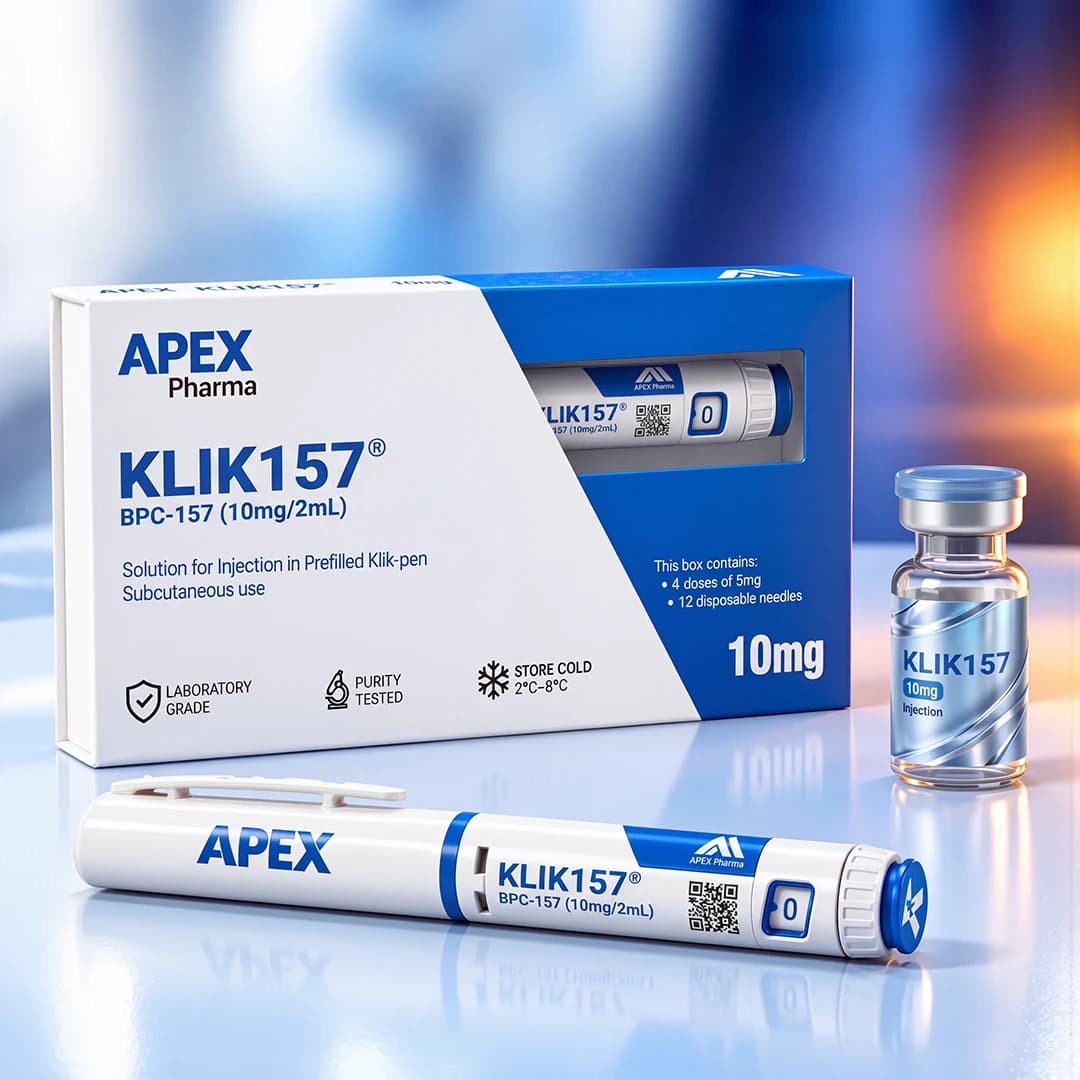
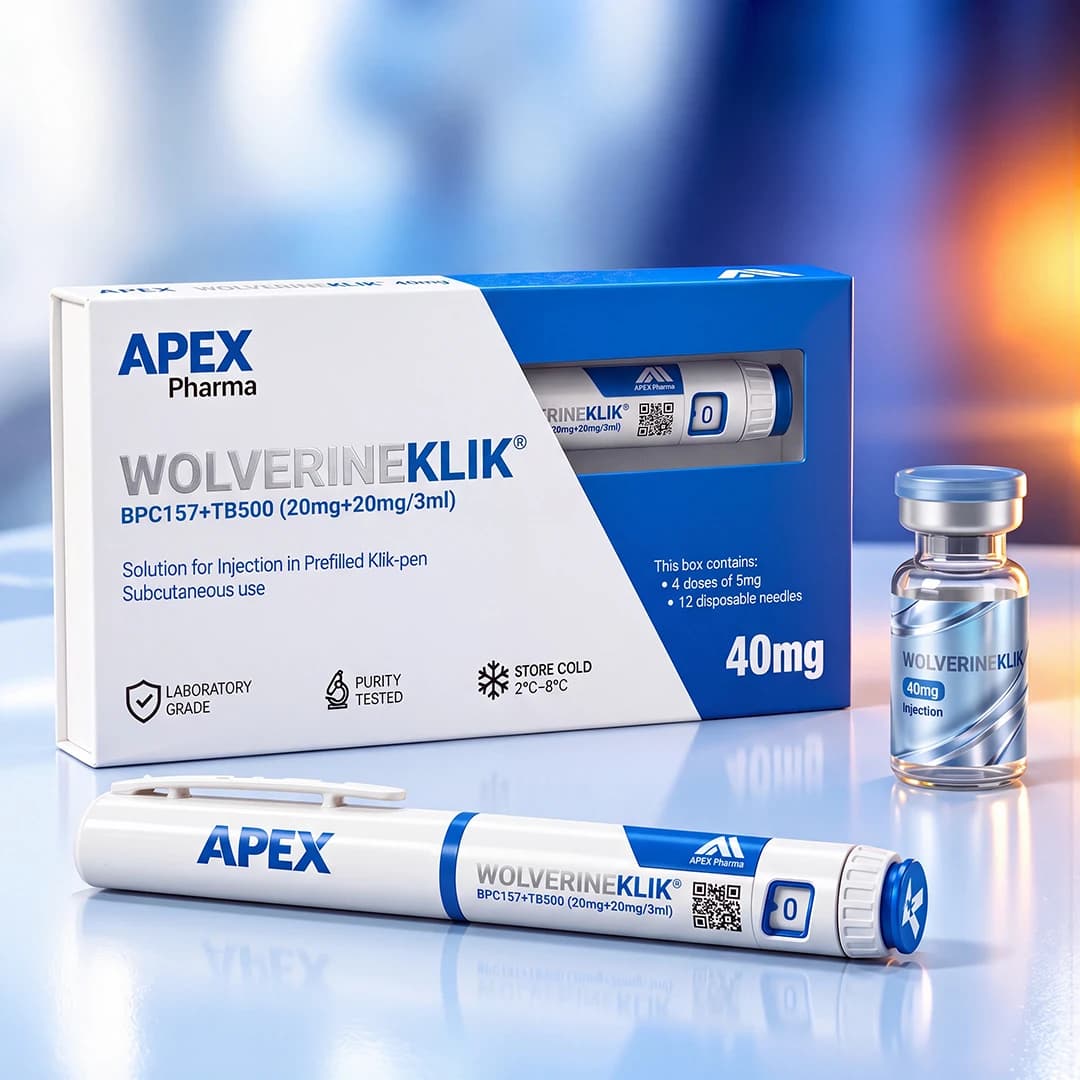
A single-compound pen is the simplest case: one compound, one cartridge, one labelled content. A blend pen mixes more than one compound in the same solution, so its headline figure is the sum of the parts. Where the maker states each compound's share, the product description gives it: the 40mg BPC-157 + TB-500 blend pen holds 20mg of each. Once mixed, the compounds share one solution, and the blend is a different product from either compound alone, with its own label and documents.
A bundle keeps compounds apart. The BPC-157 + TB-500 bundle is two separate 10mg pens, each with its own cartridge and label, so any lab report has to match each pen's own product, strength and batch. A report for one pen does not cover the other. The NAD+ double pen is two identical pens sold together as one pack.
Peptide pen vs vial
Research peptides are also supplied in glass vials, usually as a freeze-dried (lyophilised) powder under a rubber stopper. The two formats differ in labelling, handling and paperwork.
| Aspect | Prefilled pen | Freeze-dried vial |
|---|---|---|
| What is supplied | A solution in a sealed cartridge | Usually a dry powder under a stopper |
| Labelled figure | Total content per pen, with the fill volume where printed | Total content per vial |
| Concentration | Fixed when the pen is filled | Set by the volume of liquid a laboratory adds |
| Mechanism | Built-in drive mechanism behind the cartridge plunger | None: a sealed vial under a rubber stopper |
| Storage | As the pen label states, for a solution | As the vial label states, for a powder |
In handling terms a pen is self-contained: the solution is made up and sealed into its cartridge when the pen is filled. A vial of powder has no solution until a laboratory prepares one, so storage guidance for a powder in a vial does not carry over to a solution in a pen. Likewise, a report on a vial does not describe a pen of the same compound: the format, the solution and usually the batch differ.
What the label and batch documents should state
A pen label is small, so the details that identify a pen and connect it to its paperwork are spread across the pen, its carton and the product documents. Together they should give:
- the compound name and, for a blend, each compound and, where stated, its share of the total
- the labelled content per pen, and the pack total where a pack holds more than one pen
- the fill volume or concentration, where the manufacturer states it
- a batch or lot number
- an expiry or retest date
- storage conditions
- a research-use statement
Batch documents sit alongside the label. A certificate of analysis should name the laboratory, the sample it received, the batch number, the methods used (typically HPLC for purity and mass spectrometry for identity) and the date of testing.
Laboratories accredited to ISO/IEC 17025, the international standard for testing and calibration laboratories, have been assessed against requirements for competence, impartiality and consistent operation. Accreditation is held by a particular laboratory, so a claim of it can be checked with the accreditation body; in the UK, UKAS keeps a searchable directory of the organisations it accredits.
A report covers the identified tested sample only. It should match the pen by product, strength and batch, and a report for a single-compound pen does not cover a blend or a bundle that contains the same compound. The peptide lab reports page lists the published reports matched to each product. Of the pens named in this article, only the NAD+ double pen has a published report so far; the BPC-157 10mg pen, the TB-500 10mg pen, the BPC-157 + TB-500 blend pen and the bundle do not yet have one. The guide to peptide testing and certificates of analysis explains how to read one.
Storage in brief
Storage is whatever the label and product documentation state for that pen. A prefilled pen holds a solution, so guidance written for freeze-dried powder does not apply to it. The BPC-157 10mg pen's label, for example, says to store it at 2–8°C (refrigerated) and not to freeze it or expose it to sunlight; conditions like these apply to the pen as supplied. Keeping a pen in its carton keeps it out of the light and keeps any batch details printed on the carton with the pen. More detail is in the guide on how to store peptide pens.
Disposing of unwanted or expired pens
An unwanted, emptied or expired pen is a mix of materials: the cartridge, the plastic housing and the parts of the mechanism, plus whatever solution is left in the cartridge. It does not belong in household waste or recycling.
Research pens are laboratory waste. Guidance for England on GOV.UK, from the Environment Agency and Defra, says waste must be identified and classified before it is sent for recycling or disposal. Laboratories then pass it to their usual waste contractor.
Regulatory and anti-doping status
BPC-157 and TB-500 are not licensed medicines in the UK. US Food and Drug Administration briefing documents for its July 2026 compounding advisory committee found no approved product containing BPC-157 in any country, and no approved TB-500 product in the United Kingdom.
There is no UK-licensed NAD+ medicine either. When checked on 22 October 2026, the MHRA's index of active substances in UK medicines had no entry for BPC-157, TB-500, thymosin beta-4 or NAD+ (nicotinamide adenine dinucleotide). The pens described here are supplied for laboratory research only; they are not licensed medicines and have not been authorised by the MHRA.
Under the 2026 Prohibited List of the World Anti-Doping Code, in force from 1 January 2026, BPC-157 is named in class S0. That class covers pharmacological substances that no other section of the List addresses and that have no current approval by any governmental regulatory health authority for human therapeutic use. Class S2.3 names "Thymosin-β4 and its derivatives e.g. TB-500". Substances in both classes are prohibited at all times.
WADA has published the 2027 List, which takes effect on 1 January 2027. According to the US Anti-Doping Agency's summary, it keeps BPC-157 under S0 and TB-500 under S2.
NAD+ is not named on the 2026 List. That does not by itself make it permitted: WADA says most categories give only common examples and are not exhaustive, and the List covers prohibited methods as well as named substances. The full List, and UK Anti-Doping in the UK, remain the references.
Frequently asked questions
What is a peptide pen?
A peptide pen is a pen-shaped device holding a sealed cartridge of peptide solution, usually made of glass. In a prefilled pen the solution is already in the cartridge when the pen is made, and a drive mechanism sits behind the cartridge plunger.
Is the milligram figure on a pen its concentration?
No. It is the labelled content: the total amount of compound in that pen. Concentration is the content divided by the volume of solution, so it also needs the fill volume, which some labels print and others do not.
What is inside a prefilled peptide pen?
A sealed cartridge of solution, usually glass, typically closed at the back by a rubber plunger and at the front by a crimped cap with a rubber seal. It is held in a pen-shaped housing with a drive mechanism behind the plunger. The exact design differs between pen models.
What is the difference between a blend pen and a pen bundle?
A blend pen holds two or more compounds mixed in one cartridge, such as the 40mg BPC-157 + TB-500 blend pen, which contains 20mg of each. A bundle is two separate pens, each with one compound, its own label and its own batch number.
Peptide pen or vial: what is the difference?
A pen holds a ready-made solution in a sealed cartridge inside a pen-shaped housing. A vial usually holds freeze-dried powder under a rubber stopper, so its concentration depends on the volume of liquid a laboratory adds.
How are unwanted or expired peptide pens disposed of?
As laboratory waste, not household waste or recycling. The laboratory identifies and classifies the waste, as GOV.UK guidance requires, and passes it to its usual waste contractor.
Products mentioned
These are commercial links to our catalogue. Products are supplied for laboratory research only, not for human or veterinary use.

Related reading
Pens & handling
Peptide storage: how to store peptide pens and research peptides
Peptide storage in plain terms: what the storage line on a label means, why heat, freezing, light and moisture matter, and how laboratories keep, log and check refrigerated material.

Quality & testing
Peptide testing in the UK: how to read a certificate of analysis
What peptide testing can and cannot show: HPLC purity, mass spectrometry, content, endotoxin and sterility tests, how to check a certificate of analysis against the product, and how to choose a laboratory in the UK.
Peptide science
What is a peptide? Amino acids, peptide bonds and how peptides are made
A plain-English guide to what peptides are: amino acids and peptide bonds, the main types, how peptides differ from proteins, three natural examples, and how synthetic peptides are made and checked.
Sources & evidence
These sources support the statements in this article. Each one describes its own subject, method or rule; none of them tested or certifies Maylene products.
- Guideline on quality documentation for medicinal products when used with a medical device (EMA/CHMP/QWP/BWP/259165/2019)
European Medicines Agency guideline adopted on 22 July 2021, in effect from 1 January 2022. Separates single-use pre-filled pens from refillable pens that take cartridges. Cited for that terminology only: it is written for medicines with a marketing authorisation, and the research pens on this site are not licensed medicines and were not assessed under it.
Regulator · Checked
- NIST Guide to the SI, Chapter 8: Comments on Some Quantities and Their Units (Special Publication 811)
US National Institute of Standards and Technology guide to the International System of Units. Gives the mass concentration of a substance B as its mass divided by the volume (ρB = mB/V).
Standard or pharmacopoeia · Checked
- Spotlight on accreditation standards: the importance of ISO/IEC 17025 for laboratory testing/calibration
United Kingdom Accreditation Service article of 7 August 2025. Describes ISO/IEC 17025 as setting the general requirements for the competence, impartiality and consistent operation of laboratories.
Standard or pharmacopoeia · Checked
- Find an accredited organisation (UKAS directory)
United Kingdom Accreditation Service directory of the organisations it accredits, searchable by name, type, region or category.
Reference · Checked
- Classify different types of waste: your legal responsibilities
Environment Agency and Defra guidance on GOV.UK, published on 1 May 2025: waste must be identified and classified before it is sent for recycling or disposal. Links to the guide on healthcare and related wastes, which lists codes for laboratory chemicals.
Regulator · Checked
- MHRA Products: substance index
Medicines and Healthcare products Regulatory Agency index of the active substances in medicines with UK product documents. Letters B, N and T checked: no entry for BPC-157, TB-500, thymosin beta-4, nadide or nicotinamide adenine dinucleotide (NAD+).
Regulator · Checked
- FDA Briefing Document: BPC-157-related bulk drug substances (Pharmacy Compounding Advisory Committee, 23–24 July 2026)
US Food and Drug Administration evaluation for its compounding advisory committee. Found no monograph for BPC-157 in the European, Japanese or International Pharmacopoeias and no approved product containing it in any country. Cited for regulatory status only.
Regulator · Checked
- FDA Briefing Document: TB-500-related bulk drug substances (Pharmacy Compounding Advisory Committee, 23–24 July 2026)
US Food and Drug Administration evaluation for its compounding advisory committee. States that there are no approved products containing TB-500 in the United Kingdom and nine other countries, and that the European Medicines Agency has not authorised any. Cited for regulatory status only.
Regulator · Checked
- The 2026 Prohibited List (English text in the Dutch Treaty Series, Tractatenblad 2026 no. 25, appendix to the Council of Europe Anti-Doping Convention)
Dutch treaty-series publication of the 2026 List, in force from 1 January 2026; the official text is maintained by WADA. Names BPC-157 under S0 and "Thymosin-β4 and its derivatives e.g. TB-500" under S2.3; both classes are prohibited at all times. NAD+ is not named.
Anti-doping authority · Checked
- The Prohibited List (World Anti-Doping Agency)
WADA's page for the Prohibited List. States that the List is updated at least annually and comes into force on 1 January, that most categories give only common examples and are not exhaustive, and that S0 covers substances not approved by any governmental regulatory health authority for human therapeutic use.
Anti-doping authority · Checked
- UK Anti-Doping: 2027 Prohibited List, summary of changes
UK Anti-Doping summary: WADA published the 2027 List on 21 September 2026, and it takes effect on 1 January 2027.
Anti-doping authority · Checked
- USADA Athlete Advisory: What's New on the 2027 WADA Prohibited List?
US Anti-Doping Agency summary of the 2027 List, in force from 1 January 2027. Lists BPC-157 as prohibited under S0 and TB-500 and thymosin beta-4 as prohibited under S2; S0 substances are prohibited at all times.
Anti-doping authority · Checked