
For laboratory research only. Products discussed here are not for human or veterinary use, are not medicines and are not authorised by the MHRA for any medical use. This article is general information, not medical advice.
In short
- HPLC purity is the main compound's share of the detected peak area. It is not a measure of how much material is present.
- Mass spectrometry checks that the main component has the expected molecular mass. It does not measure purity.
- Endotoxin, sterility and metals tests are separate. A purity report does not cover them.
- Check the sample name, batch, dates, sample photo and verification key against the product and the laboratory's own website.
- The reports on our certificates page cover the tested samples only, not every batch in stock.
What a certificate of analysis is
A certificate of analysis (COA) is a laboratory's record of the tests it ran on one sample and the results it got. This guide to peptide testing in the UK explains what the tests can show, how to check a report from a UK or overseas laboratory, and how to tell whether a report belongs to the product it comes with. It uses the reports on our peptide lab reports and certificates of analysis page as worked examples. Peptide testing usually answers four separate questions, and no single test answers all four.
| Test | Question it answers | What it does not tell you |
|---|---|---|
| HPLC purity | What share of the detected material is the main compound? | How much material there is, or whether it is sterile |
| Mass spectrometry (MS) | Does the main component have the expected molecular mass? | How pure the sample is |
| Content or assay | How much of the compound is in the sample? | Which impurities are present |
| Endotoxin and sterility | Are bacterial endotoxins or living microorganisms present? | Identity, purity or amount |
HPLC peptide purity: what the percentage means
Peptide purity testing usually relies on high-performance liquid chromatography (HPLC), which pushes a dissolved sample through a packed column. Different molecules leave the column at different times, and a detector draws each one as a peak. Purity is usually worked out by area normalisation: the area of the main peak divided by the total area of all the peaks recorded, as a percentage.
So an HPLC purity of 99.5% means that other detected peaks made up 0.5% of the total peak area under that method. The figure has limits:
- It only counts what the detector can see. Water, salts and counter-ions such as acetate or trifluoroacetate (TFA) do not appear as peptide peaks, so high purity is not the same as high peptide content.
- Impurities that leave the column with the main compound hide inside its peak. European medicines guidance warns about these co-eluting impurities, and notes that diastereomers (versions of the peptide in which some amino acids are in their mirror-image form) may need methods of their own.
For scale, the European Medicines Agency's guideline on synthetic peptides, in force since 1 June 2026, applies the European Pharmacopoeia thresholds for medicines: peptide-related impurities are reported above 0.1%, identified above 0.5% and supported by safety data (qualified) above 1.0%. Typical impurities are near-copies of the target, with an amino acid missing, cut short or added (see how synthetic peptides are made). These thresholds are set for medicines. The GHK-Cu report we publish is not a medicines-release report: it gives one purity figure and lists no individual impurities.
Mass spectrometry: checking peptide identity
Mass spectrometry weighs molecules, and the laboratory compares the observed mass with the mass expected from the formula. For GHK, the tripeptide part of GHK-Cu, PubChem gives the formula C14H24N6O4 and a monoisotopic mass (the mass when every atom is its most common isotope) of about 340.19. In positive-ion mode, commonly used for peptides, the molecule picks up a proton, so a matching signal appears near a mass-to-charge ratio (m/z) of 341.19.
A match is good evidence that the main component is what the label says, but not proof of everything. Molecules with the same atoms in a different order, or with mirror-image amino acids, can share a mass, and mass spectrometry alone says little about how much of the sample is the target. The EMA guideline therefore recommends at least two orthogonal (differently based) identification methods for peptide medicines and, when the structure is characterised, expects representative mass spectra with tables of theoretical against observed masses. On a research report, identity is often one line: a tick, ‘confirmed’ or an observed mass.
Content: how much is actually there
A content test, also called an assay or quantity test, measures how much of the compound is in the sample, usually against a reference standard. It answers the question purity cannot: does an item labelled 100mg contain about 100mg? Results may be given per container in milligrams, or as a concentration in milligrams per millilitre (mg/mL). For medicines, the EMA guideline expects assay limits measured by liquid chromatography to be expressed on a counter-ion-free, water-free basis, unless otherwise justified.
The GHK-Cu 100mg report we publish gives a GHK-Cu concentration of 39.18 mg/mL, split into GHK at 32.54 mg/mL and copper at 6.64 mg/mL, and the two parts add up to the total. A concentration only converts into a total amount once the filled volume is known, and the report does not state one.
Blends and bundles: one result per component
A blend pen holds more than one compound in one solution, so a useful report identifies and measures each one separately, for example by its own chromatography peak and measured mass. A single purity figure cannot show how a labelled total is divided between the compounds. A report for a single-compound pen does not carry over to a blend, or the other way round, and a bundle of separate pens needs a report for each pen (see single-compound, blend and bundle pens). On 22 October 2026 our library had no published report for either of the catalogue's two blend pens, BPC-157 + TB-500 (40mg) and BPC-157 + TB-500 + GHK-Cu (70mg), or for the BPC-157 + TB-500 bundle.
Endotoxin, sterility and other contaminants
Endotoxins are fever-causing (pyrogenic) substances, such as lipopolysaccharide, found in the cell wall of bacteria; that is the definition in the US Food and Drug Administration's (FDA) guidance on aseptic processing. The same guidance notes that sterilising-grade filters and moist-heat (steam) sterilisation have not been shown to remove endotoxin, so a sterile sample can still contain it, and the two are tested separately. The FDA's guidance on pyrogen and endotoxin testing (second edition, March 2026) refers to the gel-clot, photometric and kinetic methods in the US Pharmacopeia. It notes that the sample itself can interfere with these assays, and that pyrogens other than endotoxins may call for a different test.
A sterility test asks whether anything grows when the sample is placed in culture media. Its limit is statistical: in the FDA's aseptic processing guidance, a 10,000-unit lot with 0.1% of units contaminated, tested by sampling 20 units, has a 98% chance of passing. A pass shows that the tested units grew nothing; it cannot vouch for every unit.
Metals and solvents need tests of their own. Belgian public-health scientists who screened the ten falsified peptide products most often found on their market, bought from three suspected illegal online pharmacies, found widely varying amounts per unit, purity between 5% and 75% for the cysteine-containing peptides, raised arsenic in several samples and lead in one. A purity-only report would show none of the metals.
Independent laboratory or supplier-issued report?
A supplier-issued COA comes from the maker or seller. It can be accurate, but it asks the reader to trust the party with an interest in the result. A third-party report comes from a separate laboratory, ideally one that lets anyone check it online.
Independence has a second layer: who chose the sample. The GHK-Cu and NAD+ reports we publish both name the pen maker as client and manufacturer. The laboratory is independent of the seller, but the maker commissioned the test, and the record does not say how the sample was chosen. A unit bought from stock says more about what is on the shelf.
Accreditation is the other check. UKAS, the UK's national accreditation body, assesses testing laboratories against ISO/IEC 17025, which covers staff competence, test methods and equipment. A laboratory is accredited only for the activities listed on its schedule, and UKAS says ISO 9001 certification is not an alternative. The GHK-Cu and NAD+ reports we publish do not state an accreditation, so we do not claim one.
How to check that a report matches the product
Work through these checks before relying on any certificate. The GHK-Cu 100mg report we publish (Janoshik task #224435) is the example.
- Product and strength. The sample name should match the compound and labelled content; our example names the sample ‘KLIK-GHK 100MG’, the maker's label name for the GHK-Cu 100mg pen.
- Batch or lot number. Compare it with the packaging; our example gives batch 07/2026. The NAD+ report we publish carries the same reference, so here it appears to mark a production period rather than a unique lot for one product. A report with no batch, or ‘N/A’, cannot be tied to any stock.
- Dates. Our example shows testing ordered on 17 August, the sample received on 28 August and the analysis done on 31 August 2026. Results describe the sample at that point, and later storage matters too (see how to store peptide pens).
- Sample photo. Our example shows a cartridge of blue liquid marked G100 rather than a retail label (see how peptide pens are built and labelled), so only the sample name and batch reference connect the report to stock, and that connection is loose.
- Verification key. Our example prints a unique key (which also ends the record's web address), a QR code and the instruction to verify the test at www.janoshik.com/verify/. Make sure the record opens on the laboratory's own domain (type the address if a report reached you as a PDF or screenshot) and shows the same sample, batch and results.
- Tests performed. The ‘tests requested’ line shows what was measured, and so what was not; our example reads ‘GHK (or GHK-Cu) analysis’. It does not name its analytical methods, and the laboratory can be asked which it used.
Red flags on a certificate of analysis
- A generic report that names a compound but no strength, format or batch, or one report offered for several products or batches.
- No laboratory name or contact details, or a laboratory you cannot find independently.
- A verification key that does not resolve on the laboratory's own website, or resolves to a different sample.
- Signs of editing: mismatched fonts, misaligned numbers, a cropped header or a blurred key.
- A purity of exactly 100%, results with no units, or dates that do not fit.
If anything does not match, ask the seller and the laboratory; a genuine laboratory can usually confirm whether a report exists.
Peptide testing in the UK: choosing a laboratory
Commissioning a test, rather than relying on a supplier's report, starts with the laboratory. UKAS lists every organisation it accredits to ISO/IEC 17025 for testing on its website, so a UK laboratory's claim can be checked there, together with the schedule of activities its accreditation covers.
A laboratory does not have to be in the UK. UKAS, a member of the International Laboratory Accreditation Cooperation (ILAC), explains that under mutual recognition arrangements such as the EA MLA and the ILAC MRA, reports from laboratories accredited by a signatory body should be accepted as technically equivalent in the other signatories' countries. What matters is that the test required is on the laboratory's schedule.
Before sending a sample, ask the laboratory:
- Which tests it runs on peptides (purity, identity, content, endotoxin, sterility, metals) and which methods it uses.
- How much sample it needs, and whether the sample is used up.
- How long results take and what each test costs, as a written quote.
- Whether the report will name the methods and the batch, and can be verified on the laboratory's own website.
- Whether those tests are covered by its accreditation.
We do not recommend a particular laboratory.
How we publish laboratory reports
Our certificates page lists the Janoshik reports we have matched to an exact product and strength (last checked 5 October 2026), each linked to the original record on the laboratory's website. Not every product has one. The two used as examples in this guide are:
- GHK-Cu 100mg (Janoshik task #224435): a purity of 99.770%, with the GHK-Cu, GHK and copper concentrations described above.
- NAD+ (Janoshik task #224434): one 500mg sample (‘KLIKNAD+ 500MG’; the photo shows a cartridge of clear liquid marked N500) was tested for identity and amount. The report gives a concentration of 244.40 mg/mL, notes that the sample was tested twice and gives no purity percentage, so our library shows none. The NAD+ product is a pack of two 500mg pens, and the report covers the single 500mg sample tested. NAD+ is a coenzyme rather than a peptide, but the same reading rules apply.
A report covers the tested sample only. It does not verify every batch in stock, and current-stock batch matching has not been independently verified for our catalogue. Compare the batch on the packaging with the report. If it differs, or a product has no report, contact us for the records for that batch. Neither the GHK-Cu nor the NAD+ product is a licensed medicine, and no laboratory report makes a product suitable for human or veterinary use; everything sold here is for laboratory research only.
Frequently asked questions
What does 99% purity mean on a peptide test report?
For an HPLC result, it means the main compound made up about 99% of the peak area the detector recorded under that method. It does not tell you how many milligrams are present, and it says nothing about sterility or endotoxin.
Does one certificate of analysis cover every batch?
No. A report covers the sample the laboratory tested. Match its batch or lot number to the packaging, and ask for the record for that batch if it differs.
How do I verify a peptide lab report, such as a Janoshik report?
Check the record on the laboratory's own website, reached by typing the address rather than through a link or file supplied with the product. The GHK-Cu and NAD+ reports we publish each print a unique key, a QR code and the instruction to verify the test at www.janoshik.com/verify/, and both records open on verify.janoshik.com. Use the key, and check that the record shows the same sample, batch, dates and results as the copy you were given.
Does a peptide testing lab have to be in the UK?
No. UKAS explains that under international mutual recognition arrangements, reports from laboratories accredited by a signatory body should be accepted as technically equivalent. Check that the laboratory's accreditation schedule covers the test needed, wherever it is based.
Where can I get peptide testing in the UK?
We do not recommend a particular laboratory. UKAS lists the laboratories it accredits to ISO/IEC 17025 on its website. Check that the test needed, such as HPLC purity or mass spectrometry, appears on the laboratory's schedule, and ask what sample it needs and for a written quote.
Why do some reports show mg/mL instead of a percentage?
A content or amount test measures how much compound is present, often as a concentration. A percentage usually comes from a purity test. The NAD+ report we publish gives a concentration only, because identity and amount were the tests requested.
Related reading

Pens & handling
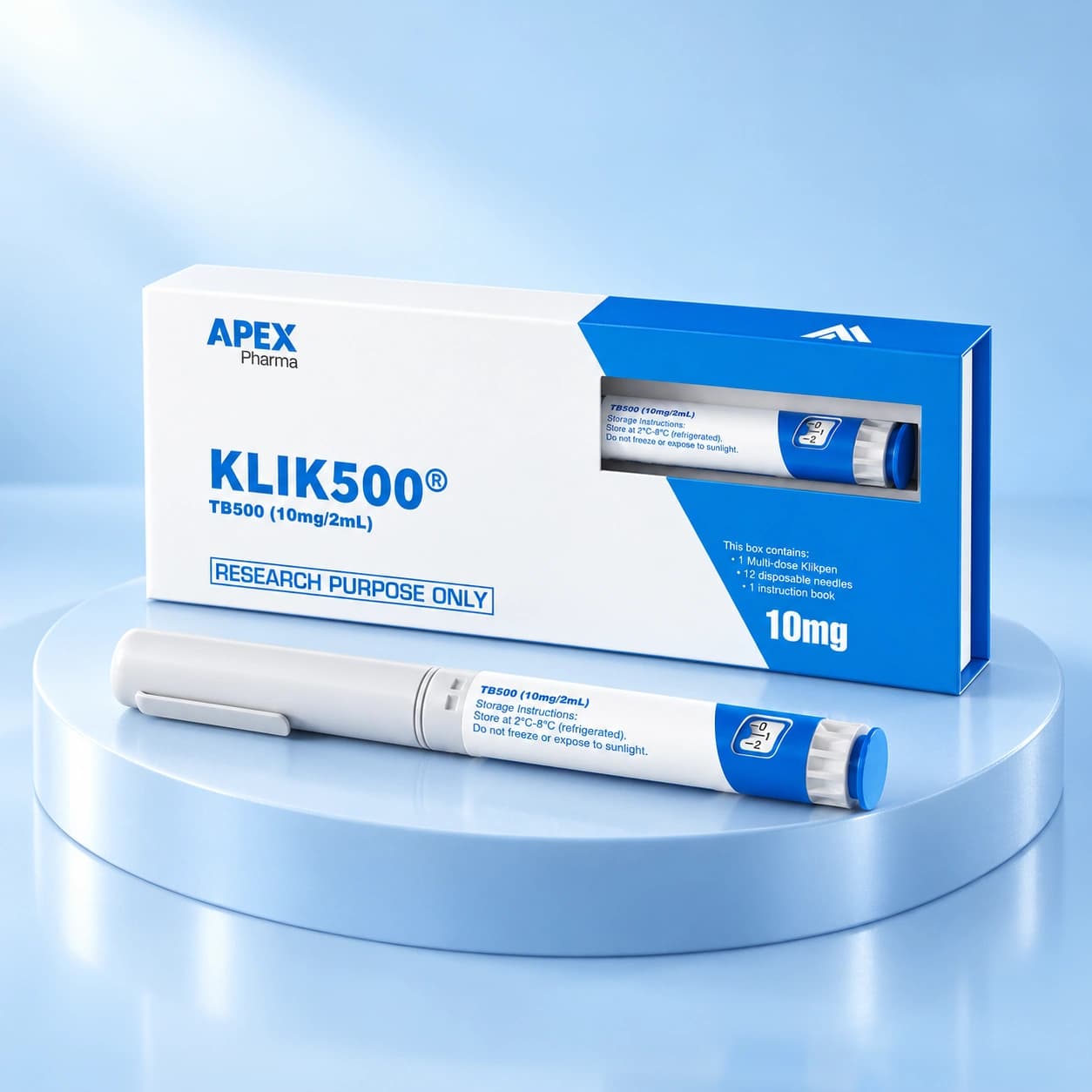
Peptide pens explained: how prefilled research pens are built and labelled
A plain guide to how prefilled research peptide pens are built and labelled, and how they compare with vials on labelling, handling and documentation.
Pens & handling
Peptide storage: how to store peptide pens and research peptides
Peptide storage in plain terms: what the storage line on a label means, why heat, freezing, light and moisture matter, and how laboratories keep, log and check refrigerated material.
Peptide science
What is a peptide? Amino acids, peptide bonds and how peptides are made
A plain-English guide to what peptides are: amino acids and peptide bonds, the main types, how peptides differ from proteins, three natural examples, and how synthetic peptides are made and checked.
Sources & evidence
These sources support the statements in this article. Each one describes its own subject, method or rule; none of them tested or certifies Maylene products.
- European Medicines Agency: Guideline on the development and manufacture of synthetic peptides (EMA/CHMP/CVMP/QWP/367182/2025)
Quality guideline for peptide medicines, effective 1 June 2026: impurity reporting, identification and qualification thresholds, at least two orthogonal identification methods, mass spectra with theoretical and observed masses for characterisation, the basis for LC assay limits, co-eluting impurities and diastereomers. It sets rules for medicines, not research products.
Regulator · Checked
- US FDA: Pyrogen and Endotoxins Testing: Questions and Answers (Edition 2, March 2026)
Guidance on endotoxin test methods (gel clot, photometric and kinetic), assay interference and pyrogens that are not endotoxins. Written for products the FDA regulates.
Regulator · Checked
- US FDA: Sterile Drug Products Produced by Aseptic Processing — Current Good Manufacturing Practice (September 2004)
The glossary definition of endotoxin, the statement that sterilising-grade filters and moist-heat sterilisation have not been shown to remove endotoxin (Section VII), and Section XI.B on sterility test sampling, including the worked example of a 20-unit test of a 10,000-unit lot. Written for sterile medicine manufacture.
Regulator · Checked
- UKAS: Testing laboratories — why leave your testing to chance?
The UK national accreditation body on ISO/IEC 17025, the scope set by each laboratory's schedule, why ISO 9001 certification is not an alternative, the UKAS listing of accredited laboratories and international mutual recognition (EA MLA and ILAC MRA).
Standard or pharmacopoeia · Checked
- PubChem: glycyl-L-histidyl-L-lysine (GHK), CID 73587
Molecular formula (C14H24N6O4), molecular weight and monoisotopic mass (340.18590327 Da) of the GHK tripeptide, used for the expected-mass example.
Reference · Checked
- Impurity profiling of the most frequently encountered falsified polypeptide drugs on the Belgian market — Janvier et al., Talanta, 2018
Laboratory screening of ten falsified peptide products bought from three suspected illegal online pharmacies: amount per unit, purity, elemental impurities and solvents. It did not test any product sold here.
Peer-reviewed paper · Checked