
For laboratory research only. Products discussed here are not for human or veterinary use, are not medicines and are not authorised by the MHRA for any medical use. This article is general information, not medical advice.
In short
- A peptide is a short chain of amino acids joined by peptide bonds; around 50 amino acids is the usual, loose boundary with proteins.
- Insulin, oxytocin and glutathione are natural peptides with very different roles in living things.
- Synthetic peptides are built one amino acid at a time on resin beads, purified by chromatography, identified by mass spectrometry and usually freeze-dried.
- A peptide cannot be identified by eye, so batch-matched laboratory reports are the main evidence of what a product contains.
- No product sold here is a licensed medicine in the UK, and a research-use label does not by itself decide whether a product counts as one.
What is a peptide?
A peptide is a short chain of amino acids joined end to end by chemical links called peptide bonds. The US National Human Genome Research Institute puts the typical length at 2 to 50 amino acids; its glossary calls longer chains polypeptides, and proteins are built from one or more of them. Other conventions draw these lines differently, as the section on peptides and proteins shows.
Amino acids share a common core, an amino group and a carboxyl group, plus a side chain that differs from one to the next. Twenty standard amino acids make up most of the proteins of living things. The order in which they are joined, the sequence, is what makes one peptide different from another.
How a peptide bond forms
A peptide bond forms when the carboxyl group of one amino acid reacts with the amino group of the next, and the elements of a water molecule are removed. Chemically, the link is an amide bond. What remains of each amino acid inside the chain is called a residue, so peptide lengths are counted in residues.
A chain has two different ends: the N-terminus, with a free amino group, and the C-terminus, with a free carboxyl group. By international convention, sequences are written from the N-terminus on the left to the C-terminus on the right.
Peptide vs protein: where the line falls
There is no single cut-off. The IUPAC-IUBMB nomenclature rules call chains of fewer than about 10 to 20 residues oligopeptides and longer ones polypeptides. Chains of more than about 50 residues are usually called proteins, though the rules note that authors differ greatly on where that line sits.
Structure matters too. A protein usually folds into a specific three-dimensional shape, and many have more than one chain. Insulin shows how blurred the line is. It has 51 amino acids in two chains. Curated databases list those chains as peptides, while the Nobel Prize citation for the work on its structure calls insulin a protein.
| Term | Usual meaning | Example |
|---|---|---|
| Tripeptide | Three amino acids | Glutathione |
| Oligopeptide | Up to about 10–20 residues | Oxytocin (9) |
| Polypeptide | Over about 10–20 residues in the IUPAC rules (NHGRI uses 51 or more) | Insulin B chain (30), under the IUPAC usage |
| Protein | Usually over about 50 residues, folded | Insulin (51) sits on the line |
Types of peptides
Peptides are grouped in several overlapping ways:
- By length: dipeptides have two amino acids and tripeptides, such as glutathione, have three; oligopeptides are short chains and polypeptides longer ones.
- By shape: many are linear chains, but some are partly cyclic. In oxytocin, a disulfide bridge closes part of the chain into a ring.
- By origin: many natural peptides are made on ribosomes from a gene's instructions; some, such as glutathione, are assembled by enzymes; and synthetic peptides are made chemically, as described below.
- By natural role: peptide hormones such as insulin and oxytocin, and peptides that take part in cell chemistry, such as glutathione.
Natural peptides: insulin, oxytocin and glutathione
Peptides occur throughout biology. Many, including peptide hormones such as insulin and oxytocin, are made like proteins. A ribosome reads messenger RNA copied from a gene and joins amino acids in the order it specifies, often as a longer precursor that is then cut. Others are built by enzymes. The three examples below describe natural roles only.
Insulin
Insulin is a hormone made by the beta cells of the pancreas, and is central to how the body handles glucose. Its two chains, of 21 and 30 amino acids, are held together by disulfide bridges. Cells first make a single 110-amino-acid precursor. A 24-amino-acid signal sequence is removed, and later a middle section containing the C-peptide is cut out, leaving the two chains. Frederick Sanger's work on its structure earned the 1958 Nobel Prize in Chemistry.
Oxytocin
Oxytocin has nine amino acids, with a disulfide bridge that closes part of the chain into a ring. It is made in the hypothalamus and released from the posterior pituitary gland. Its natural roles include the contractions of childbirth, milk release and social behaviour. In 1953 Vincent du Vigneaud determined its composition, and he also made it in the laboratory; his 1955 Nobel Prize cited "the first synthesis of a polypeptide hormone".
Glutathione
Glutathione is a tripeptide of glutamic acid, cysteine and glycine, and an unusual one. Its glutamic acid is attached through its side chain, hence the full name γ-glutamylcysteinylglycine. The nomenclature rules say links of this kind are sometimes called isopeptide bonds. Glutathione is assembled by two enzymes rather than on a ribosome.
It is the most abundant thiol (a compound with a sulfur–hydrogen group) inside cells. There it takes part in redox reactions, which pass electrons between molecules, and acts as a cofactor that some enzymes need.
What do peptides do, and what are they used for?
In biology, peptides do many jobs. Some, like insulin and oxytocin, are peptide hormones that carry signals around the body. Others, like glutathione, take part in the chemistry inside cells. And every protein is built from one or more chains of amino acids linked by peptide bonds.
In research, synthetic peptides are useful because their sequence can be specified exactly. A laboratory can copy one section of a natural protein, change a single amino acid to study structure or binding, or use a well-characterised peptide as an analytical reference standard.
Some peptides are also made and supplied as medicines, under medicines law. A research-use label does not place a product outside that law. Whether something counts as a medicine depends on how it is presented as a whole and on what it does, so a label alone does not settle it.
Is it a peptide? Insulin, creatine, NAD+ and steroids
A peptide is defined by its chemistry: a chain of amino acids joined by amide bonds. Several molecules often mentioned alongside peptides do not qualify.
| Molecule | Peptide? | What it is |
|---|---|---|
| Insulin | Yes, though often called a small protein | Two chains of 21 and 30 amino acids |
| Oxytocin | Yes | Nine amino acids |
| Glutathione | Yes | Three amino acids |
| Creatine | No | A derivative of the amino acid glycine |
| NAD+ | No | A coenzyme made of two nucleotides |
| Steroids | No | Compounds built on a fused 17-carbon ring system |
Compound guideNAD+ guide
Peptides and steroids are sometimes confused because both groups include hormones. Peptide hormones such as insulin are chains of amino acids. Steroids are built on a fused 17-carbon ring system, and the group includes cholesterol and numerous hormones. The two classes are chemically unrelated.
How synthetic peptides are made
Synthetic peptides are usually made by solid-phase peptide synthesis (SPPS). The European Medicines Agency's guideline for peptide medicines describes it alongside solution-phase synthesis and fragment condensation, and acknowledges that most peptides will be made this way. Bruce Merrifield developed the method in the early 1960s and received the 1984 Nobel Prize in Chemistry for it. The growing chain is anchored to an insoluble resin, so excess reagents and by-products can be rinsed away after every step.
- Anchoring: the first amino acid, at the C-terminal end, is attached to the resin.
- Deprotection: a temporary protecting group is removed from the end of the chain, and the resin is washed.
- Coupling: the next protected amino acid is joined by a new peptide bond; chain ends that failed to react may be capped.
- Repetition: these steps are repeated for every amino acid in the sequence.
- Cleavage: the finished chain is released from the resin and its side-chain protecting groups are removed, giving a crude peptide.
Small losses at each step add up, so the crude product contains near-miss molecules. The EMA guideline describes several kinds of these peptide-related impurities, including:
- Deletion sequences: one or more amino acids missing.
- Truncated sequences: chains stopped early by capping.
- Insertion sequences: an amino acid added more than once in a single coupling step.
Purification, identity and freeze-drying
The crude peptide is purified by preparative chromatography, typically high-performance liquid chromatography (HPLC), and the purest fractions are pooled. Two questions are then answered. Identity: mass spectrometry measures the molecular mass and can confirm the sequence. Purity: analytical HPLC reports what share of the detected peak area belongs to the target peptide rather than to related impurities; it does not measure how much of the powder's weight is peptide.
For peptide medicines, the EMA guideline recommends at least two orthogonal methods, meaning tests based on different principles, to confirm identity.
Finally, the solution is usually freeze-dried (lyophilised), leaving a dry powder; the EMA calls this common practice. The powder is not pure peptide by weight. It also holds a counter-ion, commonly acetate or trifluoroacetate, and some water, so purity, peptide content, counter-ion and water content are separate tests.
How research peptides are named and supplied
Peptide names come from several traditions:
- Trivial names, such as insulin and oxytocin, which the nomenclature rules note are common for peptides of biological origin.
- Sequence codes, using the standard one-letter symbols: GHK is glycine, histidine, lysine, and GHK-Cu is that tripeptide bound to copper.
- Acronyms: MOTS-c stands for mitochondrial open reading frame of the 12S rRNA-c, a 16-amino-acid peptide.
- Product and blend names, which are not chemical descriptions. The label and laboratory report should name each compound and its amount.
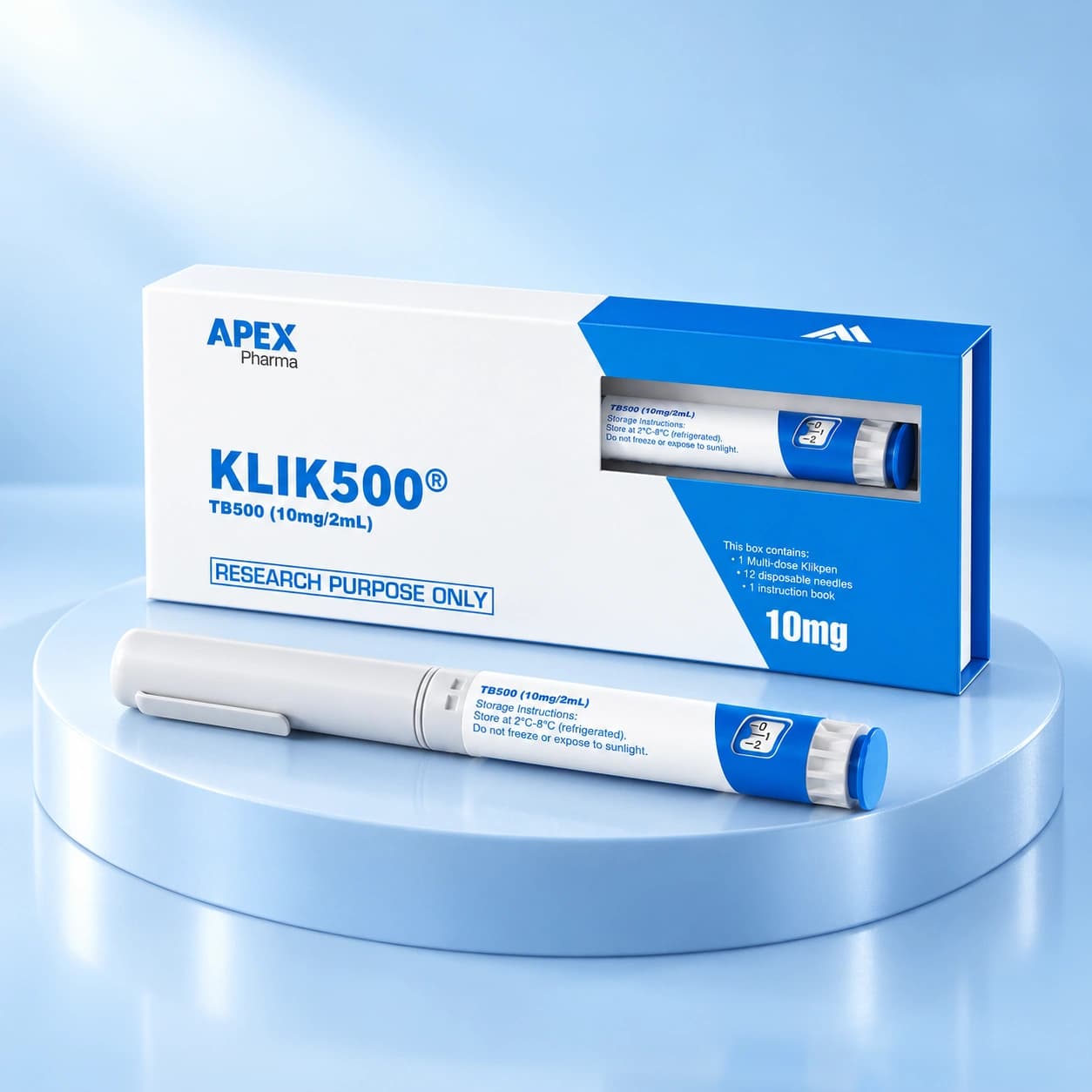
Laboratory peptides are commonly supplied as freeze-dried powder in sealed vials. This shop supplies its compounds in a different format: already in solution in a prefilled pen, labelled with the total content in milligrams. Peptide pens explained covers how these pens are built and labelled. Storage follows the label, and how to store peptide pens covers temperature, light and moisture.
Why quality documentation matters
A peptide cannot be identified by looking at it. The correct material, a sequence missing one amino acid and a different compound altogether can all look like the same powder or clear liquid. Only analytical tests tell them apart.
A certificate of analysis should name the laboratory, batch number, test date, methods and results, typically HPLC purity and mass-spectrometry identity. The batch number should match the label. A report covers the identified tested sample only, and does not show sterility or endotoxin levels unless those were tested. Peptide testing and certificates of analysis explains each line of a report. This shop's published lab reports are records of tested samples; not every product has one, and a report does not verify every batch in stock.
Research peptides and UK medicines law
Frequently asked questions
What is a peptide in simple terms?
A peptide is a short chain of amino acids joined by peptide bonds. Chains of up to about 50 amino acids are usually called peptides; longer, folded chains are usually called proteins, although there is no fixed cut-off. Short peptides are also called oligopeptides, and longer ones polypeptides.
What is the difference between a peptide and a protein?
Mainly size and structure. The international nomenclature rules say chains of more than about 50 amino acids are usually called proteins, but authors differ on the boundary. Proteins also tend to fold into a fixed three-dimensional shape and may contain several chains.
What is a peptide bond?
It is the amide bond formed when the carboxyl group of one amino acid joins the amino group of the next, with the loss of the elements of a water molecule. In a standard chain, each amino acid is linked to the next this way.
Is a peptide the same as a steroid?
No. A peptide is a chain of amino acids. Steroids, such as cholesterol, are polycyclic compounds built on a fused 17-carbon ring system and contain no amino-acid chain. The two classes are chemically unrelated.
Is creatine a peptide?
No. Creatine is a small molecule that PubChem describes as a derivative of the amino acid glycine. It is not a chain of amino acids and has no peptide bonds.
What are peptides used for?
In living things, peptides act as hormones and signals, as insulin and oxytocin do, and take part in cell chemistry, as glutathione does. In laboratories, synthetic peptides with exactly specified sequences are used to study structure and binding and as reference materials.
Related reading
Pens & handling
Peptide pens explained: how prefilled research pens are built and labelled
A plain guide to how prefilled research peptide pens are built and labelled, and how they compare with vials on labelling, handling and documentation.
Quality & testing
Peptide testing in the UK: how to read a certificate of analysis
What peptide testing can and cannot show: HPLC purity, mass spectrometry, content, endotoxin and sterility tests, how to check a certificate of analysis against the product, and how to choose a laboratory in the UK.
Pens & handling
Peptide storage: how to store peptide pens and research peptides
Peptide storage in plain terms: what the storage line on a label means, why heat, freezing, light and moisture matter, and how laboratories keep, log and check refrigerated material.
Sources & evidence
These sources support the statements in this article. Each one describes its own subject, method or rule; none of them tested or certifies Maylene products.
- IUPAC-IUBMB nomenclature of amino acids and peptides: definitions and naming of peptides (3AA-11 to 3AA-13)
Joint commission recommendations (1983): what a peptide and a peptide bond are, dipeptides, oligopeptide, polypeptide and protein size conventions, links sometimes called isopeptide bonds, N- and C-terminal residues and writing order.
Standard or pharmacopoeia · Checked
- IUPAC-IUBMB nomenclature of amino acids and peptides: common α-amino acids and side chains (3AA-1 to 3AA-2)
Table 1 of the α-amino acids commonly found in proteins and represented in the genetic code, and the definition of the side chain as everything beyond the repeating main-chain atoms.
Standard or pharmacopoeia · Checked
- IUPAC-IUBMB nomenclature of amino acids and peptides: the one-letter system (3AA-20 to 3AA-21)
Standard one-letter symbols for amino acids, including G for glycine, H for histidine and K for lysine.
Standard or pharmacopoeia · Checked
- NHGRI Talking Glossary: Peptide
Glossary definition: a peptide is typically 2 to 50 amino acids; 51 or more is a polypeptide, and proteins are made from one or more polypeptides.
Reference · Checked
- NHGRI Talking Glossary: Amino acids
Glossary definition: 20 different amino acids make up proteins, in a sequence encoded by a gene.
Reference · Checked
- NHGRI Talking Glossary: Ribosome
Glossary definition: the ribosome reads messenger RNA and joins amino acids in the order it specifies.
Reference · Checked
- European Medicines Agency: Guideline on the development and manufacture of synthetic peptides (EMA/CHMP/CVMP/QWP/367182/2025)
EU quality guideline for synthetic peptides in medicines, in effect from 1 June 2026. Cited only for manufacturing chemistry: solid-phase, solution-phase and fragment-condensation routes, deletion, truncated and insertion impurities, chromatographic purification, lyophilisation, at least two orthogonal identity methods and separate specification tests. It does not apply to or assess research products.
Regulator · Checked
- Nobel Prize in Chemistry 1984: Bruce Merrifield, facts
Prize record for the development of chemical synthesis on a solid matrix, describing step-by-step chain building with impurities rinsed away between steps.
Reference · Checked
- Nobel Prize in Chemistry 1955: Vincent du Vigneaud, facts
Prize record for the first synthesis of a polypeptide hormone; in 1953 oxytocin was isolated and its composition determined, and du Vigneaud also produced it artificially.
Reference · Checked
- Nobel Prize in Chemistry 1958: Frederick Sanger, facts
Prize record for work on the structure of proteins, especially insulin: the sequences of its two chains and, in 1955, how they are linked.
Reference · Checked
- UniProt P01308: Insulin (human)
Curated protein record: 110-residue precursor with a 24-residue signal sequence, B chain of 30 and A chain of 21 residues, the C-peptide cut from between them, interchain disulfide bonds, made by pancreatic beta cells. Natural function only.
Reference · Checked
- UniProt P01178: Oxytocin-neurophysin 1 proprotein (human)
Curated protein record: nine-residue oxytocin with one disulfide bond and a C-terminal amide, cut from a larger precursor, carried to and released from the posterior pituitary. Natural function only.
Reference · Checked
- UniProt P48637: Glutathione synthetase (human)
Curated enzyme record: the second of two steps in glutathione biosynthesis, joining gamma-glutamylcysteine to glycine; glutathione as the most abundant intracellular thiol.
Reference · Checked
- PubChem: Glutathione (CID 124886)
Compound record: a tripeptide of glutamic acid, cysteine and glycine, with the glutamic acid attached through its side chain; a cofactor for some enzymes.
Reference · Checked
- PubChem: Creatine (CID 586)
Compound record: creatine is a glycine derivative, not a peptide.
Reference · Checked
- PubChem: NAD (Nadide, CID 5892)
Compound record: nicotinamide adenine dinucleotide is a coenzyme made of two nucleotides, not a peptide.
Reference · Checked
- MeSH descriptor D013256: Steroids
Medical Subject Headings scope note: steroids are polycyclic compounds with a common fused 17-carbon ring system; the group includes cholesterol and numerous hormones.
Reference · Checked
- UniProt A0A0C5B5G6: Mitochondrial-derived peptide MOTS-c (human)
Curated record used for the name only: mitochondrial open reading frame of the 12S rRNA-c, 16 residues.
Reference · Checked
- MHRA Guidance Note 8: A guide to what is a medicinal product
UK regulator guidance on the two-part definition of a medicinal product, by presentation and by function, in the Human Medicines Regulations 2012; presentation is judged in context and as a whole, with labelling one factor among several.
Regulator · Checked