

This article is for general education and research information. It does not provide medical advice or instructions for personal use.
A peptide can have several identities at the same time.
A researcher may describe one molecule by its amino acid sequence. A chemistry paper may use a systematic name. A biology textbook may place it in a functional family, while a pharmaceutical database may use a nonproprietary drug name.
None of those labels necessarily conflicts with the others. They answer different questions.
That is where peptide classification becomes useful. Instead of forcing every peptide into one category, scientists can classify it by chain length, structure, biosynthetic origin, chemical modification, or biological role. Peptide nomenclature then provides a common way to describe exactly which amino acids are present and how they are arranged.
For readers new to peptide bonds, amino acid chains and basic peptide biology, What Are Peptides? A Beginner’s Guide to How They Work provides the foundation. Here, the focus is narrower: how scientists read, name and classify peptide molecules.
Peptide Classification Starts With More Than Chain Length
The first instinct is often to classify a peptide by counting amino acids. That works for some terms, but it does not provide a complete taxonomy.
The U.S. National Library of Medicine defines peptides as amino acids connected by peptide bonds that may form linear, branched, or cyclic structures. Its Medical Subject Headings system places oligopeptides at approximately 2 to 12 amino acids and polypeptides at approximately 13 or more.
Those numbers are useful within that classification system, but they should not be treated as a universal biochemical law. IUPAC peptide nomenclature focuses primarily on chemical connectivity, amino acid residues, and sequence rather than imposing one global residue-count boundary between every peptide and polypeptide.
Some labels are much less ambiguous:
- A dipeptide contains two amino acid residues.
- A tripeptide contains three.
- A tetrapeptide contains four.
- Oligopeptide generally describes a relatively short peptide, although the numerical boundary depends on the classification system.
- Polypeptide refers to a longer amino acid chain, again without one cutoff accepted for every scientific purpose.
This matters when reading research. A molecule described as an oligopeptide in one database may fall under a broader peptide category elsewhere. The chemistry has not changed. Only the classification framework has.
Chain length is also a poor shortcut for predicting biological behaviour. Two peptides containing the same number of residues can have different sequences, shapes, targets and functions.
That is why a useful peptide classification system looks at several properties together.
| Classification method | What it tells you | Typical terminology |
|---|---|---|
| Residue count | Number of amino acids in the chain | Dipeptide, tripeptide, oligopeptide, polypeptide |
| Structure | How the chain is physically arranged | Linear, cyclic, branched, disulfide-constrained |
| Origin | How the molecule is biosynthesized | Ribosomal, non-ribosomal |
| Chemical features | Changes or groups attached to the sequence | Acetylated, amidated, phosphorylated, lipidated |
| Biological role | What the peptide does or which system it belongs to | Neuropeptide, peptide hormone, antimicrobial peptide |
A separate question is where a peptide ends and a protein begins. That distinction involves more than counting residues, especially when folding and biological structure are considered.
Learn the peptide vs protein deeply for detailed information about how peptides are different from proteins.
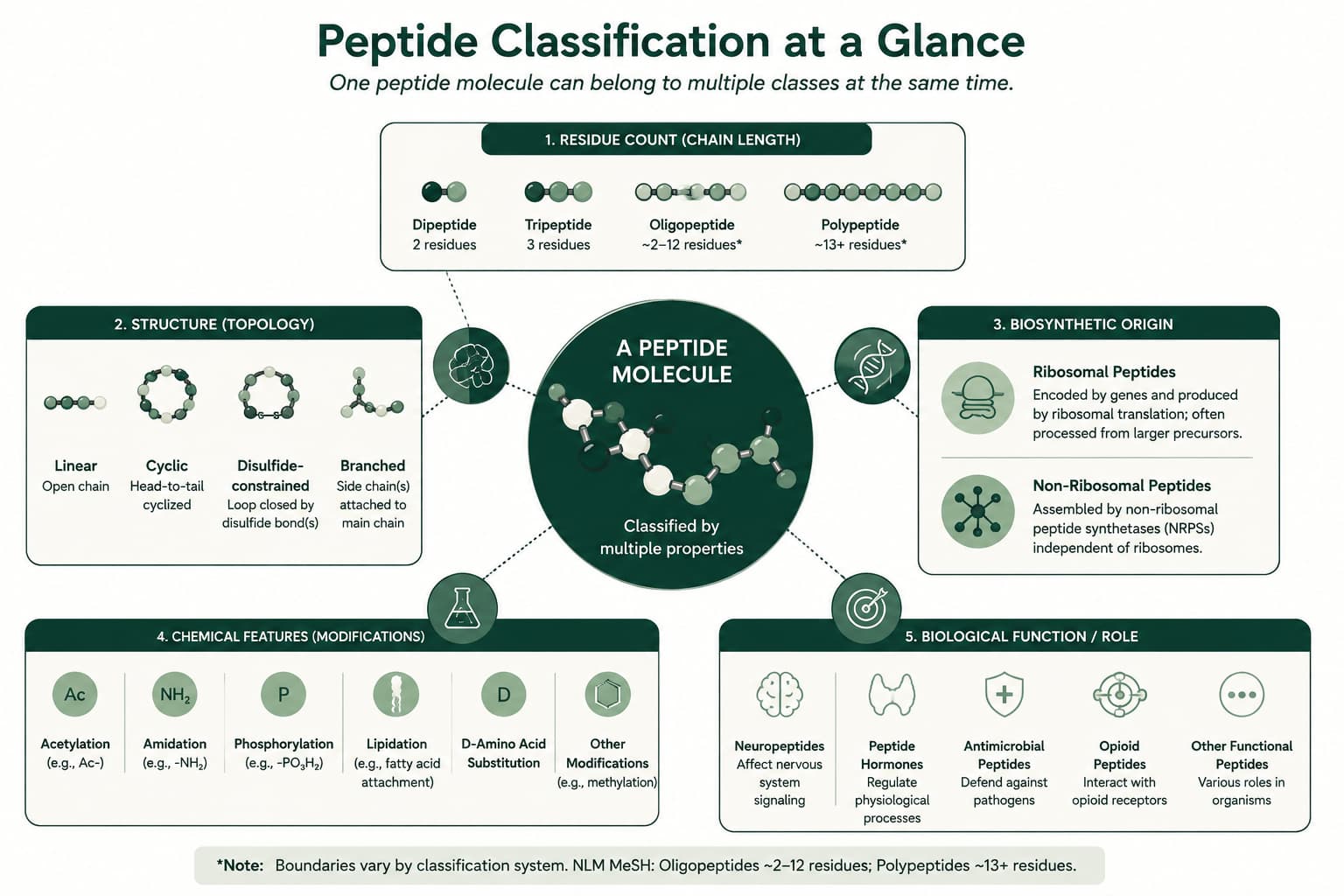
Figure 2. Peptide classification overview showing how peptides are grouped by residue count, structure, biosynthetic origin, chemical modifications, and biological function.
How Peptide Sequences Are Written and Named
The most useful skill in peptide nomenclature is learning to read a sequence in the correct direction.
Scientific convention writes peptide sequences from the N-terminus on the left toward the C-terminus on the right. IUPAC-IUBMB recommendations use the same direction for both sequence representation and peptide naming.
Take a simple three-residue sequence:
Ala-Gly-Leu
It reads as:
N-terminus → alanine → glycine → leucine → C-terminus
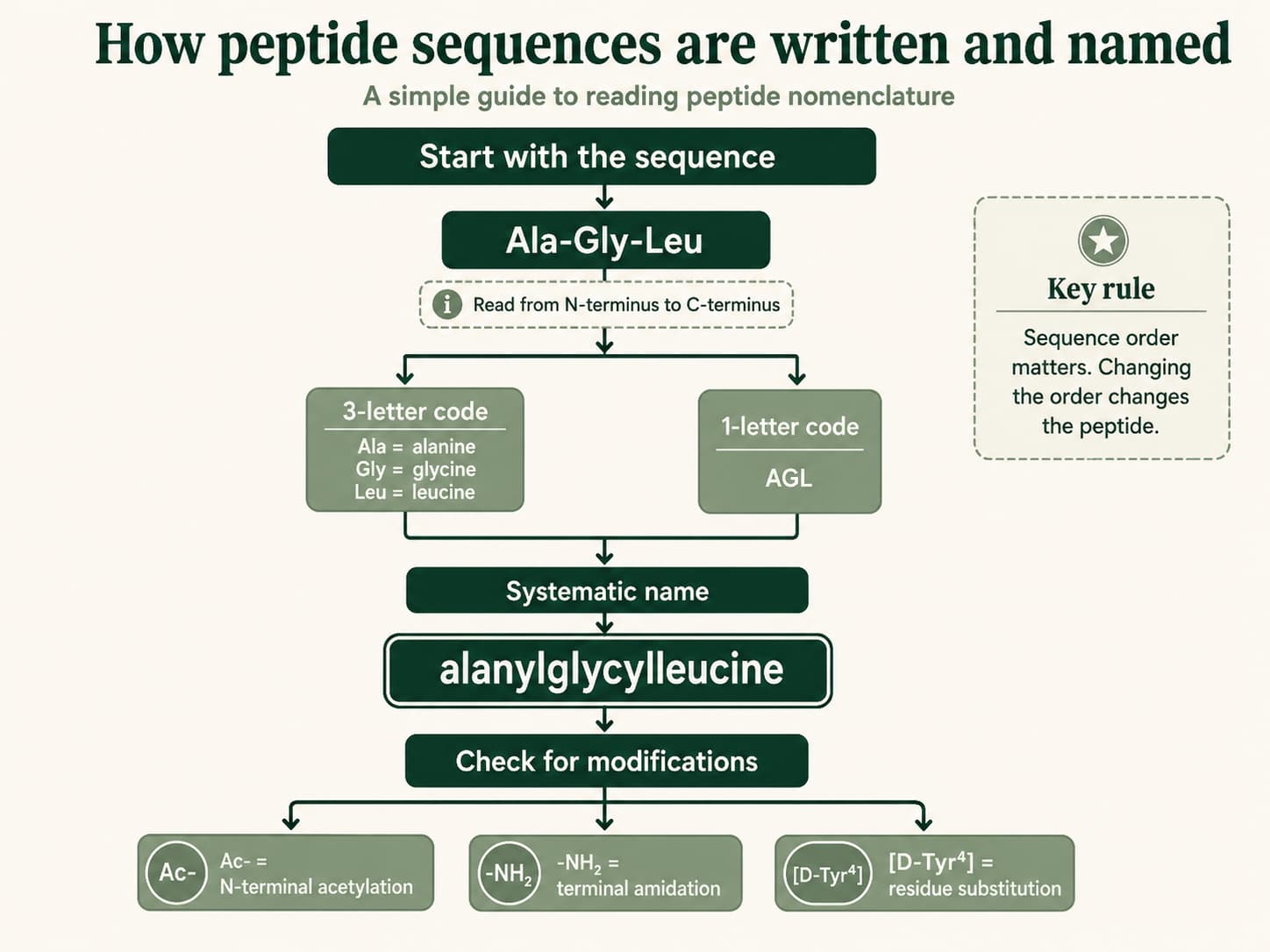
Changing that order changes the peptide.
Ala-Gly-Leu and Leu-Gly-Ala contain the same three amino acid types, but their amino acid sequences are different. Sequence is therefore part of molecular identity, not merely a convenient list of ingredients.
Three-letter and one-letter amino acid codes
Writing full amino acid names quickly becomes cumbersome, so peptide chemistry uses standardized abbreviations.
Alanine is written Ala, glycine Gly, and leucine Leu. The sequence above can therefore be written:
Ala-Gly-Leu
For longer sequence comparisons, scientists often use one-letter codes:
AGL
The IUPAC-IUBMB one-letter system was developed because long sequences become difficult to compare using full or three-letter names. The recommendations specifically describe one-letter notation as useful for sequence alignment, comparison and computer-based analysis.
Most standard amino acids have a unique letter, such as
- A for alanine
- G for Glycine
- And L for Leucine
The system also contains ambiguity codes. B may represent aspartic acid or asparagine, while Z may represent glutamic acid or glutamine in relevant contexts. X can indicate an unknown or other amino acid.
These codes make peptide sequences compact, but they do not remove the need to specify modifications when the chemistry becomes more complicated.
How systematic peptide names are constructed
The same three-residue example also shows how formal peptide names work.
According to IUPAC nomenclature, amino acid residues before the C-terminal residue are written as acyl-group names ending in -yl. The final C-terminal amino acid keeps its amino acid name.
So:
Alanine + glycine + leucine
becomes:
alanylglycylleucine
The order matters here too.
IUPAC gives the simple example of glycine followed by alanine as glycylalanine, while reversing those residues produces alanylglycine.
This is a useful demonstration of why peptide nomenclature is tied so closely to sequence. A name can encode the order of residues rather than simply identifying which amino acids are present.
Structure And Chemical Modifications Change the Classification
A sequence tells you a great deal about a peptide, but it does not always describe the finished molecular structure.
Some peptides are linear, with the chain extending from an N-terminus toward a C-terminus. Others form cyclic or otherwise constrained structures. The NLM classification explicitly recognizes peptide structures that can be linear, branched, or cyclical.
Cyclic structure can arise in different ways. A peptide may form a covalent connection between its ends, while other peptides are constrained through side-chain connections such as disulfide bridges.
These descriptions should not be collapsed into one category. A head-to-tail cyclic peptide and a peptide containing a disulfide-constrained loop may both be conformationally restricted, but their chemical connectivity is different.
Chemical modifications add another layer.
What Ac and NH₂ mean in peptide notation
A research paper or laboratory catalog may show a sequence that looks like this:
Ac-Ala-Gly-Leu-NH₂
The extra symbols carry chemical information.
Ac- can indicate N-terminal acetylation. A terminal -NH₂ indicates an amide rather than a free terminal carboxyl group.
IUPAC nomenclature includes forms such as Ac-Gly for N-acetylglycine, Ser-OMe for a methyl ester, and Glu-NH₂ for an amide derivative.
Researchers may also need to describe a replacement at a specific residue.
IUPAC recommendations use square brackets for modifications to an established named peptide. For example, [D-Tyr⁴] identifies D-tyrosine at residue position 4 in the relevant named sequence. The same framework provides notation for residue replacement, insertion, removal, and sequence reversal.
This is why two peptides with similar names should not automatically be treated as chemically identical. A single substitution, altered stereochemistry, or terminal modification produces a different molecular structure.
For someone reading a research paper, a practical order works well:
Read the sequence first, check its direction, identify residue numbers, then look for brackets, D/L designations, and terminal modifications.
That approach usually reveals more than trying to interpret the peptide's familiar name alone.
Origin, Function and Drug Names Use Different Systems
Peptides can also be classified by how they are made.
Many biological peptides begin with genetically encoded precursor proteins produced through ribosomal translation. The precursor may then be cut and chemically processed before the mature peptide becomes biologically active.
The human OXT gene offers a useful real example. NCBI identifies it as a protein-coding gene that produces a precursor from which oxytocin and neurophysin I are processed. In other words, the familiar peptide name “oxytocin” describes the mature biological product, while its biosynthetic story begins with a larger genetically encoded precursor.
That distinction prevents a common mistake. A mature peptide sequence does not always correspond to the full sequence initially translated by the ribosome.
Non-ribosomal peptides follow another route
Some organisms make peptides without assembling the sequence directly through ribosomal translation.
Non-ribosomal peptide synthetases, usually abbreviated NRPSs, are large enzyme systems that build peptide products through modular biochemical reactions. InterPro describes NRPS condensation domains as components that catalyze peptide-bond formation within these multimodular complexes. Some can work with D-amino-acid-containing intermediates as well as L-amino-acid substrates.
This biosynthetic classification is different from structural classification. A peptide's origin does not automatically tell you whether it is linear, cyclic, or chemically modified.
Functional peptide families describe biology
Scientists also use familiar functional categories such as neuropeptides, peptide hormones, antimicrobial peptides and opioid peptides. NLM's peptide taxonomy includes these and many other biologically defined groups.
These terms answer a different question: what biological system is the peptide associated with?
A functional label therefore does not replace the amino acid sequence. Two members of a biological family may differ in sequence, structure and receptor selectivity.
For the next layer of biology, How Peptide Signalling Works in the Human Body explains how peptide signals interact with receptors and trigger cellular responses.
Drug names are not systematic peptide names
Pharmaceutical naming introduces another system entirely.
A peptide medicine may have a chemical description, an amino acid sequence, an International Nonproprietary Name, or INN, and one or more commercial brand names. These labels should not be used interchangeably.
WHO maintains the INN system and a formal stem system for pharmaceutical substances. The system is actively maintained. In February 2026, WHO published another addendum to its 2024 INN Stem Book, and its 82nd INN Consultation reported 292 requests discussed and 275 new names selected.
A drug-name suffix should therefore not be treated as a substitute for examining peptide chemistry or sequence.
The same principle applies to regulatory status. A scientific name does not tell you whether a product has been approved for a medical use. FDA-Approved Peptides vs Experimental Peptides covers that question separately, while Are All Peptides Safe? Why the Answer Depends on the Compound explains why classification alone cannot establish safety.
The useful rule is simple: identify what naming system you are looking at before concluding the name.
FAQs
How are peptides named?
Systematic peptide names follow the amino acid sequence from the N-terminus toward the C-terminus. Internal and N-terminal residues generally use acyl names ending in -yl, while the C-terminal residue retains its amino acid name. Peptides may also have established biological or pharmaceutical names.
What is peptide classification?
Peptide classification groups molecules according to properties such as residue count, structure, biosynthetic origin, chemical modification or biological function. A single peptide can belong to several classifications at the same time.
What is the difference between an oligopeptide and a polypeptide?
The terminology depends on the reference system. NLM MeSH currently describes oligopeptides as containing roughly 2 to 12 residues and polypeptides as approximately 13 or more. These numbers should not be assumed to be universal across all branches of peptide science.
Why are peptide sequences written from N-terminus to C-terminus?
This is the standard biochemical convention. IUPAC-IUBMB sequence notation places the residue with the free amino group at the left and the residue with the free carboxyl group at the right.
What do one-letter peptide codes mean?
Each letter represents an amino acid residue. For example, A means alanine, G glycine and L leucine, so AGL represents Ala-Gly-Leu. The one-letter system is especially useful when comparing long amino acid sequences.
What is the difference between linear and cyclic peptides?
A linear peptide follows an open chain arrangement. A cyclic peptide contains covalent connectivity that forms a cycle. Other peptides may be conformationally constrained through side-chain links such as disulfide bonds, which should be described according to their actual chemical structure.
Can one peptide belong to more than one class?
Yes. A peptide can be classified simultaneously by its number of residues, sequence, topology, biosynthetic origin, chemical modifications and biological role. These categories describe different properties rather than competing definitions.
Peptide classification becomes much easier once those layers are separated. Start with the amino acid sequence, read it from N-terminus to C-terminus, note any structural or chemical modifications, then ask whether the context is describing biosynthesis, biological function or pharmaceutical naming. That method gives a clearer molecular identity than relying on a familiar peptide name alone.
Related reading
Peptide science
What Are Peptides? A Beginner’s Guide to How They Work
What are peptides? Learn what peptides are, how amino acid chains form peptides, what peptides do in the body, how they differ from proteins, and why their safety depends on the compound.
Peptide science
Peptides vs Proteins: What Is the Difference?
Learn how peptides and proteins differ in amino acid chain length, 3D folding, function, digestion and absorption, with examples including insulin and collagen.
Peptide science
How Peptide Signalling Works in the Human Body
Learn how peptide signalling works in the human body, including receptor binding, GPCRs, second messengers, insulin signalling and cellular responses.