
This article is for general education and research information. It does not provide medical advice or instructions for personal use.
Key takeaways
- Peptides and proteins are both made from amino acids joined by peptide bonds.
- Peptides are usually shorter, while proteins more often depend on stable three-dimensional folding, but there is no universal residue cutoff between them.
- Chain length alone does not predict function. Insulin, for example, sits close to the peptide-protein boundary at 51 amino acid residues.
- Dietary protein digestion and intact therapeutic peptide delivery are different processes, so smaller size does not automatically mean easier absorption.
A tub of whey protein, a jar of collagen peptides, and an insulin pen all contain molecules built from amino acids. That shared chemistry can make the labels sound interchangeable. They are not.
Peptides are generally shorter amino acid chains. Proteins are usually longer and rely more heavily on stable three-dimensional folding. Science does not use one universal residue count that separates every peptide from every protein. Size helps, but structure, molecular mass, function, and scientific context also affect the name.
This distinction matters when someone is comparing a nutritional protein powder with collagen peptides or reading about a therapeutic peptide. The products may begin with the same molecular building units, yet the body handles them differently and they serve different purposes.
For a wider introduction to the category, read What Are Peptides? A Beginner’s Guide to How They Work.
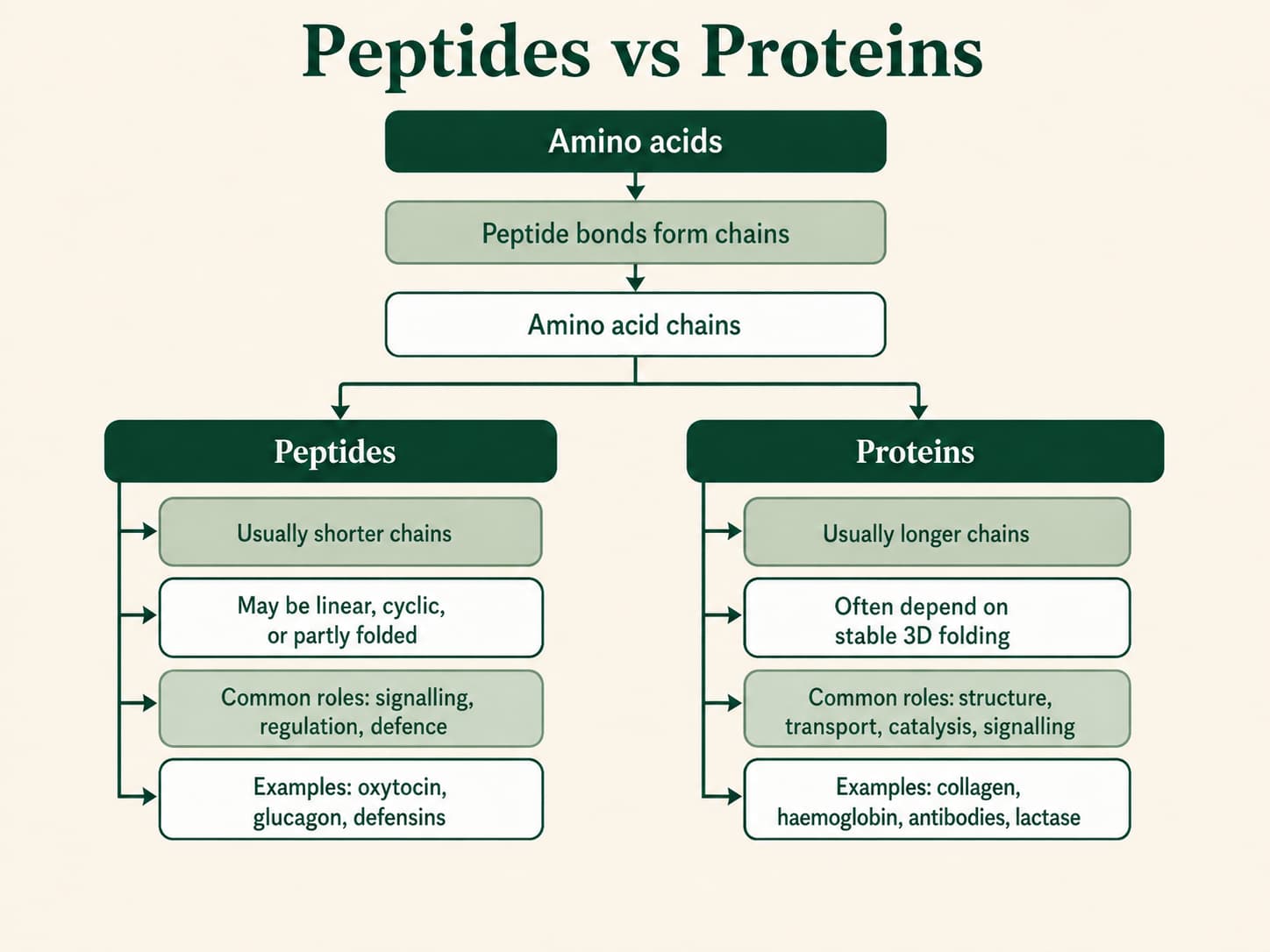
Figure 1. Peptides vs proteins share the same amino acid building blocks and peptide bonds, but peptides are usually shorter chains while proteins are typically longer and more dependent on stable three-dimensional folding.
Same Amino Acids at a Different Molecular Scale
Peptides and proteins are made from amino acids. The NCBI overview of primary protein structure explains that 20 standard amino acids commonly occur in proteins. Each contains an amino group, a carboxyl group, and a variable side chain. That side chain influences properties such as charge, polarity, and chemical reactivity.
When amino acids connect, the carbonyl carbon of one forms a covalent bond with the nitrogen of another. The IUPAC definition of a peptide describes this peptide bond as forming with the formal loss of water. Once an amino acid is part of the chain, it is called an amino acid residue. In a linear chain, the end with an available amino group is the N-terminus, while the other end is the C-terminus.
The residue order is the primary sequence. Changing that order can change how a chain folds, which surfaces it exposes, and what it can bind. Two molecules can contain the same amino acids in different sequences and behave very differently.
The peptide bond itself is not unique to short chains. The same bond continues along a polypeptide and through the chains that make up a protein. The distinction comes from the finished molecule, not from a different type of chemical link.
| Feature | Peptides | Proteins |
|---|---|---|
| Basic material | Amino acid residues | Amino acid residues |
| Main linkage | Peptide bonds | Peptide bonds |
| Typical Chain Lenght | Usually shorter | Usually longer |
| Fixed residue cutoff | No universal cutoff | No universal cutoff |
| Shape | May be flexible, cyclic, or partly folded | Often has stable higher-order folding |
| Common roles | Signalling, regulation, defence, and binding | Catalysis, structure, transport, signalling, and defence |
| Examples | Oxytocin, glucagon, defensins | Collagen, haemoglobin, antibodies, lactase |
These are common tendencies rather than rules that classify every molecule.
Why Length Alone Cannot Settle the Definition
Many introductory explanations place the peptide-to-protein transition near 40 or 50 amino acid residues. That convention gives beginners a useful starting point, but formal definitions do not agree on one exact number.
The current IUPAC Gold Book defines polypeptides as peptides containing ten or more amino acid residues. Its protein definition uses an approximate molecular-mass threshold above 10,000 and states that the boundary is not precise. These definitions use chemistry and molecular mass rather than a strict 50-residue rule.
Insulin shows why the boundary becomes unclear.
Mature human insulin contains 51 amino acids arranged in two chains. The A chain has 21 residues and the B chain has 30. Two disulfide bonds connect the chains, while another disulfide bond forms within the A chain. A 2025 review of insulin products explains that this higher-order structure is necessary for receptor binding and normal insulin activity.
NCBI’s The Cell uses insulin as an example of a protein composed of two polypeptide chains, one containing 21 residues and the other 30. In endocrinology, insulin is also routinely described as a peptide hormone. The molecule has not changed between those descriptions. The scientific context has.
Molecular mass can also vary between chains with the same residue count because amino acids have different masses. Chemical modifications, attached sugar groups, lipid groups, and disulfide bonds can further affect a molecule’s properties.
When the terminology is ambiguous, useful descriptors includes
- Chain Length
- Molecular Mass
- Number of Chains
- Three-dimensional Structure
- Biological Function
- And Established Usage for That Molecule.
The statement that every peptide contains fewer than 50 residues should be treated as a teaching convention, not a fixed biological law.
How Folding Changes Structure and Function
Length becomes more informative when it is considered alongside shape.
Primary structure is the amino acid sequence. Secondary structure includes local patterns such as alpha helices, beta sheets, and turns. Tertiary structure is the complete three-dimensional arrangement of one polypeptide chain. Quaternary structure applies when several folded subunits assemble into one functional complex. Not every protein has quaternary structure.
Hydrogen bonds, hydrophobic interactions, ionic attractions, and disulfide bonds can help stabilise a folded molecule. That shape may form an enzyme’s active site, an antibody’s binding surface, or a transporter’s channel. The IUPAC definition of primary structure separates the amino acid sequence from the molecule’s later spatial arrangement.
Proteins often depend heavily on organised architecture. Lactase needs a correctly shaped active site to break down lactose. Haemoglobin uses four protein subunits to carry oxygen. Collagen uses three polypeptide chains arranged in a triple helix to provide mechanical support in connective tissue.
Peptides can also form defined structures. Oxytocin contains nine residues and a disulfide-linked ring. Insulin has alpha-helical regions despite its limited size. Other peptides form turns, loops, hairpins, or cyclic structures.
Both peptides and proteins can adopt defined shapes. Proteins more often depend on extensive, stable higher-order folding, while many shorter peptides remain comparatively flexible.
Denaturation and digestion are also different processes.
Heat, acid, or solvents can disturb a protein’s higher-order structure without cutting the chain into separate residues. Hydrolysis breaks peptide bonds. A cooked egg protein may lose its native shape, but digestive enzymes still need to cut its polypeptide chains before most of the material can be absorbed.
Function overlaps as well. Peptides may act as hormones, neurochemical messengers, antimicrobial molecules, or local regulators. Proteins may act as enzymes, receptors, antibodies, transporters, structural fibres, or signals.
Insulin acts through the insulin receptor, which is itself a protein. This is one example of how peptide signalling and protein function overlap. Defensins are short peptides involved in innate immune defence, whereas antibodies are large proteins that recognise specific molecular targets.
For a closer explanation of receptor binding, read How Peptide Signalling Works in the Human Body.
What Digestion Means For Peptide and Proteins
The distinction becomes practical when comparing dietary protein, collagen peptides and intact therapeutic peptides.
Dietary proteins are not usually absorbed as intact, folded molecules. In the stomach, hydrochloric acid helps unfold them and activates pepsin. Pepsin begins hydrolysing peptide bonds.
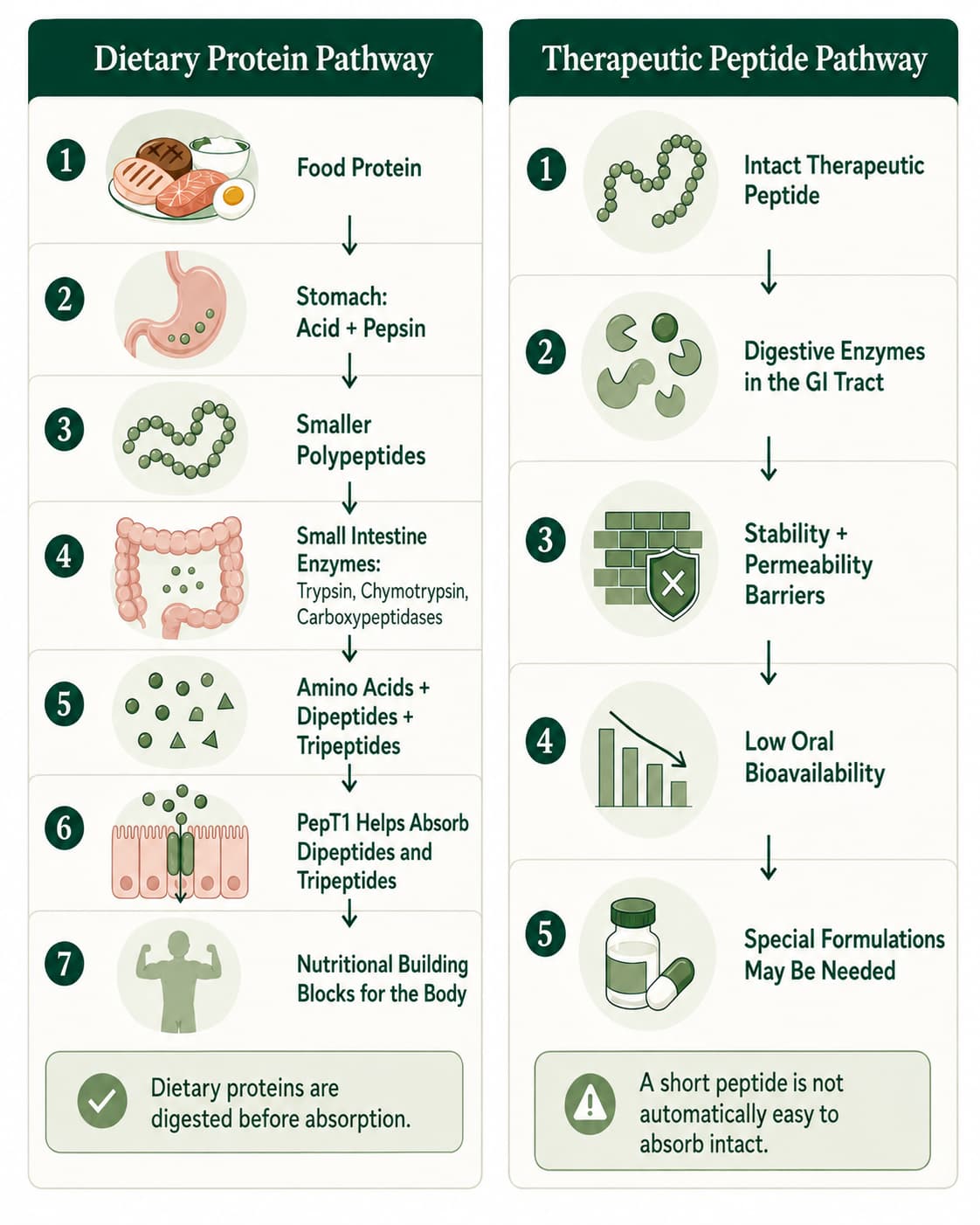
| Figure 2. Dietary proteins are broken down into amino acids and short peptide fragments before absorption, while intact therapeutic peptides face enzymatic and permeability barriers that can limit oral bioavailability. |
|---|
Digestion continues in the small intestine. Pancreatic enzymes such as trypsin, chymotrypsin, and carboxypeptidases produce amino acids, dipeptides, tripeptides, and other fragments. The NCBI overview of nutrient biochemistry describes this sequence from gastric denaturation to small-intestinal digestion.
A human intestinal PepT1 study found that the transporter carries dipeptides and tripeptides, but not free amino acids or peptides containing more than three residues.
This is why the claim that peptides are always absorbed faster than proteins is too broad.
A 2026 review of oral protein and peptide therapeutics identifies 4 Gastrointestinal barriers:
- Hard pH condition
- Enzymatic Degradation
- The Mucus Layer
- And Intestinal epithelial barrier.
These barriers help explain why intact peptide delivery by mouth remains difficult
Absorption means different things in nutrition and pharmaceutical delivery.
Nutrition research may follow a dipeptide into an intestinal cell, where it can be split into amino acids. Pharmaceutical research asks whether a complete therapeutic molecule reaches circulation in an active form. Success in the first setting does not prove success in the second.
Product labels add another layer of difference.
- Protein powder supplies dietary protein in gram quantities. Digestion breaks it into amino acids and short fragments that contribute to nutritional intake. It does not reproduce the receptor-specific action of insulin or another defined peptide medicine.
- Native collagen is a structural protein. Hydrolysed collagen is produced by breaking that large protein into smaller peptide fragments. A 2024 review reports molecular weights of about 285-300 kDa for native collagen and about 3-6 kDa for hydrolysed collagen peptides, while noting that peptide size varies with the hydrolysis process and enzyme used
- A therapeutic peptide has a defined sequence, formulation, route, and biological target. Its research applies to that particular compound and tested use. It cannot replace daily dietary protein, and evidence for one peptide cannot be transferred to collagen powder, a cosmetic ingredient, or an unrelated research product.
When comparing these categories, start with what the label actually describes and what evidence applies to that specific form.
Protein powder is a dietary protein source. Collagen peptides are hydrolysed fragments of collagen. A therapeutic peptide is a pharmacological compound whose evidence depends on its exact sequence, formulation, route and studied use
Similar wording on the label does not place all three products in the same category.
For further comparison, read Natural, Synthetic and Therapeutic Peptides Explained. The regulatory distinction is covered in FDA-Approved Peptides vs Experimental Peptides, while Are All Peptides Safe? Why the Answer Depends on the Compound explains why safety must be assessed compound by compound.
Oral semaglutide shows why small size does not guarantee easy absorption
Oral semaglutide provides a real example of these delivery barriers. The FDA’s 2026 prescribing information states that the oral formulation uses SNAC to facilitate semaglutide absorption and that absorption occurs predominantly in the stomach.
Even with this specialised formulation, estimated absolute bioavailability for the 3 mg, 7 mg and 14 mg Rybelsus tablets is about 0.4% to 1%. The example shows why being smaller than a typical protein does not automatically make an intact peptide easy to deliver through the gastrointestinal tract.
What to Remember About Peptides and Proteins
Peptide and protein are useful molecular labels, but neither term tells you everything about how a molecule behaves. When comparing dietary protein, collagen hydrolysates or therapeutic peptides, look at the exact molecule, structure, route and supporting evidence rather than assuming the category name predicts its function or absorption.
Common Questions About Peptides and Proteins
What is the main difference between a peptide and a protein?
Peptides are generally shorter amino acid chains. Proteins are usually longer and depend more heavily on stable three-dimensional folding. Scientists also consider molecular mass, the number of chains, biological function, and established terminology because no single residue cutoff fits every molecule.
Is a peptide simply a small protein?
That description can help at a beginner level, but it is incomplete. Peptides and proteins share the same amino acid chemistry and occupy an overlapping molecular range. Structured peptides and small proteins sit near the point where common terminology becomes less consistent.
Is insulin a peptide or a protein?
Insulin is usually described as a peptide hormone. It contains 51 residues in two disulfide-linked chains and has a defined three-dimensional structure. Protein-biochemistry sources also use insulin as a classic protein example, so the preferred term depends partly on scientific context.
Is collagen a peptide or a protein?
Native collagen is a protein formed from three polypeptide chains arranged in a triple helix. Collagen peptides are smaller fragments produced through hydrolysis. They contain collagen-derived amino acid sequences but no longer retain the full structure of native collagen.
Are peptides absorbed faster than proteins?
Not as a universal rule. Dietary dipeptides and tripeptides can use PepT1, while intact proteins require more extensive digestion. Larger peptides and peptide medicines may still be degraded by enzymes or cross the intestinal wall poorly.
Can peptides replace protein powder?
No. Protein powder provides dietary protein in gram quantities. Therapeutic peptides act through compound-specific biological targets and are used for different purposes. They do not supply the amount or amino acid profile expected from food protein.
Related reading
Peptide science
What Are Peptides? A Beginner’s Guide to How They Work
What are peptides? Learn what peptides are, how amino acid chains form peptides, what peptides do in the body, how they differ from proteins, and why their safety depends on the compound.
Peptide science
How Peptide Signalling Works in the Human Body
Learn how peptide signalling works in the human body, including receptor binding, GPCRs, second messengers, insulin signalling and cellular responses.
Peptide science
Natural, Synthetic and Therapeutic Peptides Explained
Learn how natural, synthetic and therapeutic peptides differ, how peptides are produced, where the categories overlap, and what peptide type really tells you.