
This article is for general education and research information. It does not provide medical advice or instructions for personal use.
Suggested URL: /natural-synthetic-therapeutic-peptides/
A collagen peptide, insulin produced inside the human body, and a prescription peptide medicine can all be described using the word peptide. Chemically, that shared label makes sense. For someone trying to understand different peptide types, however, it can create confusion.
The simplest way to separate them is to ask three different questions:
Where does the peptide come from? How was it produced? What is it being used for?
Natural and synthetic usually describe origin or production, while therapeutic describes medical development or use. These categories can overlap. A medicine may be based on a peptide that occurs naturally in the body, manufactured in a laboratory, structurally modified, and then developed as a therapeutic drug.
Understanding that distinction makes it easier to interpret peptide research, supplement claims, pharmaceutical terminology, and discussions about experimental compounds.
Key takeaways
- Natural peptides are produced by living organisms or released naturally from larger proteins.
- Synthetic peptides are assembled through controlled chemical manufacturing and may reproduce or modify a naturally occurring sequence.
- Recombinant peptides are produced using engineered biological systems rather than direct chemical assembly.
- Therapeutic peptides are peptides developed for a defined medical purpose.
- Bioactive peptides are peptides capable of producing a biological effect, but biological activity alone does not prove clinical effectiveness.
- Natural, synthetic and therapeutic are overlapping descriptions rather than three completely separate molecular families.
- “Natural” does not automatically mean safe, and “synthetic” does not automatically mean dangerous.
- The exact molecule, sequence, manufacturing quality, formulation, evidence and regulatory status matter more than the category name alone.
What Makes Something a Peptide?
Peptides are molecules made from amino acids joined through peptide bonds. They generally contain shorter amino-acid chains than proteins, although scientists do not use one universal length cutoff in every field.
What matters here is that the term covers a very broad molecular group. Peptides can function as hormones, nervous-system signals, immune molecules, food-derived compounds, laboratory research tools and medicines.
Insulin, glucagon and oxytocin are familiar examples of naturally occurring peptide hormones. Other peptides occur in microorganisms, plants, foods, venoms and many other biological systems.
If you want the molecular foundation before comparing the different categories, read What Are Peptides? A Beginner’s Guide to How They Work.
Peptides can be classified by origin, structure, length, function, receptor target, manufacturing method or medical use. That is why there is no single universal list of peptide types.
For this guide, the most useful distinction is origin, production and purpose.
Natural Peptides Are Produced by Biological Systems
A natural peptide is produced by a living organism or generated naturally when a larger biological molecule is processed.
Human cells continuously produce peptides that participate in communication and regulation throughout the body. Many peptide hormones and neuropeptides begin as larger precursor molecules that cells process into mature, biologically active forms. Research on peptide-hormone biology describes this precursor processing as a normal part of peptide synthesis and secretion.
Natural peptides should not be treated as one functional group simply because they share a biological origin. Their amino-acid sequences and molecular targets can differ substantially.
Endogenous peptide hormones
Endogenous peptides are peptides produced within an organism.
Human examples include insulin, glucagon and oxytocin. These peptides participate in different physiological processes and interact with different molecular targets.
The fact that insulin and glucagon are both peptide hormones does not make them interchangeable. Their sequences, receptors and biological functions differ.
This is an important principle of peptide biology: being a peptide tells you something about molecular structure, but it does not tell you what the molecule does.
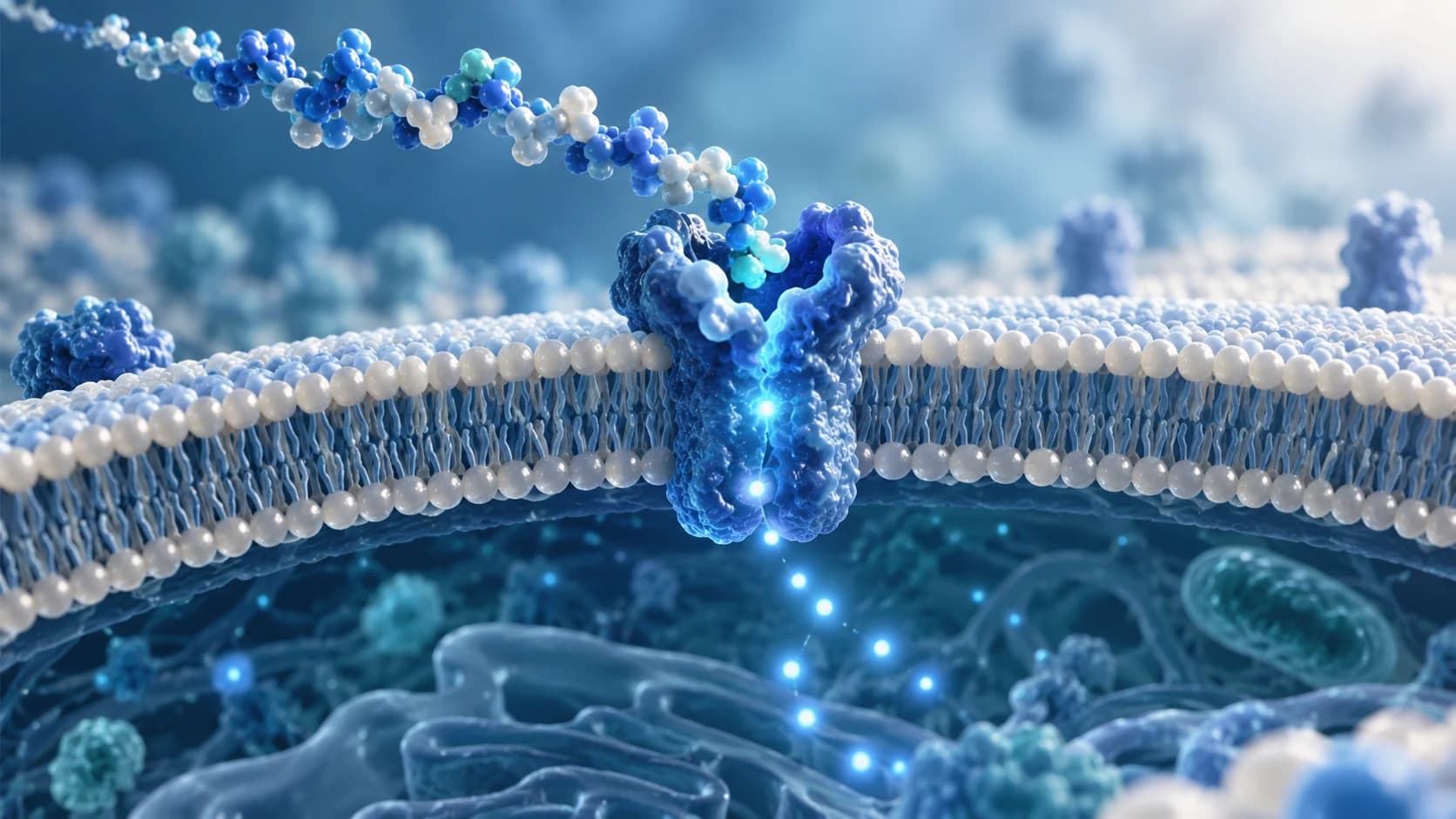
For a deeper explanation of receptor binding and cellular responses, read How Peptide Signalling Works in the Human Body.
Neuropeptides and immune-related peptides
The nervous system also uses numerous peptides as signalling molecules. Examples include endorphins, enkephalins, substance P and neuropeptide Y.
Other naturally occurring peptides contribute to innate immune defence. Defensins are one familiar group.
Again, the peptide label does not imply a shared effect. A neuropeptide involved in nervous-system communication and a peptide involved in microbial defence can have very different structures, receptors and mechanisms.
Food-derived bioactive peptides
Natural peptide biology is not limited to molecules circulating inside the human body.
Proteins in foods can release smaller peptide fragments during digestion, fermentation or enzymatic processing. Researchers may describe some of these as bioactive peptides when they produce measurable biological activity in a particular experimental context.
That term needs careful interpretation.
Activity in a laboratory experiment does not automatically prove that the same peptide survives digestion, is absorbed in sufficient amounts, reaches the relevant tissue and produces a meaningful clinical effect in humans. Bioavailability depends on factors including peptide structure, digestive stability and intestinal transport.
This is one reason dietary peptides should not be treated as nutritional versions of injectable or prescription peptide medicines.
For the structural distinction between amino-acid chains of different sizes, see Peptides vs Proteins: What Is the Difference?.
Synthetic Peptides Are Built Under Controlled Conditions
A synthetic peptide is produced using laboratory chemistry rather than being isolated directly from its original biological source.
Synthetic does not necessarily mean biologically unfamiliar.
Scientists can manufacture a peptide with the same amino-acid sequence as a naturally occurring molecule. They can also alter the sequence or add structural features to change particular molecular properties.
That makes “synthetic” primarily a description of how the peptide was made, not a judgment about whether it is beneficial, harmful or medically useful.
How synthetic peptides are manufactured
One established method is solid-phase peptide synthesis, commonly called SPPS.
In SPPS, the growing peptide chain remains attached to a solid support while amino acids are added step by step. Modern peptide production can also use solution-phase and other chemical synthesis approaches. Recent peptide-synthesis literature continues to describe SPPS as a major method for chemical peptide manufacture.
The European Medicines Agency's current guideline on synthetic peptides, legally effective from June 1, 2026, covers manufacturing and quality issues including solid-phase synthesis, liquid-phase synthesis, fragment condensation, conjugation, stereoisomers, sequence-related impurities, characterization and analytical control.
Producing the amino-acid chain is only part of the process. Peptides intended for pharmaceutical use also require appropriate purification, characterization and control of product quality.
Synthetic and recombinant are not identical terms
Chemical synthesis should also be distinguished from recombinant production.
Synthetic chemistry builds the peptide through chemical reactions. Recombinant manufacturing uses genetically engineered cells or biological systems to produce a desired molecule.
FDA's July 2026 peptide guidance updates distinguish between recombinantly, synthetically and semi-synthetically produced peptide products, showing why those manufacturing descriptions should not be treated as synonyms.
The distinction is useful when comparing peptide products because two molecules may share a similar sequence while being manufactured through different processes.
Why scientists modify peptide sequences
Researchers do not always want to reproduce a natural peptide exactly.
A naturally occurring peptide may be broken down quickly, cleared rapidly from circulation or have other properties that make it difficult to use as a medicine. Peptide-drug research therefore investigates structural changes intended to affect properties such as stability, receptor interaction, solubility or duration of exposure.
Possible approaches include amino-acid substitution, cyclization and attachment of other chemical groups.
The result may still be closely related to a natural peptide while no longer being structurally identical to it.
This distinction becomes important when someone claims that a laboratory-made peptide is “the same as” a naturally occurring hormone. Similar biological targets do not necessarily mean identical structure, pharmacokinetics, formulation or clinical evidence.
Therapeutic Peptides Are Defined By Medical Purpose
A therapeutic peptide is a peptide developed as a drug for a defined medical purpose.
This label answers a different question from natural or synthetic.
Natural or synthetic? This asks about biological origin or manufacturing.
Therapeutic? This asks about development and use as a medicine.
Therapeutic peptide development has often drawn from naturally occurring biology. Scientists can study a natural peptide, reproduce or modify its structure, investigate its pharmacology and develop a pharmaceutical product around it.
FDA's peptide-drug clinical pharmacology guidance addresses areas such as pharmacokinetics, drug interactions, immunogenicity, safety and efficacy during peptide-drug development.
A peptide being biologically active or chemically synthesizable does not by itself make it a therapeutic medicine.
Semaglutide shows how the categories can overlap
Semaglutide provides a useful example.
It is a peptide-based medicine related to the body's GLP-1 signalling system. It is not simply native GLP-1 removed from the body and placed into a pharmaceutical product. Its structure has been developed to provide pharmacological properties suitable for therapeutic use.
The example demonstrates why peptide categories overlap:
- the biological starting point comes from a naturally occurring signalling system;
- the therapeutic molecule is manufactured;
- its structure differs from the native biological peptide;
- and the finished drug is evaluated as a specific pharmaceutical product.
FDA's July 28, 2026 product-specific guidance update includes semaglutide, liraglutide, trizepatide, glucagon, teriparatide and several other peptide drug products.
Evidence for one of those medicines cannot automatically be transferred to a different peptide simply because both belong to the broad peptide category.
For the regulatory distinction, read FDA-Approved Peptides vs Experimental Peptides.
How Natural, Synthetic & Therapeutic Peptide Types Overlap

Figure 1: How peptide types overlap: Natural, synthetic, recombinant, therapeutic, bioactive and investigational labels describe different aspects of a peptide, and one peptide can belong to several categories.
The easiest way to compare these terms is to ask what information each label actually provides.
| Peptide label | What it describes | Example concept | Does the label prove medical approval? |
|---|---|---|---|
| Natural peptide | Biological origin | Oxytocin produced in the body | No |
| Synthetic peptide | Chemical manufacturing | A peptide assembled through SPPS | No |
| Recombinant peptide | Biological manufacturing method | A peptide produced using engineered cells | No |
| Therapeutic peptide | Medical development or use | A peptide developed as a drug | No, not by the term alone |
| Bioactive peptide | Measurable biological activity | Hormonal or food-derived peptide activity | No |
| Investigational peptide | Research or drug-development status | A compound under study | No |
A single peptide can fit more than one row.
Researchers may begin with a natural peptide, manufacture or modify an analogue through synthetic chemistry, and then investigate that molecule as a therapeutic peptide.
This is more accurate than treating natural, synthetic and therapeutic peptides as three unrelated chemical families.
Bioactive Does Not Mean Clinically Proven
The term bioactive peptide appears in nutrition, pharmaceutical research, cosmetics and biochemistry.
It means that a peptide produces measurable biological activity under particular conditions. It does not tell you whether the molecule is natural or synthetic, whether it has been tested adequately in humans, or whether it is an approved medicine.
A peptide can show receptor activity in a cell experiment and still face major obstacles before becoming a practical treatment. Those obstacles can include degradation, limited absorption, unsuitable pharmacokinetics or lack of convincing human evidence.
Laboratory activity, animal-model findings, early human trials and established clinical use therefore represent different levels and types of evidence.
“Bioactive” should never be read as a synonym for “clinically proven.”
Natural Does Not Automatically Mean Safe
Natural and synthetic are descriptive terms, not safety ratings.
A naturally occurring molecule can have strong biological effects. Likewise, a synthetic peptide is not inherently dangerous simply because it was made through laboratory chemistry.
For manufactured peptide products, factors such as identity, sequence, impurities, formulation, stability and production controls can materially affect product quality. The EMA's current synthetic-peptide guideline specifically addresses characterization, impurities and analytical control.
Safety must therefore be assessed at the level of the individual compound and product.
More useful questions include:
- What exact peptide is involved?
- What does it interact with?
- How was it manufactured?
- What dose and formulation were studied?
- What human evidence exists?
- What is its regulatory status?
For a dedicated discussion of peptide risk, read Are All Peptides Safe? Why the Answer Depends on the Compound.
Peptide Types Do Not Determine Biological Activity
Two synthetic peptides can have completely different effects.
Two naturally occurring peptides can also perform unrelated biological roles.
Peptide activity depends strongly on molecular sequence, structure, target interaction and how the molecule is processed in the body. Changing one or more amino acids can affect properties such as receptor interaction or susceptibility to enzymatic breakdown.
Many signalling peptides act by binding to receptors and triggering processes inside target cells. Other peptides may interact with membranes, enzymes or different molecular targets.
That mechanism is separate from whether the molecule was naturally produced or chemically synthesized.
This prevents one of the most common misunderstandings in peptide discussions: treating “peptides” as though they were one drug with one shared list of benefits, effects and risks.
They are not.
Peptide is a broad molecular category. Each compound needs to be evaluated individually.
Five questions to ask when comparing peptide types
Instead of relying on labels such as “natural” or “lab-made,” use these five questions.
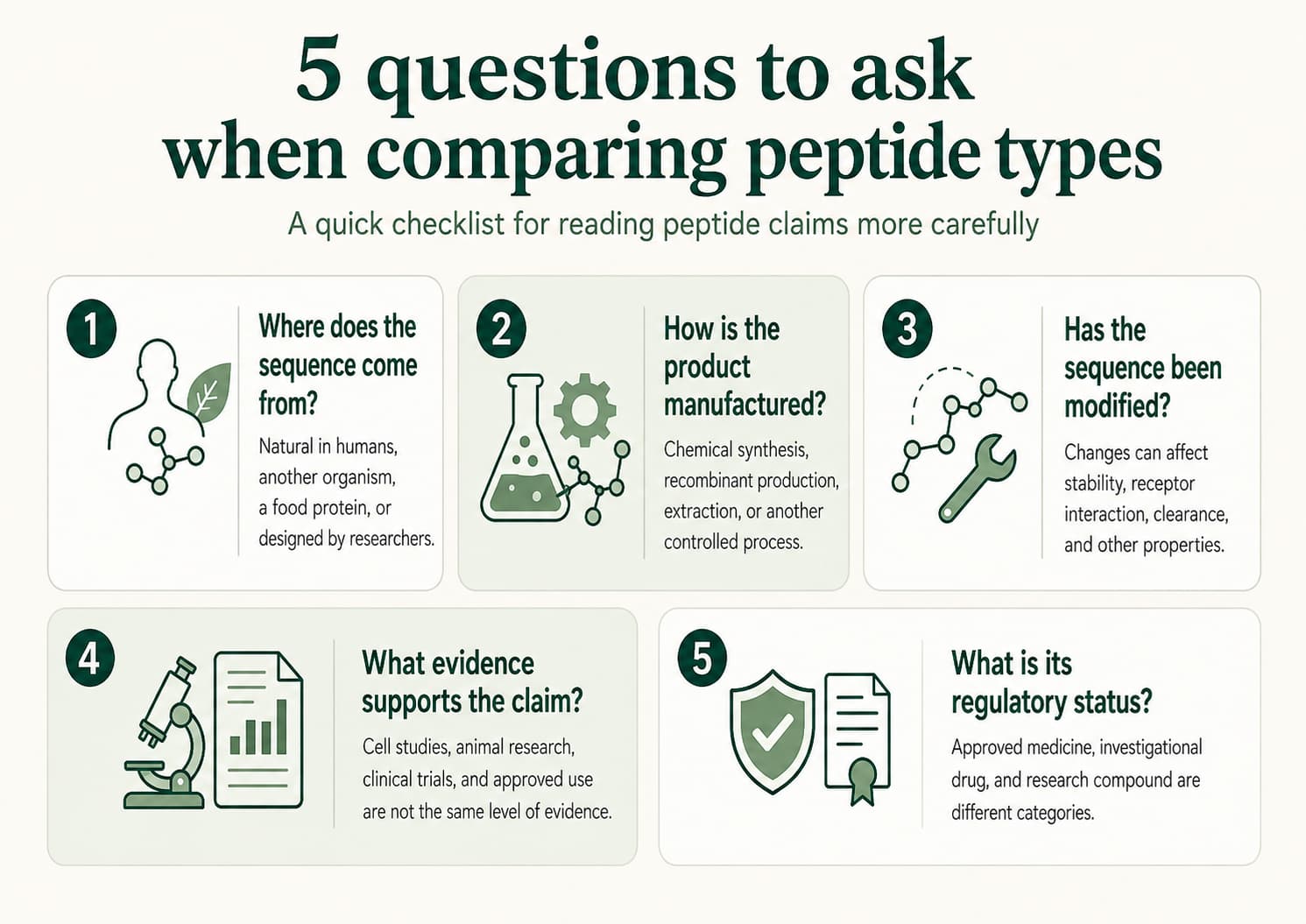
1. Where does the peptide sequence come from?
The original sequence may occur naturally in humans, another organism or a larger food protein. It may also have been designed or substantially modified by researchers.
2. How is the product manufactured?
A peptide may be chemically synthesized, produced through recombinant biotechnology, extracted from a biological source or manufactured through another controlled process.
3. Has the sequence or structure been modified?
A peptide analogue may differ from its natural template. Those changes can alter molecular stability, receptor interaction, clearance or other pharmacological properties.
4. What evidence supports the claim?
Cell experiments, animal studies, early clinical trials and approved medical use should not be treated as equivalent evidence.
A result involving one peptide also cannot automatically be transferred to another peptide with a similar name or target.
5. What is its regulatory status?
An approved peptide medicine, an investigational drug and a research compound represent different categories.
Regulatory status needs to be checked for the specific product and intended use rather than inferred from the word “peptide.”
The Distinction to Remember
Natural, synthetic, and therapeutic are best understood as answers to different questions.
- Natural describes biological origin.
- Synthetic describes chemical manufacturing.
- Therapeutic describes medical development or use.
Those descriptions can overlap.
A naturally occurring peptide can provide the biological template for a laboratory-manufactured analogue. Researchers may modify that analogue to alter its molecular or pharmacological properties. If a specific finished product completes the necessary development and regulatory process, it may become an approved peptide medicine.
That framework makes peptide information much easier to evaluate. Instead of assuming that all peptides behave alike, identify the exact compound first, then examine its sequence, source, manufacturing method, biological target, evidence and regulatory status.
FAQs
What are the main types of peptides?
Peptides can be grouped according to origin, structure, size, biological function, manufacturing method or medical use. Common terms include natural peptides, synthetic peptides, recombinant peptides, bioactive peptides and therapeutic peptides.
What is the difference between natural and synthetic peptides?
Natural peptides are produced by biological systems or released naturally from larger biological molecules. Synthetic peptides are assembled through controlled chemical processes. A synthetic peptide may reproduce a naturally occurring sequence or contain deliberate structural modifications.
Are all therapeutic peptides synthetic?
No. Therapeutic describes medical development or use rather than one manufacturing technique. Peptide medicines may be chemically synthesized, recombinantly produced or manufactured through other validated processes. FDA currently distinguishes among recombinant, synthetic and semi-synthetic peptide drug production.
What are examples of natural peptides?
Examples include insulin, glucagon, oxytocin, endorphins and many other signalling peptides made by biological systems. Natural peptides also occur in plants, microorganisms, animals and food proteins.
What are synthetic peptides used for?
Synthetic peptides are used in laboratory research, analytical applications, biotechnology, diagnostics and drug development. Chemical synthesis allows researchers to reproduce natural sequences or design modified peptide analogues.
Is a bioactive peptide the same as a therapeutic peptide?
No. Bioactive means that a peptide produces measurable biological activity under defined conditions. A therapeutic peptide refers to a peptide developed for a medical purpose. Biological activity alone does not establish clinical effectiveness or regulatory approval.
Are natural peptides safer than synthetic peptides?
Not necessarily. Natural and synthetic describe origin or production, not safety. Safety depends on the individual molecule, exposure, formulation, manufacturing quality, available evidence and intended use.
Are research peptides the same as approved peptide medicines?
No. Research or investigational status should not be treated as equivalent to regulatory approval. An approved medicine is evaluated as a specific product for a defined use, including its manufacturing, formulation and supporting evidence.
Related reading
Peptide science
What Are Peptides? A Beginner’s Guide to How They Work
What are peptides? Learn what peptides are, how amino acid chains form peptides, what peptides do in the body, how they differ from proteins, and why their safety depends on the compound.
Peptide science
Peptides vs Proteins: What Is the Difference?
Learn how peptides and proteins differ in amino acid chain length, 3D folding, function, digestion and absorption, with examples including insulin and collagen.
Peptide science
How Peptide Signalling Works in the Human Body
Learn how peptide signalling works in the human body, including receptor binding, GPCRs, second messengers, insulin signalling and cellular responses.