
This article is for general education and research information. It does not provide medical advice or instructions for personal use.
In a 2026 study, 32 male rats underwent Achilles tendon transection and repair, and those given TB-500 at 60 µg/kg/day for four weeks showed a higher maximum load to failure than controls, a difference that reached statistical significance (p < 0.05). The result is intriguing, but it comes from a small animal experiment, and it raises a practical question:
What is this short peptide doing to cells?
This guide explains what TB-500 is, what is known about its cellular mechanism, where the evidence stops, and how it is regulated today. nih
At a glance
- TB-500 is a synthetic seven-amino-acid fragment of thymosin beta-4 (Tβ4).
- Its best-supported activity is binding actin, the protein that lets cells move and change shape.
- Evidence comes from cell assays and animal models. Most of the broader mechanistic literature uses full-length Tβ4.
- TB-500 is not FDA-approved, and it is prohibited in sport.
What Is TB-500? Structure and How It Differs From Thymosin Beta-4
Tβ4 is a 43-amino-acid protein, about 4,963 Da, present in nearly all human tissues. TB-500 is a synthetic N-acetylated heptapeptide that carries residues 17 through 23 (LKKTETQ) of that parent protein. At roughly 889 Da, it is about one-sixth the size of the original molecule.
| Feature | Thymosin beta-4 | TB-500 |
|---|---|---|
| Origin | Naturally occurring protein | Laboratory-made fragment |
| Length | 43 amino acids | 7 amino acids (Ac-LKKTETQ) |
| Approximate mass | 4,963 Da | 889 Da (free base) |
| Known functions | Actin binding plus separate active regions for survival and anti-inflammatory signaling | Retains the central actin-binding region |
| Human data | Some early-phase work | FDA reports none identified for TB-500 drug products |
The differences matter because the parent protein has several active regions. One region near the amino terminus supports cell survival, while the LKKTETQ stretch is linked to angiogenesis, wound healing, and cell migration. A finding about Tβ4 therefore cannot be assumed to hold for TB-500. Keep that in mind throughout this article, because much of the mechanistic literature was built on the full protein. wiley
Manufacturing also affects research results. TB-500 can be produced by Fmoc solid-phase peptide synthesis. Purification commonly leaves trifluoroacetic acid (TFA) bound to the peptide. Residual TFA can be toxic to cultured cells and skew assay readings, which is why cell-based work usually calls for an acetate form. fda
How TB-500 Works: Actin Binding and Cell Movement
Cells use actin in two forms: free globular monomers (G-actin) and assembled filaments (F-actin). Crawling toward an injury means constantly building and dismantling filaments at the cell's leading edge.
Tβ4 is a major actin-sequestering molecule inside cells, and LKKTET was first identified as its main actin-sequestering site. By holding monomers in reserve, Tβ4 keeps a ready pool of building material available. TB-500 contains this motif, which is why it is described as an actin-binding peptide. wiley
There is a subtlety that most summaries skip. When researchers add the LKKTETQ fragment to endothelial cells from outside, it may not be acting as an intracellular stockroom at all. In migration and vessel-sprouting assays, the actin-binding fragment matched full-length Tβ4 at roughly 50 nM, and adding soluble actin blocked the effect, which led the authors to suggest that actin on the cell surface may act as the receptor. So the same motif may work in two ways, buffering monomers within a cell and engaging actin at the cell surface. Which route dominates for a systemically administered fragment has not been settled. Uspto
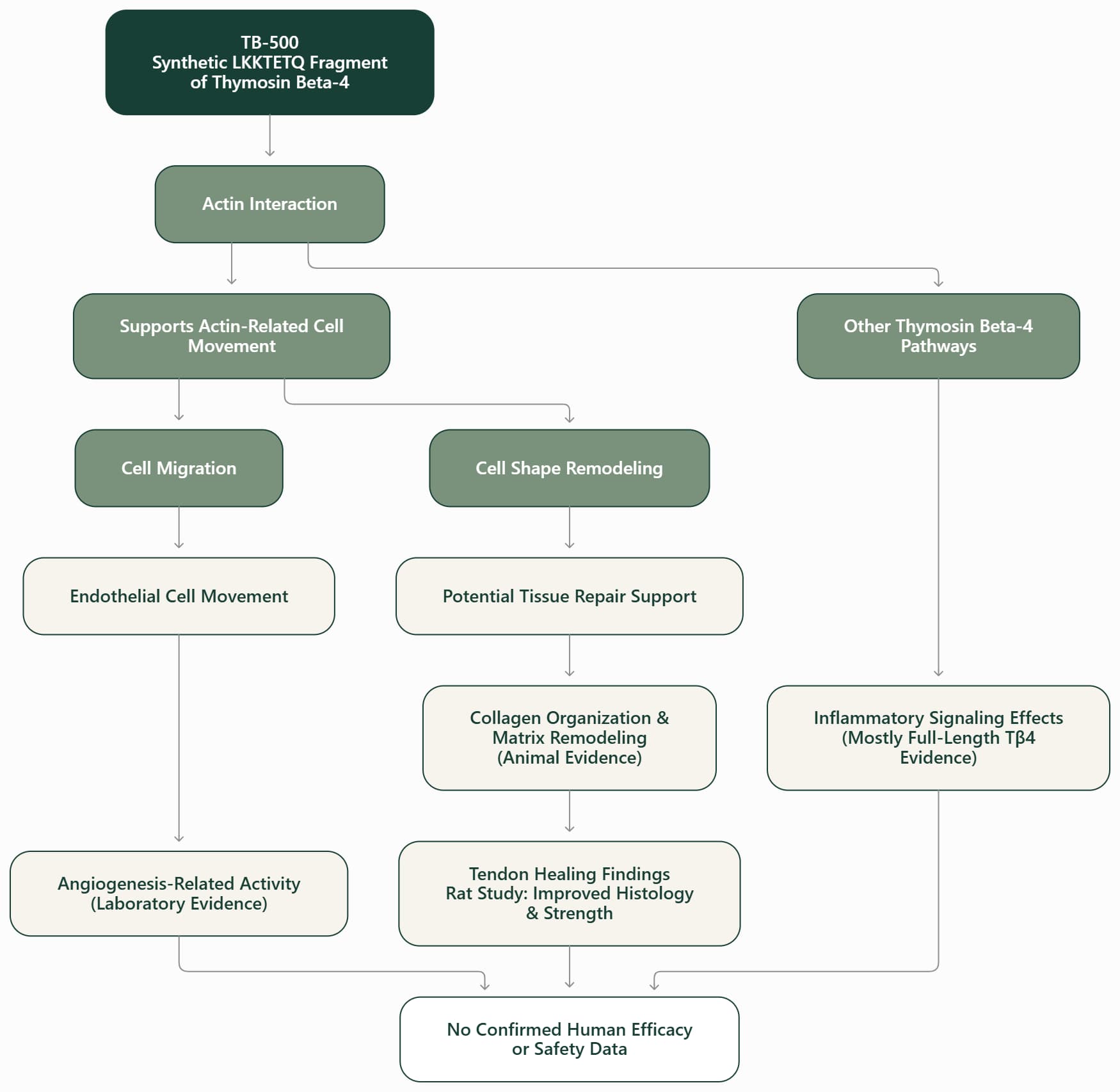
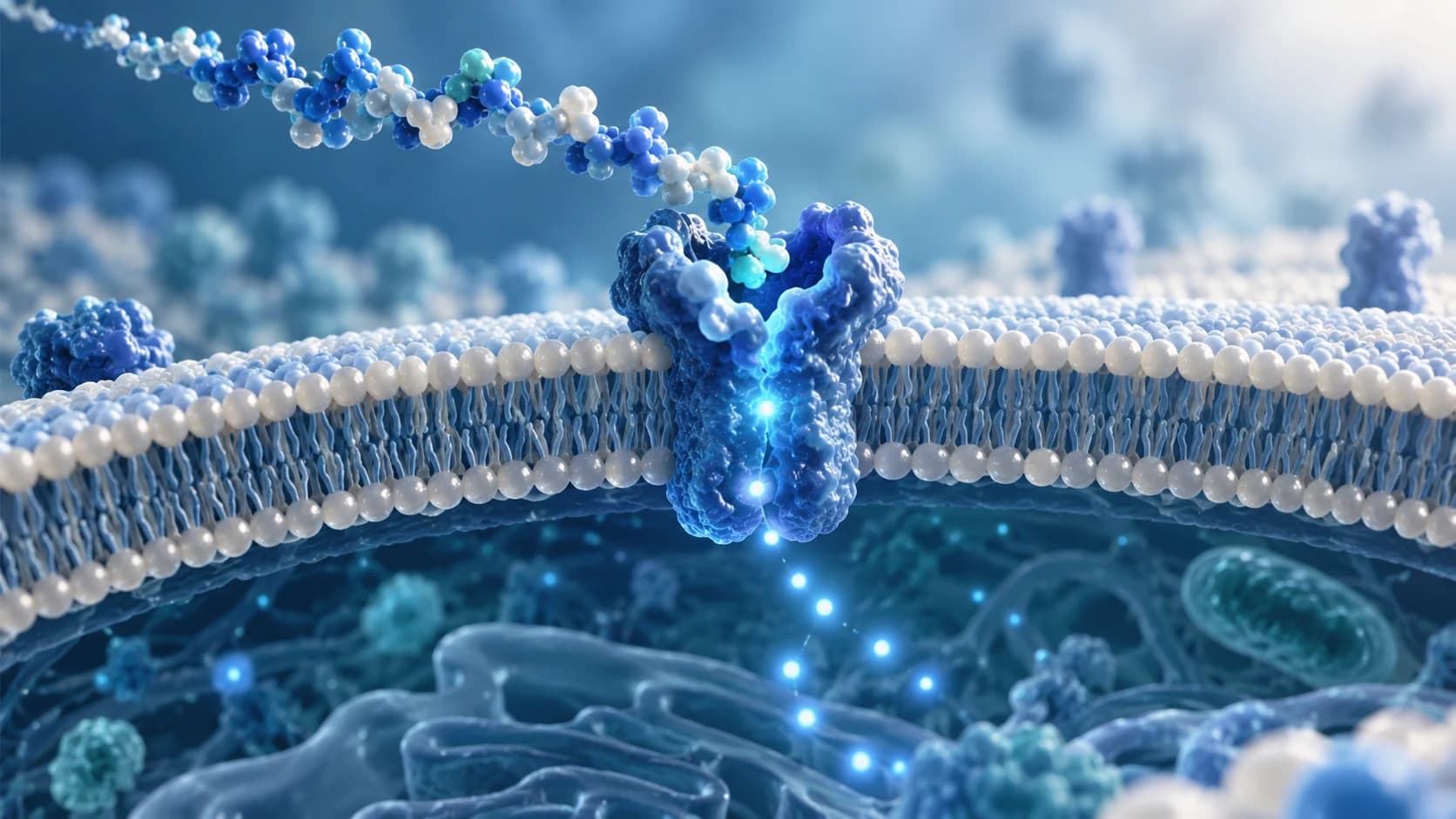
Figure 1: TB-500 mechanism of action explained: See how the thymosin beta-4 fragment may affect actin signaling, cell movement, blood vessel formation, and tendon healing.
Actin binding also cannot explain everything attributed to Tβ4. A review of the vascular literature notes evidence that some Tβ4-driven endothelial migration and angiogenesis occurs independently of actin binding. The anti-inflammatory findings discussed below show the same pattern. ox
TB-500 and Angiogenesis: Endothelial Cell Motility
Poorly perfused tissues such as tendon heal slowly, partly because new capillaries must sprout to deliver oxygen and nutrients. Sprouting requires endothelial cells that can migrate, adhere and form tubes.
Endothelial migration and tube formation have been demonstrated in vitro with LKKTETQ, and sprouting from aortic rings has been shown ex vivo. These are laboratory systems. They show that the fragment can trigger vessel-forming behavior under controlled conditions. They do not show that TB-500 grows new vessels in an injured human tendon. wiley
What Does TB-500 Do in the Body? Preclinical Evidence
Tendon repair: the 2026 rat study
The most direct TB-500 tendon data come from one experiment. Rats were split into control, BPC-157, TB-500 and combined groups of eight, treated intraperitoneally for four weeks, and tendons were then tested for strength and scored under the microscope. Total Bonar scores were significantly lower in the TB-500 group (p = 0.016), as were total Movin scores (p = 0.017), indicating better tendon architecture, collagen alignment and less degeneration. Lower scores on both systems mean healthier-looking tissue. nihnih
Some limits are worth knowing. The strength testing used only four tendons per group. The animals were healthy young rats, and the authors themselves describe the findings as preliminary evidence supporting further investigation. The combination group did not show a clearer benefit than TB-500 alone, so the study gives no support for the popular idea that pairing the two peptides adds up. jointdrs
Collagen organization and matrix remodeling
Repaired tendon is only as good as the collagen laid down. In the TB-500 group, higher collagen type III expression appeared alongside improved Bonar and Movin scores, less accumulated ground substance (GAG) and stronger collagen type I birefringence. Type III collagen is typically an early repair product, and the authors read its elevation as a sign of active remodeling rather than poor healing. Whether the better-organized matrix explains the higher breaking load is a reasonable hypothesis, but this study was not designed to prove it. jointdrs
Skin wounds
Reviews credit the LKKTETQ region with promoting wound healing and cell migration. Most dermal wound work has used the full protein, so treat skin-healing claims for TB-500 specifically as unproven. wiley
Inflammation and Cytokine Signaling
Chronic inflammation stalls repair, and Tβ4 has been studied as a dampening influence. In cell experiments, Tβ4 suppressed TNF-α-induced NF-κB activation and IL-8 expression, and a mutant with no actin-binding ability still did so. That finding is important for anyone summarizing TB-500's mechanism. The anti-inflammatory effect appears to come from a different part of the protein or a different pathway, so it should not be credited to the actin-binding fragment without direct evidence. nih
Tβ4 is not uniformly calming, either. Tβ4 and derived peptides triggered mediator release from mast cells in a concentration-dependent way, and the LKKTET motif was suggested as a possible contributor. The picture is still incomplete. sciencedirect
Safety Questions That Remain Open
No human safety data. FDA has stated that it has not identified human exposure data for drug products containing TB-500. The rodent findings say little about dose, duration or adverse effects in people. peptidedosingprotocols
Theoretical cancer concern. A pro-migratory, pro-vessel peptide invites a question about tumors. Increased Tβ4 expression has been reported in several cancers and linked to metastasis in colorectal, renal and lung tumors, and experimental overexpression enhanced tumor growth and spread in mouse models. A review of this literature points out that experiments giving β-thymosin peptides to already established tumors are needed. The picture is not one-directional, because Tβ4 expression was lower in myeloma cells than in normal plasma cells. Overexpression inside tumor cells is also not the same as an injected peptide. The point is that the question is open and has not been answered by human studies. Full article: β-Thymosins in Cancer: Implications for The Clinic +2
Product quality. FDA's review noted that no certificate of analysis was submitted for TB-500 free base, and that assay, impurities, endotoxins and aggregates are not tested or controlled. Products sold online under "research use only" labels come with no such assurance. fda
Regulatory Status as of September 2026
FDA. TB-500 is not an approved drug for any indication. The compounding picture has shifted quickly this year. It was removed from the FDA 503A Category 2 list in April 2026 after the original nominations were withdrawn, which is not the same as approval. Then on July 23, 2026 the Pharmacy Compounding Advisory Committee voted 8 to 6, with one abstention, to recommend TB-500 free base and acetate for the 503A Bulks List. The panel's votes overrode FDA scientists, who had recommended against including any of the seven peptides reviewed. The vote is advisory only. FDA must still take further action, including formal rulemaking, before any recommended substance can be added to the list. Because this area is moving, check FDA's current notices before relying on any summary, including this one. TB-500 Research Guide 2026: Thymosin Beta-4 Fragment +3
Outside the US. FDA's briefing document reports that TB-500 is not recognized in the European or Japanese pharmacopeias, and that no approved TB-500 products were found in Canada, Australia, the UK, or several EU countries. fda
Anti-doping. The WADA Prohibited List names "Thymosin-β4 and its derivatives e.g. TB-500" under S2.3, growth factors and growth factor modulators. The S2 category is prohibited at all times, in and out of competition. drugs
FAQs
Can TB-500 and thymosin beta-4 be used interchangeably in research? No. Sellers sometimes label them as the same thing, but the fragment lacks the regions responsible for several Tβ4 activities, so results do not transfer automatically.
Why do TFA and acetate forms matter? TFA left over from purification can harm cultured cells and produce false toxicity or distorted results. Acetate is the preferred counter-ion for bioassays.
Is a positive FDA advisory vote the same as approval? No. It recommends a bulk substance for a compounding list, which is a different pathway from drug approval, and FDA has not yet completed the rulemaking that would put TB-500 on that list.
Does the tendon study prove TB-500 heals injuries in people? No. It is one experiment in healthy young rats with small biomechanical groups, and its authors call the results preliminary.
Where should a researcher look for reliable data? Start with the primary papers listed below and FDA's public briefing documents rather than vendor pages.
Key Takeaways
TB-500 is an actin-binding fragment of thymosin beta-4 with documented effects on cell migration and vessel formation in laboratory assays, and one small rat study linking it to stronger, better-organized repaired tendon. Its actin mechanism has more than one possible route, and some effects attributed to the parent protein, such as NF-κB suppression, do not depend on actin binding. There are no human efficacy or safety data, product quality is uncontrolled outside regulated channels, and it is prohibited in sport.
This article is for educational purposes only and does not constitute medical advice. It does not recommend or endorse the use of TB-500.
References
- Biçer O, Adanir O, Güleryüz Y, et al. Effects of BPC-157 and TB-500 on Achilles tendon healing in rats: a histopathological and biomechanical study. Jt Dis Relat Surg. 2026;37(3):822-837. doi:10.52312/jdrs.2026.2951
- Philp D, Huff T, Gho YS, Hannappel E, Kleinman HK. The actin binding site on thymosin β4 promotes angiogenesis. FASEB J. 2003;17(14):2103-2105.
- Sosne G, Qiu P, Goldstein AL, Wheater M. Biological activities of thymosin β4 defined by active sites in short peptide sequences. FASEB J. 2010.
- Qiu P, Wheater MK, Qiu Y, Sosne G. Thymosin β4 inhibits TNF-α-induced NF-κB activation, IL-8 expression, and the sensitizing effects by its partners PINCH-1 and ILK. FASEB J. 2011.
- FDA Pharmacy Compounding Advisory Committee briefing document on TB-500 (fda.gov/media/193349/download).
- WADA. 2026 Prohibited List, section S2.3.
- Cha HJ, et al. and related work summarized in: β-Thymosins in cancer: implications for the clinic. Future Oncol. 2009.
Related reading
Peptide science
What Are Peptides? A Beginner’s Guide to How They Work
What are peptides? Learn what peptides are, how amino acid chains form peptides, what peptides do in the body, how they differ from proteins, and why their safety depends on the compound.
Peptide science
Peptides vs Proteins: What Is the Difference?
Learn how peptides and proteins differ in amino acid chain length, 3D folding, function, digestion and absorption, with examples including insulin and collagen.
Peptide science
How Peptide Signalling Works in the Human Body
Learn how peptide signalling works in the human body, including receptor binding, GPCRs, second messengers, insulin signalling and cellular responses.