
This article is for general education and research information. It does not provide medical advice or instructions for personal use.
TB-500 shows up constantly in fitness forums, biohacking groups, and recovery clinics, usually described as a shortcut to faster healing. The reality is more complicated. TB-500 is a synthetic seven-amino-acid peptide built from a small piece of a much larger natural protein called thymosin beta-4. Scientists have studied that larger protein for decades in cell cultures, animals, and a handful of human eye-disease trials.
TB-500 itself, the small fragment sold online, has a thinner and more contested evidence base. One of the more important 2024 laboratory papers on TB-500 found that the fragment did not trigger wound healing in a cell assay, while a breakdown product of TB-500 did. That finding rarely makes it into marketing copy.
This guide covers what TB-500 actually is, how it is proposed to work, what the research does and does not show, and where the regulatory and safety lines currently sit. The goal is not to tell you TB-500 works or doesn't work, but to give you an accurate, sourced picture so you can evaluate the claims yourself.
What is TB-500?
TB-500 (Ac-Leu-Lys-Lys-Thr-Glu-Thr-Gln-OH, commonly written Ac-LKKTETQ) is a synthetic heptapeptide corresponding to amino acids 17 through 23 of thymosin beta-4, with an acetyl group added to the front of the sequence. Its registered identity is CAS number 885340-08-9, PubChem CID 62707662, with molecular formula C38H68N10O14 and a molecular weight of about 889 grams per mole.
Thymosin beta-4 itself is a naturally occurring, 43-amino-acid protein found inside most cells in the body, including platelets and white blood cells, where it plays a role in regulating the cell's internal skeleton. It weighs roughly 4,900 to 4,960 daltons depending on the source, several times larger than TB-500. This size difference is not a technicality. TB-500 was designed to reproduce a specific active region of thymosin beta-4, not the whole molecule, and the acetyl group added during synthesis changes its charge and shape. Because of that, research on full thymosin beta-4 cannot automatically be assumed to apply to the smaller TB-500 fragment, even though the two names get used interchangeably online.
A 2026 FDA briefing document prepared for the agency's Pharmacy Compounding Advisory Committee made a related point: TB-500 is a common name, not a formal chemical designation, and different suppliers have used it for slightly different substances, including a free-base form and an acetate salt form. That naming inconsistency is one of the reasons the FDA gave for its cautious stance, covered later in this guide.
How Does TB-500 Work?
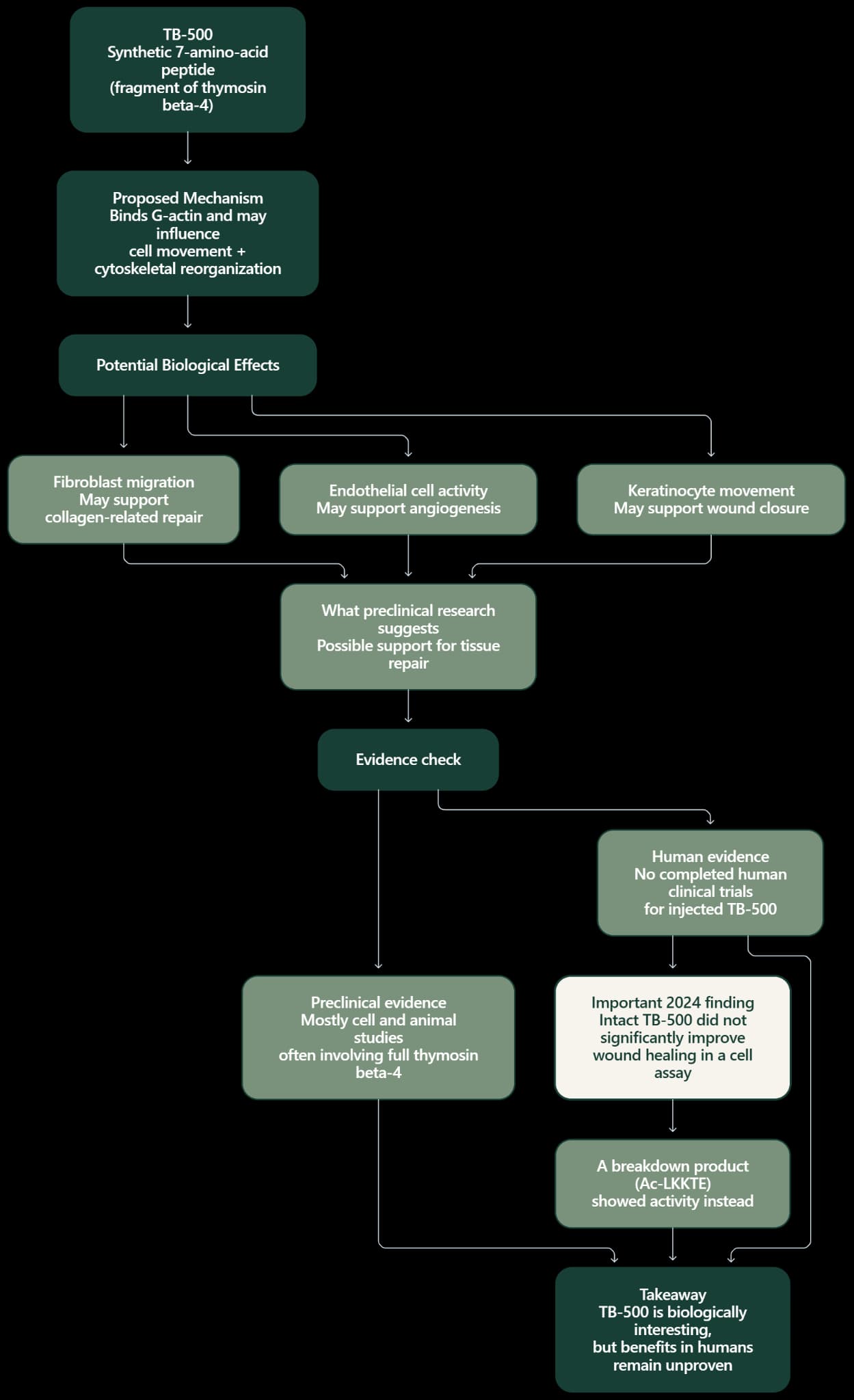
The proposed mechanism centers on a six-amino-acid core within the TB-500 sequence, LKKTET, which binds to a form of the protein actin called G-actin (globular, unassembled actin). Actin is one of the main structural proteins that gives cells their shape and lets them move. In its free form, G-actin can be assembled into long actin filaments (F-actin), which cells use like an internal scaffolding to crawl, contract, and change shape.
By binding loose G-actin, TB-500 is proposed to regulate how quickly and where new actin filaments form. In cell and tissue models, this kind of actin regulation has been linked to the movement of repair cells, including fibroblasts (which lay down new collagen), endothelial cells (which form blood vessel linings), and keratinocytes (skin cells involved in closing wounds).
It's worth being precise about what has and has not been shown. The actin-binding activity of the LKKTET sequence is reasonably well documented in thymosin beta-4 biology. Less settled is whether the isolated TB-500 fragment, on its own, reliably drives the downstream repair effects often attributed to it. As covered under Current Scientific Evidence below, a detailed 2024 laboratory study raised real doubts on that specific point.
What Is It Used For?
TB-500 is discussed in research and online communities in connection with several areas, though none of these represent an FDA-approved use:
- Soft-tissue and skeletal muscle repair
- Tendon, ligament, and other connective-tissue recovery
- Dermal wound healing and scar tissue modulation
- Formation of new blood vessels (angiogenesis) and endothelial cell migration
TB-500 is also frequently mentioned alongside another peptide, BPC-157, in what online communities call a "stack." The rationale is that BPC-157 acts mainly locally, including activating VEGFR2 signaling at an injury site, while TB-500 acts more broadly through its influence on actin and cell migration. That is a reasonable hypothesis, but it has not been tested in a controlled human trial of the combination. Some vendor sites cite specific human "responder rates" for this pairing; those figures could not be verified against any peer-reviewed source.
Potential Benefits According to Current Research
Based on preclinical (cell-based and animal) research into thymosin beta-4 biology, and to a lesser extent TB-500 specifically, several potential effects have been proposed:
- Soft-tissue recovery support. Animal studies of thymosin beta-4 report improvements in structural recovery of muscle, tendon, and dermal tissue after injury.
- Angiogenesis. Thymosin beta-4 has been shown in laboratory and animal models to support growth of new capillary networks, which could theoretically help deliver oxygen and nutrients to damaged tissue.
- Reduced inflammatory signaling. Some studies describe a dampening effect on inflammatory pathways, including interactions with proteins that would otherwise activate NF-kB signaling.
- Extracellular matrix support. Actin reorganization and fibroblast activity are linked to collagen deposition, part of the later stages of wound healing.
These are genuine, published lines of research. What they are not is proof that injecting TB-500 produces these effects reliably in humans. Nearly all of this evidence comes from cell cultures, rodents, or other animal models, and much of it concerns the full protein rather than the isolated fragment. Treat "potential benefit" as exactly that: a plausible, researched hypothesis, not a confirmed outcome.
Mechanism of Action
At a cellular level, the proposed sequence works like this: TB-500 binds free G-actin monomers, holding a reserve pool of building blocks. When a cell needs to reorganize its internal skeleton, such as during migration toward a wound, this reserve can be drawn on to assemble new actin filaments quickly. That reorganization is what allows fibroblasts to migrate into a wound bed and endothelial cells to form the early tubule structures of new blood vessels.
The more interesting piece of the mechanism story comes from a 2024 study in the Journal of Chromatography B by Rahaman and colleagues. The researchers tracked how TB-500 breaks down in rat models and in human serum, liver, and kidney enzyme systems, then tested the wound-closure activity of TB-500 and its individual breakdown products in a cell-based scratch assay. Their finding: intact TB-500 did not produce a statistically significant improvement in wound closure. A specific breakdown product, Ac-LKKTE, did. The authors concluded that wound-healing activity previously attributed to TB-500 in the literature may actually come from this metabolite rather than TB-500 itself.
That is a meaningful distinction for anyone evaluating TB-500 claims. If accurate, it suggests TB-500 might function as a precursor that needs to be converted into something else inside the body before becoming biologically active, rather than acting directly. This remains an open research question, not a settled one, but it is exactly the kind of finding a cautious overview of TB-500 needs to include rather than skip over.
Current Scientific Evidence
The evidence base for TB-500 breaks into two very different categories, and keeping them separate matters.
Preclinical evidence. Cell culture and animal studies, mostly involving full-length thymosin beta-4 rather than the TB-500 fragment, describe effects on wound closure, tissue structural recovery, and blood vessel formation in rodents and other animals. This body of work is genuine and has been published in peer-reviewed journals for more than two decades.
Human clinical evidence. Here the picture changes substantially. TB-500, the seven-amino-acid fragment, has no completed human clinical trials establishing safety or effectiveness for any condition. This was confirmed directly in the FDA's own July 2026 briefing document for its Pharmacy Compounding Advisory Committee, which noted that the nominator supporting TB-500's inclusion on the FDA's compounding list had not provided human clinical evidence, only preclinical references concerning thymosin beta-4.
There is human data, but it concerns a different, related product: RGN-259, a topical eye-drop formulation of full-length thymosin beta-4 developed by RegeneRx Biopharmaceuticals and its joint venture ReGenTree. In a randomized, placebo-controlled, double-masked Phase III trial published in the International Journal of Molecular Sciences, for a condition called neurotrophic keratopathy, complete corneal healing at four weeks occurred in 6 of 10 patients treated with RGN-259, compared with 1 of 8 patients on placebo. Earlier Phase II work also reported improved dry eye signs and symptoms with the same active ingredient. These are real, published human results, but they apply to a topical eye formulation of the full 43-amino-acid protein. They do not establish that an injected TB-500 fragment produces comparable effects on muscle, tendon, or skin elsewhere in the body.
Regulatory review. At its July 23 to 24, 2026 meeting, the FDA's Pharmacy Compounding Advisory Committee reviewed TB-500 among several peptides considered for the 503A Bulks List, which governs which substances licensed compounding pharmacies may legally use. The FDA's briefing document recommended against including TB-500, citing that the substance was not well-characterized (partly due to the naming inconsistencies mentioned earlier), that no human effectiveness data existed, that an in vitro study had found TB-500 did not induce wound healing in fibroblast culture (likely the Rahaman findings above), and that the injectable route raised unresolved immunogenicity concerns. TB-500 is not an FDA-approved drug for any use, and it has not been added to the 503A Bulks List, meaning licensed compounding pharmacies are not authorized to prepare it.
Common Side Effects Reported in Studies
Because TB-500 has no completed human trials, there is no formal, controlled safety dataset describing its side effects in people. Two weaker, separate sources of information exist instead.
Anecdotal reports. People who use TB-500 outside any clinical trial setting commonly describe mild injection-site reactions such as redness or irritation, temporary fatigue, or brief lightheadedness after injection. These reports are not collected through a formal adverse-event system, so their frequency and reliability cannot be confirmed.
Clinical trial data on related formulations. In the Phase III neurotrophic keratopathy trial described above, no significant adverse effects were observed with topical RGN-259. That is a reassuring data point about full-length thymosin beta-4 delivered to the eye, but it says little about injecting the smaller TB-500 fragment under the skin.
Theoretical concerns. Because TB-500's proposed mechanism involves supporting angiogenesis and cell migration, both researchers and the FDA have flagged a theoretical concern: these same processes are involved in how tumors build their own blood supply. This does not mean TB-500 has been shown to cause cancer; it has not been studied long enough in humans either way. It means the underlying biology gives a specific reason for caution in anyone with a current or recent cancer history, discussed further below.
Dosage Used in Research Studies
An important caveat up front: there is no FDA-approved or clinically validated dosing protocol for TB-500 in humans, because no completed human trial has established one. Anything describing a specific human dosage for TB-500 is, by definition, not derived from controlled clinical research.
In animal studies, doses vary by species, delivery route, and research goal, and are not directly translatable to a human "equivalent" dose the way some online calculators suggest. Doping-detection research in horses, for instance, has focused on how quickly TB-500 and its metabolites clear from plasma and urine after subcutaneous injection, rather than on establishing a therapeutic dose.
Online communities frequently describe self-administered dosing patterns, sometimes organized into "loading" and "maintenance" phases. Because these come from user reports and vendor material rather than published clinical protocols, we cannot confirm their safety, effectiveness, or accuracy, and we won't repeat specific numbers here as though they were validated guidance. A decision about dosing a research compound belongs in a conversation with a licensed physician, not a forum thread.
How Is It Administered?
TB-500 is typically sold as a freeze-dried (lyophilized) powder that must be reconstituted with a sterile liquid, commonly bacteriostatic water, before use. It is generally administered by subcutaneous injection, into the fatty layer just beneath the skin, with injection sites rotated to reduce local irritation.
General peptide-handling guidance from suppliers typically recommends keeping unreconstituted powder frozen or refrigerated and away from light, and keeping any reconstituted solution refrigerated, using it within a limited window often cited as around 30 days. These recommendations mostly reflect general peptide stability practice rather than studies measuring TB-500's stability specifically, so treat exact shelf-life numbers as general guidance rather than settled fact.
None of this describes an approved medical procedure. TB-500 is not a prescribed medication with FDA-reviewed instructions for use.
Who Should Avoid It?
Several groups have a clear, identifiable reason to avoid TB-500, based on either its proposed mechanism or its regulatory status:
- Anyone with a current or recent history of cancer. The pro-angiogenic mechanism proposed for TB-500 raises a theoretical concern about supporting tumor blood supply.
- Pregnant or breastfeeding individuals. No developmental or reproductive safety data exist for TB-500 in humans or animals.
- Competitive athletes. TB-500 and other thymosin beta-4 derivatives are prohibited at all times, in and out of competition, under the World Anti-Doping Agency's S2 category covering peptide hormones and growth factors. This category has named thymosin beta-4 and TB-500 specifically since 2018, and a positive test can bring multi-year sanctions.
- Anyone with proliferative retinopathy (abnormal blood vessel growth in the eye). A compound proposed to promote new vessel formation is a poor fit for a condition already defined by excessive vessel growth.
- Anyone hoping to substitute it for evaluated medical care. Because TB-500 lacks completed human trials, it should not replace a diagnosed and properly managed treatment plan for an injury or condition.
Safety Considerations
Sourcing and purity. TB-500 is sold by research-chemical suppliers, not licensed pharmacies, and quality varies widely between vendors. Independent, third-party testing, ideally including HPLC purity analysis and mass spectrometry confirmation of identity, plus a Certificate of Analysis showing the product is free of bacterial endotoxins and heavy metals, is the only realistic way to have any confidence in what is actually in a given vial.
Immunogenicity. The FDA's 2026 briefing document specifically flagged immunogenicity as a concern for TB-500's injectable route, noting that impure or aggregated peptide preparations can trigger unwanted immune reactions. This is a general risk with unregulated, self-injected peptide products, not unique to TB-500, but it is a real one.
Baseline monitoring. People who choose to use unapproved research peptides sometimes arrange baseline blood work beforehand, commonly a complete blood count with differential, a metabolic panel, high-sensitivity CRP, and fasting glucose and IGF-1. This kind of monitoring cannot make an unapproved compound safe, but it can help a physician catch an adverse trend early.
Regulatory uncertainty. Because TB-500 sits outside the FDA-approved drug pathway, is not currently on the 503A Bulks List, and is prohibited under WADA rules for athletes, its legal standing depends heavily on how and by whom it is used. Regulatory reviews of peptides like TB-500 continue to move through FDA advisory processes, and the status described here reflects information available as of 2026.
FAQs
Is TB-500 the same as thymosin beta-4?
No. Thymosin beta-4 is the full, naturally occurring 43-amino-acid protein. TB-500 is a synthetic seven-amino-acid fragment of that protein, with an added acetyl group. Because of that structural difference, research on one cannot be assumed to apply directly to the other.
Is TB-500 FDA-approved?
No. In July 2026, the FDA's Pharmacy Compounding Advisory Committee reviewed TB-500 for possible inclusion on the 503A Bulks List and recommended against adding it, citing insufficient characterization and a lack of human effectiveness data.
Does TB-500 actually work in the body, or is that still unproven?
Genuinely unproven for TB-500 specifically. A 2024 laboratory study found that TB-500 itself did not produce a significant wound-healing effect in a cell-based assay, while one of its breakdown products did. That does not settle the question, but it shows why TB-500 and thymosin beta-4 research should not be treated as interchangeable.
Can BPC-157 and TB-500 be combined?
They are frequently discussed together online, based on the idea that BPC-157 acts more locally and TB-500 acts more systemically. No published, controlled human trial has tested this combination, and human "success rate" figures circulating on some vendor sites could not be verified against any peer-reviewed source.
Is TB-500 legal?
It depends on context. It is not an FDA-approved drug and is not on the FDA's 503A compounding list. It is explicitly banned for athletes under WADA rules at all times. Regulations keep changing, so check current status rather than relying on older information.
Key Takeaways
- TB-500 is a synthetic seven-amino-acid fragment (Ac-LKKTETQ) of thymosin beta-4, not the same molecule as the full protein.
- Its proposed mechanism involves binding G-actin to regulate cell movement and cytoskeletal reorganization, potentially supporting repair-cell migration during wound healing.
- A 2024 laboratory study raised real doubts about whether TB-500 itself, versus one of its metabolites, drives the wound-healing effects often attributed to it.
- Human clinical evidence exists for a related, topical thymosin beta-4 eye formulation (RGN-259), not for injected TB-500 itself, which has no completed human trials.
- The FDA reviewed TB-500 in July 2026 and recommended against adding it to its list of approved compounding substances; WADA bans it for athletes at all times.
- Anyone considering TB-500 should weigh the absence of human safety and efficacy data, the unregulated supply chain, and the contraindications above before trusting online claims.
Disclaimer
This article is for educational and research purposes only and does not constitute medical advice. TB-500 is an unapproved, investigational compound and is not intended for human therapeutic use, diagnosis, prevention, or treatment of any disease. It has not been evaluated by the FDA for safety or effectiveness in humans. Nothing in this article should be interpreted as a recommendation to use TB-500. Speak with a licensed healthcare provider before making decisions about your health, and consult current FDA and WADA guidance directly, since regulatory status can change after this article's publication date.
Related reading
Peptide science
What Are Peptides? A Beginner’s Guide to How They Work
What are peptides? Learn what peptides are, how amino acid chains form peptides, what peptides do in the body, how they differ from proteins, and why their safety depends on the compound.
Peptide science
Peptides vs Proteins: What Is the Difference?
Learn how peptides and proteins differ in amino acid chain length, 3D folding, function, digestion and absorption, with examples including insulin and collagen.
Peptide science
How Peptide Signalling Works in the Human Body
Learn how peptide signalling works in the human body, including receptor binding, GPCRs, second messengers, insulin signalling and cellular responses.