

This article is for general education and research information. It does not provide medical advice or instructions for personal use.
Clinical trial gets used loosely in peptide marketing. A single small study, an animal experiment, or even a lab test on isolated cells sometimes gets folded into the phrase, as if all research carries the same weight. It does not.
Human clinical trials follow a specific, staged process, and a peptide's position in that process indicates exactly how much is known about it. This article breaks down what happens at each phase, what question it is designed to answer, and why the vast majority of peptides sold today never make it through the full sequence.
Quick Fact Sheet
Short Answer: Human clinical trials run in three main phases before approval, each testing a different question, moving from a small group focused on safety to a large group confirming effectiveness.
- Phase 1: Small group, primarily tests safety and dosing.
- Phase 2: Larger group, tests whether the treatment actually works.
- Phase 3: Large, multi-site group, confirms effectiveness and safety at scale.
- Phase 4: Occurs after approval, monitors long-term safety in the general public.
Key Reality: Most compounds fail somewhere in this process, and most research peptides sold online have never entered it at all.
Before Human Trials Even Start
Before any compound reaches a human volunteer, it undergoes preclinical research, which consists of laboratory and animal studies designed to establish basic safety and biological activity. Our guide on interpreting peptide research covers how this stage works and why animal data cannot be assumed to translate directly to people.
Only compounds that clear this preclinical stage, and that a company chooses to pursue through the FDA's Investigational New Drug process, move on to human testing at all.
Before any compound reaches a human volunteer, it undergoes preclinical research. This stage consists of laboratory experiments and animal studies designed to establish basic safety, mechanism of action, and biological activity.
However, preclinical findings are inherently preliminary. Metabolic pathways, drug clearance, and toxicity profiles in animals frequently differ from those in humans, meaning positive results in laboratory or animal models cannot be assumed to translate directly to people.
Only compounds that clear this preclinical stage, and that a sponsor chooses to pursue through the FDA's Investigational New Drug (IND) application process, advance to human testing.
Phase 1: Is It Safe, and How Does the Body Handle It?
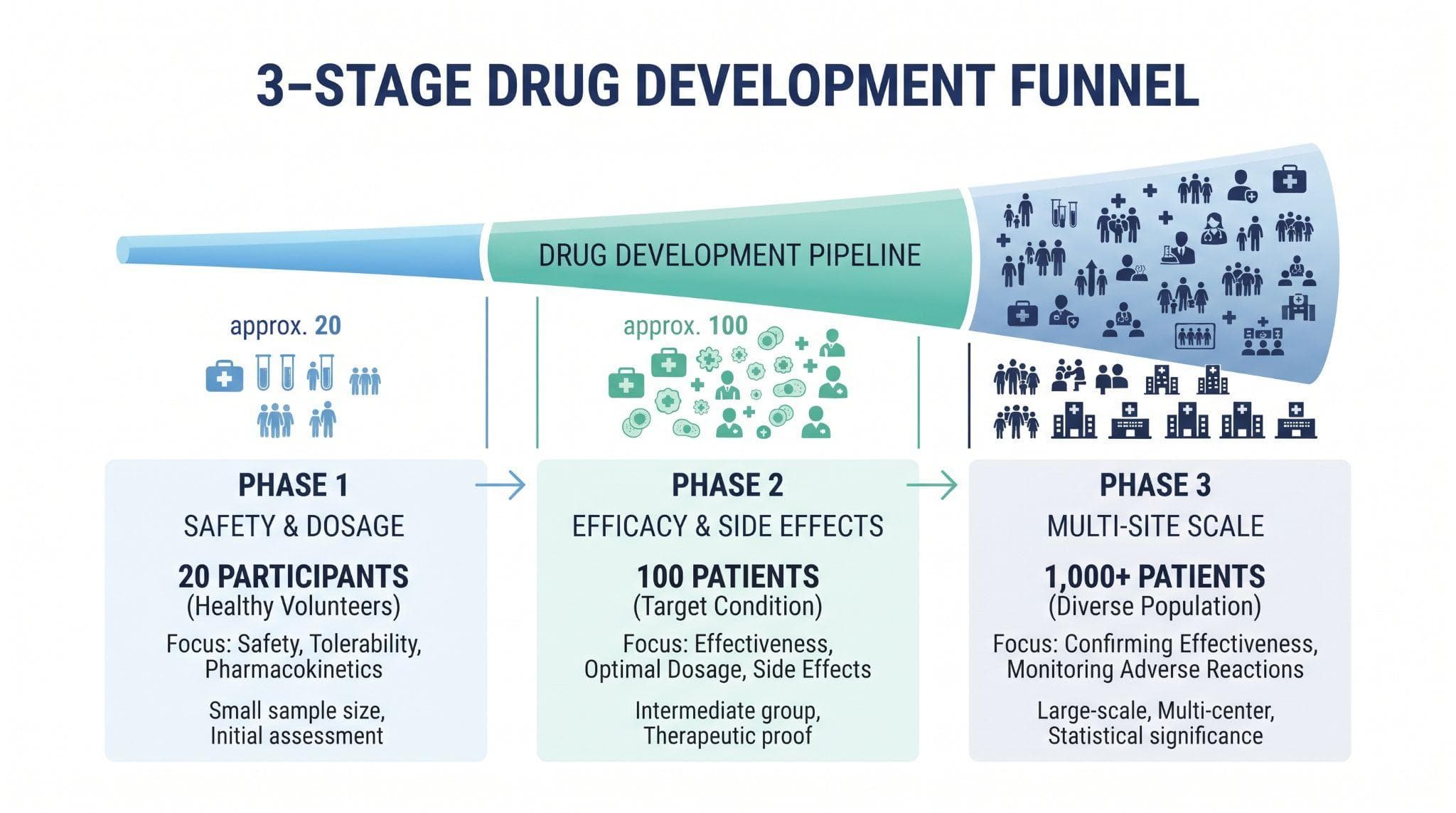
Phase 1 is the first time a compound is given to humans. According to the FDA's own description of this stage, Phase 1 studies typically involve 20 to 80 participants, usually healthy volunteers, and are closely monitored to gather information about how the drug interacts with the human body.
The primary goal here is safety, not effectiveness. Researchers are trying to identify a safe dosage range, understand how the body absorbs, processes, and eliminates the compound, and catch any acute side effects early. Phase 1 studies typically run for several months to about a year.
A compound that performs well in Phase 1 has only cleared the first hurdle. It has not yet been shown to actually treat or improve anything.
Phase 2: Does It Actually Work?
If Phase 1 suggests a compound is reasonably safe, it can advance to Phase 2. This phase enrolls a larger group, typically 100 to 300 participants, and for the first time includes people who actually have the condition the compound is meant to address.
The central question shifts from safety to efficacy. Researchers look at whether the compound relieves symptoms, slows a condition's progression, or produces a measurable, positive change. Phase 2 studies usually last several months to two years and continue monitoring for side effects that a smaller Phase 1 group may not have revealed.
Not every compound survives this stage. A meaningful share of drugs that enter Phase 2 do not move forward, either because the effect is not strong enough or because new safety concerns emerge with a larger group.
Phase 3: Confirming It at Scale
Phase 3 is the largest and most demanding stage, typically involving 300 to 3,000 participants across multiple sites, sometimes in multiple countries. These studies are usually randomized and controlled, meaning participants are randomly assigned to receive either the new compound, an existing standard treatment, or a placebo, and the results are compared directly.
Because the participant pool is so much larger, Phase 3 studies are far more likely to catch rare side effects that smaller earlier trials could have missed entirely. This phase provides the strongest evidence available on whether a compound is both safe and effective across a broader, more diverse population.
Successful Phase 3 results do not guarantee approval. The FDA reviews the complete evidence package, including manufacturing quality, safety, efficacy, and proposed labeling before making a decision.
Phase 4: What Happens After Approval
Approval is not the end of testing. Phase 4 trials, sometimes called post-market surveillance, monitor a compound's safety and performance once it is being used by the general public rather than a controlled trial population. This phase can surface long-term effects or very rare risks that only become visible once a much larger and more varied group of people has used the compound over time.
Why Most Research Peptides Never Reach This Process
Very few compounds that enter Phase 1 end up approved. Moving a peptide through all three phases takes years and typically costs far more than a small company can absorb, and that cost only makes sense if the compound can eventually be sold at a scale that recovers the investment.
This creates a real incentive problem for many peptides. Naturally occurring peptide sequences, or ones that are easy for competitors to replicate, are harder to patent, which limits the financial case for funding a multi-year, multi-phase trial. As covered in our peptide safety guide, this is a major reason why compounds like BPC-157 remain widely available as unregulated research chemicals despite years of preclinical interest, rather than progressing through the same process that brought insulin or GLP-1 medications to market.
A Practical Comparison
| Phase | Typical Participants | Primary Question | Typical Duration |
|---|---|---|---|
| 1 | 20 to 80, usually healthy volunteers | Is it safe, and what is a safe dose | Several months to 1 year |
| 2 | 100 to 300, includes people with the condition | Does it actually work | Several months to 2 years |
| 3 | 300 to 3,000, multiple sites | Does it work and stay safe at scale | 1 to 4 years |
| 4 | General public, post-approval | What happens with long-term, widespread use | Ongoing after approval |
How to Spot a Peptide Wrongly Marketed as "Clinically Tested"
A product described simply as clinically tested or backed by clinical research tells you almost nothing on its own. The same phrase could describe a completed Phase 3 trial with thousands of participants, or a small Phase 1 safety study that never moved further, or in some cases, research conducted in animals rather than humans at all.
To evaluate peptide claims reliably, trace the research to its source and verify three key details: the clinical trial phase, the number of human participants involved, and whether the study can be independently verified rather than just cited.
Frequently Asked Questions
Does entering Phase 1 mean a peptide is safe for general use?
No. Phase 1 only tests a compound in a small group, usually healthy volunteers, to establish a safe dose range and identify obvious side effects. It does not confirm the compound works for its intended purpose or that it is safe across a broader population.
How long does it take a compound to go through all three phases?
The full process commonly takes several years from the start of Phase 1 to a completed Phase 3 trial, and that is only for compounds that successfully advance at each stage. Many compounds are discontinued partway through.
Why do some effective-seeming peptides never reach Phase 3?
Cost is a major factor, since Phase 3 trials require large, multi-site studies that can cost far more than a small company can fund. Patent limitations on naturally occurring or easily replicated peptide sequences can also reduce the financial incentive to pursue full trials.
If a peptide has published Phase 1 data, is it further along than one with no human data at all?
Yes, in the sense that it has entered human testing and cleared an initial safety review. However, Phase 1 data alone does not establish that the compound works or that it is safe for the wider population, so the distinction is meaningful but limited.
Where can I check what phase a specific compound has reached?
ClinicalTrials.gov is a public registry where many ongoing and completed trials are listed by compound name, which can help confirm what phase a specific peptide has actually reached rather than relying on marketing claims.
Disclaimer: This article is for research and educational purposes only. It does not constitute medical advice. Always consult a licensed healthcare provider before starting any peptide product, whether prescribed or purchased independently.
Related reading
Peptide science
What Are Peptides? A Beginner’s Guide to How They Work
What are peptides? Learn what peptides are, how amino acid chains form peptides, what peptides do in the body, how they differ from proteins, and why their safety depends on the compound.
Peptide science
Peptides vs Proteins: What Is the Difference?
Learn how peptides and proteins differ in amino acid chain length, 3D folding, function, digestion and absorption, with examples including insulin and collagen.
Peptide science
How Peptide Signalling Works in the Human Body
Learn how peptide signalling works in the human body, including receptor binding, GPCRs, second messengers, insulin signalling and cellular responses.