
This article is for general education and research information. It does not provide medical advice or instructions for personal use.
Drug developers rarely get every desirable property in one type of molecule.
Many small-molecule drugs can enter cells relatively easily, but some biological targets lack the compact binding pockets that these molecules commonly exploit. Antibodies can recognize large surfaces with high selectivity, yet their size generally restricts their ability to cross cell membranes.
Peptides give researchers another molecular option.
A peptide is a chain of amino acids, while a peptide drug is a peptide developed or engineered for pharmaceutical use. Researchers can change individual amino acids, constrain a peptide into a particular shape, modify how long it circulates, alter its interaction with cell membranes, or combine it with another therapeutic component.
This chemical flexibility is one reason peptides are receiving increased attention in modern drug discovery. Better synthesis, larger screening systems, formulation technologies, structural biology, and computational design are allowing scientists to investigate peptide candidates that would previously have been difficult to turn into practical medicines.
That does not mean peptides are automatically safer, more effective, or better than other drug classes. Their value depends on the biological target, the properties of the individual molecule, how it is delivered, and the evidence produced during development.
Key takeaways
- Peptide drugs occupy useful chemical territory between many conventional small molecules and much larger protein therapeutics.
- Some peptide designs can interact with broad or difficult biological targets, including selected protein-protein interactions.
- Stability, clearance, membrane permeability, and oral absorption remain important limitations.
- Researchers can modify individual peptide candidates to address specific weaknesses rather than treating peptide properties as fixed.
- Cyclic-peptide screening and AI-assisted sequence optimization are widening drug-discovery options.
- Promising peptide research is not the same as an approved medicine. Laboratory findings, animal studies, clinical trials, and regulatory approval represent different stages of evidence.
Why Peptides Fit Modern Drug Design
Drug researchers often choose between different therapeutic formats according to the target they are trying to control.
Small molecules are comparatively compact and frequently have advantages in oral delivery and cell penetration. Antibodies are much larger and can recognize extensive extracellular target surfaces. Peptide drugs sit between these two formats in size and offer their own combination of molecular recognition and chemical modification.
| Feature | Small molecules | Peptide drugs | Antibody therapeutics |
|---|---|---|---|
| Relative size | Small | Intermediate | Large |
| Main design approach | Medicinal chemistry | Sequence, backbone, and chemical modification | Protein engineering |
| Broad protein surfaces | Can be difficult to address | Accessible to selected designs | Often accessible outside cells |
| Intracellular access | Often better | Usually limited without optimization | Usually very limited |
| Oral delivery | Feasible for many drugs | Difficult for many peptides | Generally impractical |
There is no winner in this comparison. The appropriate format depends on the target and what the drug needs to do.
Peptides become particularly interesting when researchers need a larger interaction surface than many conventional small molecules provide without using a full-sized protein therapeutic.
One example involves protein-protein interactions, or PPIs. These interactions can involve relatively broad contact surfaces instead of a deep binding pocket.
A 2026 Nature Chemical Biology study tested this idea against the interaction between Keap1 and Nrf2. Researchers screened 15,360 structurally diverse cyclic peptides, identified an inhibitor, and then used additional design, synthesis, and testing to produce a membrane-permeable compound active in living cells.
The study also demonstrates limitations. Membrane-permeable cyclic peptides were not obtained automatically simply by making a peptide cyclic. The researchers described de novo development of compounds combining target binding with membrane permeability as challenging.
For the structural distinction between these therapeutic formats, see Peptides vs Proteins.
What Changed to Make Peptide Research More Practical?
Peptides are not new biological molecules. What has changed is the set of tools researchers can use to discover, modify, and evaluate them.
Modern peptide synthesis makes it possible to systematically alter amino-acid sequences and incorporate structural changes. Large screening libraries allow thousands of different molecules to be tested against the same target. Structural methods help researchers understand how a peptide interacts with a receptor or protein surface.
Computational models can now narrow extremely large sequence spaces before scientists decide which candidates to synthesize. Formulation research can also address particular delivery problems rather than assuming every peptide must behave like its natural counterpart.
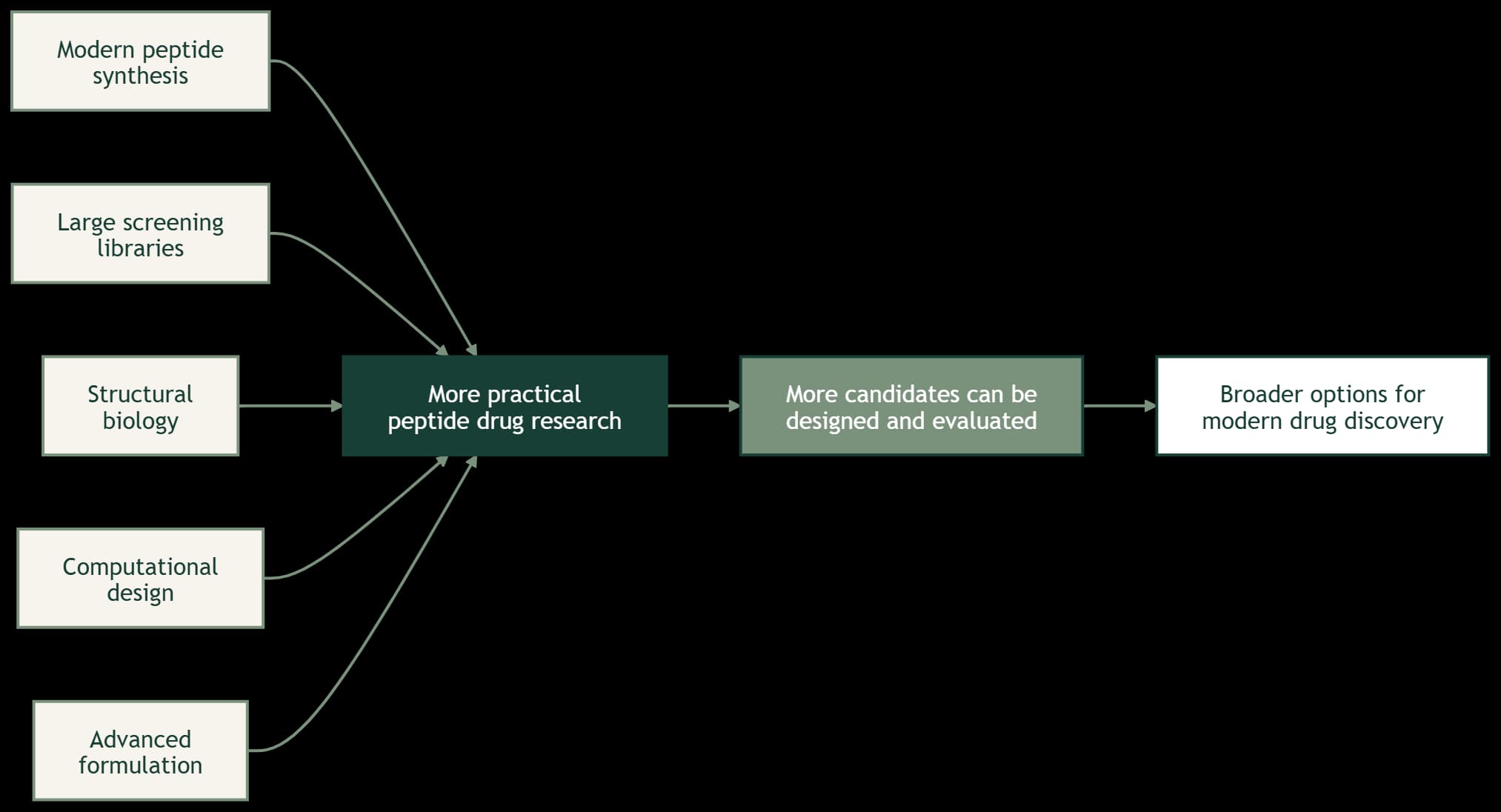
Advances in peptide drug research: Improved synthesis, screening, structural biology, computational design, and formulation are expanding peptide discovery and development.
These developments matter because naturally occurring biological peptides did not evolve to function as medicines. A short-lived signal may be ideal for normal physiology but unsuitable for a drug that needs sustained exposure.
Modern peptide drug development therefore often begins with biological recognition and then asks a practical question:
Can this molecule be redesigned so that its useful activity is retained while its drug-like properties improve?
The answer has to be established for each candidate.
How Researchers Engineer Around Peptide Limitations
Peptide therapeutics have several recurring development problems.
Proteolytic enzymes can break peptide bonds. Some molecules are cleared from circulation quickly. Many peptides are too large or polar to cross lipid membranes efficiently. Oral administration is particularly difficult because a peptide may need to survive digestive conditions and then cross the gastrointestinal barrier in sufficient amounts.
Researchers use different strategies depending on the problem.
| Starting problem | Possible research approach | Intended effect |
|---|---|---|
| Rapid enzymatic degradation | Amino-acid substitution or cyclization | Increase stability |
| Short circulation time | Chemical modification or conjugation | Extend exposure |
| Flexible structure | Constrain the peptide backbone | Improve selected binding or stability properties |
| Poor membrane penetration | Structural and chemical optimization | Improve cellular access |
| Poor gastrointestinal absorption | Specialized formulation | Increase delivery of a selected peptide |
These are development strategies, not universal solutions. A modification that improves one peptide may have little benefit for another or may introduce a new problem.
Oral semaglutide is a useful example.
A Science Translational Medicine study investigated semaglutide co-formulated with SNAC, an absorption enhancer. The researchers found that semaglutide absorption occurred in the stomach near the tablet surface and required co-formulation with SNAC. SNAC provided local protection against enzymatic degradation and temporarily increased transcellular absorption.
The most useful part of the finding is its specificity. The researchers described this absorption mechanism as compound-specific. Oral semaglutide therefore shows that this formulation can overcome a delivery barrier for a particular peptide. It does not establish that peptides generally can be converted easily from injections into tablets.
What Makes a Peptide Candidate Worth Developing?
Strong target binding is only the beginning of drug development.
A promising peptide candidate eventually has to answer several separate questions:
- Does it bind the intended biological target?
- Does that binding produce the desired biological effect?
- Is the molecule stable enough for its intended use?
- Can enough of it reach the relevant tissue?
- How quickly is it distributed, metabolized, and cleared?
- Can it be manufactured consistently?
- Does preclinical testing identify unacceptable toxicity?
- Does clinical research establish an appropriate balance of safety and benefit?
This explains why a peptide can perform impressively in a laboratory assay yet never become a medicine.
Potency does not compensate for a drug that cannot reach its target or remain present long enough to act.
The receptor and signaling biology behind these effects is covered in How Peptide Signalling Works in the Human Body.
How Peptides Are Expanding Beyond Hormone-Based Drugs
Many established peptide medicines are connected to natural hormones and signaling pathways, but current research is exploring additional roles for peptide molecules.
One example is the peptide-drug conjugate, or PDC.
A PDC connects a peptide component to another therapeutic payload through a linker. Researchers can investigate whether the peptide helps recognize a chosen molecular target while the attached payload performs another therapeutic function.
The current ClinicalTrials.gov record for PQ203 gives a specific example.
PQ203 is described as a peptide drug-conjugate being evaluated in a first-in-human Phase 1 study involving patients with advanced solid tumors, including triple-negative breast cancer. The trial began on September 16, 2025, has an estimated enrollment of 80 participants, and is studying safety, tolerability, pharmacokinetics, dose selection, and preliminary antitumor activity.
As of the current ClinicalTrials.gov record, the study is recruiting, and its estimated primary completion is December 2028. No study results are posted.
That means PQ203 has entered human investigation. It does not mean its effectiveness has been established or that regulatory approval will follow.
This distinction between research stage and proven medicine applies across peptide development.
How AI Is Changing Peptide Discovery
Even a relatively short peptide can have an enormous number of possible amino-acid sequences. Synthesizing and testing every theoretical candidate is unrealistic.
Computational models can help researchers search this space more selectively.
Generative systems may propose sequence changes, predict useful properties, and prioritize molecules for synthesis. The important step comes afterward: those predictions still have to be tested experimentally.
A 2026 Nature Machine Intelligence study introduced ApexGO, a generative AI approach for optimizing antimicrobial peptide templates.
Researchers began with ten peptide templates, generated modified sequences, chemically synthesized 100 optimized peptides, and experimentally tested them against 11 clinically relevant bacterial pathogens.
Of the 100 synthesized peptides, 86 showed detectable antimicrobial activity against at least one tested strain. The paper reported an 85% experimental hit rate for its Gram-negative optimization task and a 72% success rate in improving antimicrobial activity against Gram-negative pathogens compared with the relevant templates.
Selected molecules were subsequently evaluated in two mouse models of Acinetobacter baumannii infection. Those experiments extended the work beyond computer prediction and laboratory screening, but they remain preclinical evidence rather than proof of clinical effectiveness in humans.
This example illustrates a realistic role for AI in peptide research:
Candidate generation → prioritization → synthesis → experimental testing → optimization
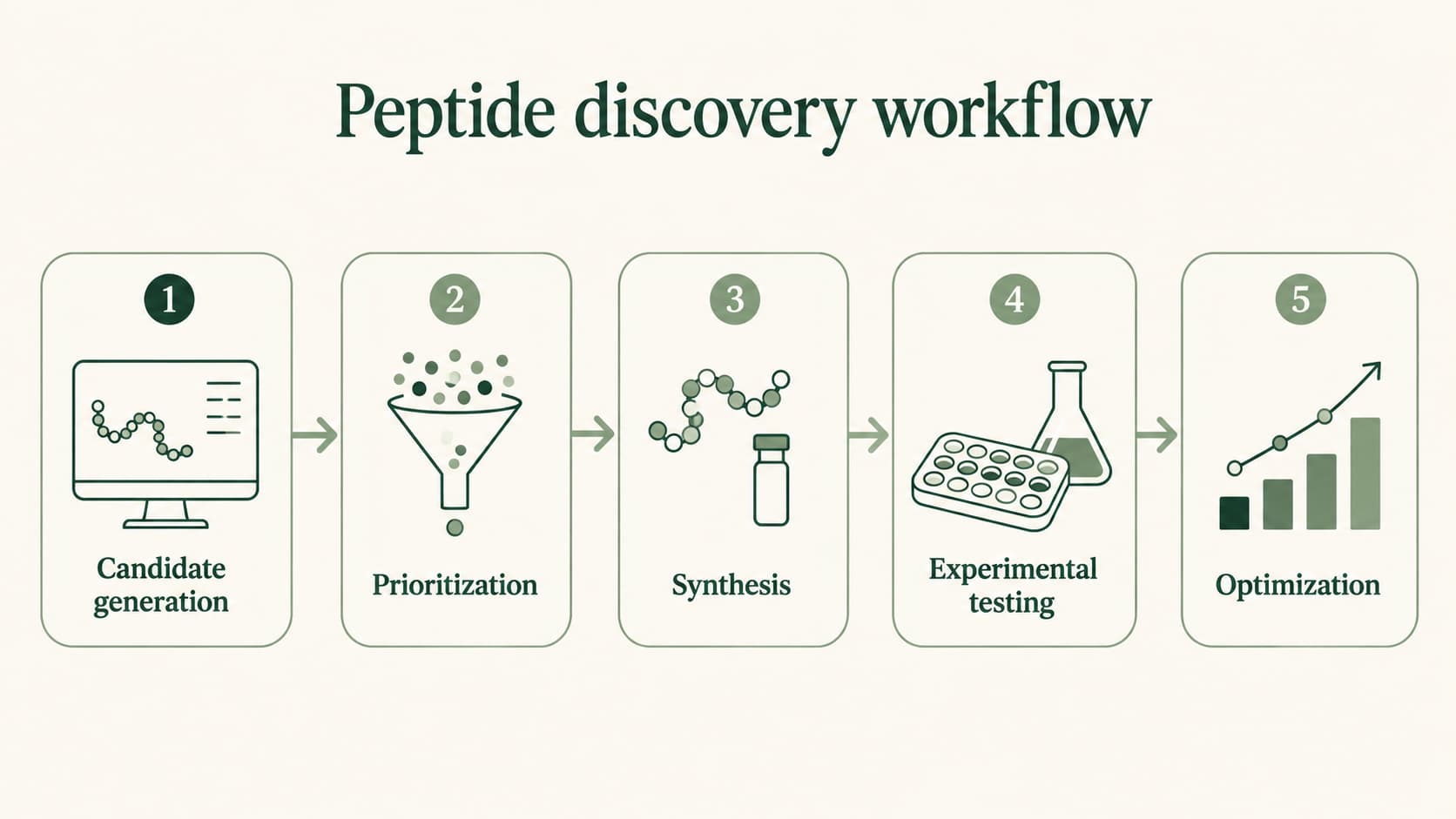
Peptide drug discovery workflow: Candidate generation, prioritization, synthesis, experimental testing, and optimization form a step-by-step process researchers use to identify and refine promising peptide drug candidates.
AI may help researchers decide what to test. It does not replace biological validation.
How a Peptide Moves From Research Candidate to Medicine
The distance between discovering an interesting peptide and developing an approved medicine is substantial.
A simplified pathway looks like this:
Biological target identified → peptide candidate discovered → sequence and structure optimized → stability and delivery evaluated → preclinical testing → human clinical trials → regulatory review
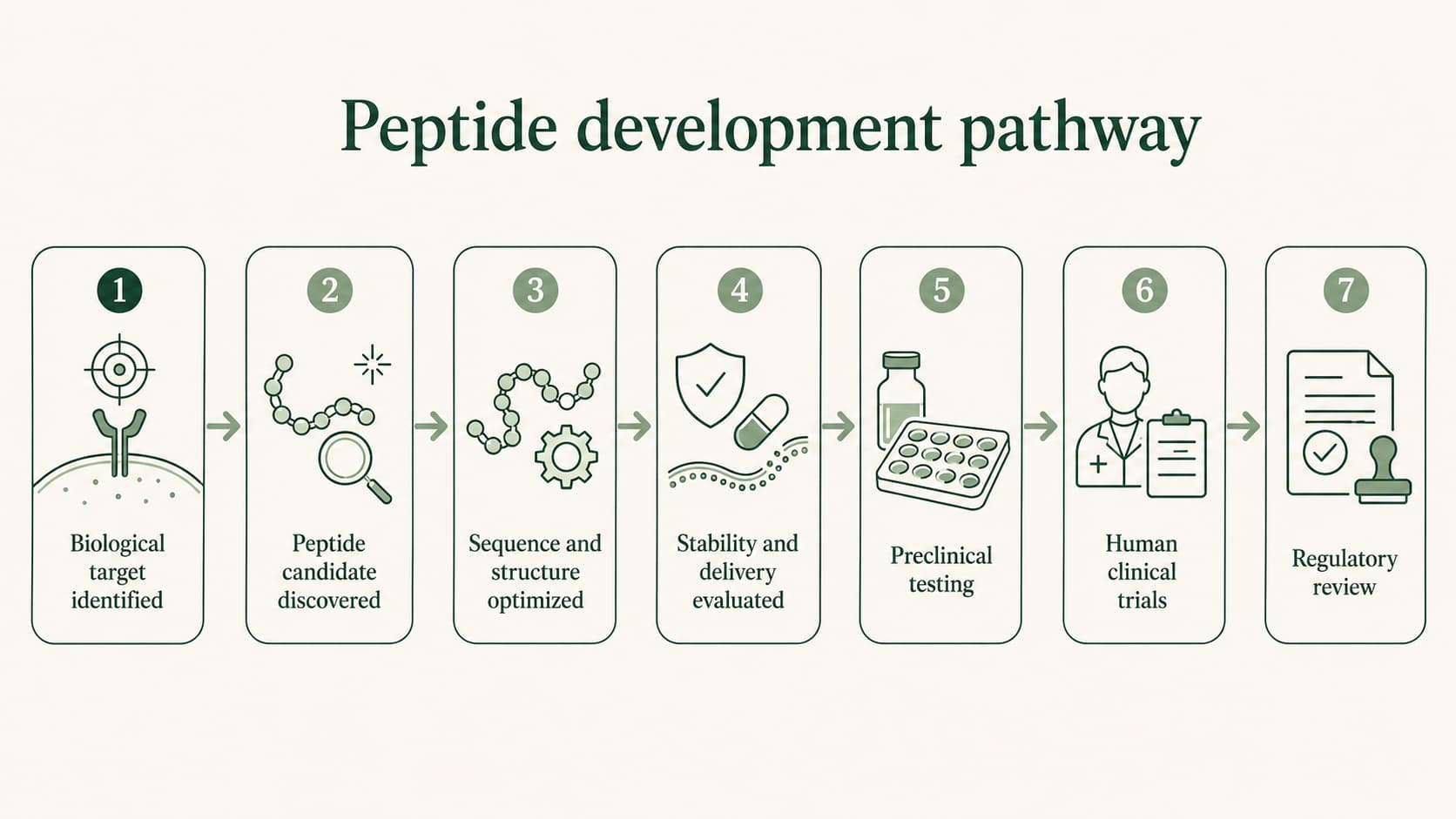
Peptide drug development pathway: From biological target identification and candidate optimization to preclinical testing, human clinical trials, and regulatory review.
Each stage can stop a development program.
A molecule may bind well but degrade too quickly. Another may remain stable but fail to reach the required tissue. A compound that works in animals may later show inadequate benefit or unacceptable risk in human trials.
This pathway is why the phrase “promising peptide research” should not be interpreted as evidence that a peptide is already a proven treatment.
The quality of evidence must be matched to the stage of development.
What FDA Activity Tells Us About Peptide Drug Development
Recent FDA activity also shows how many technical questions surround a peptide drug product.
On July 28, 2026, the FDA published 17 revised draft product-specific guidances for generic peptide products. Products covered include semaglutide, tirzepatide, liraglutide, glucagon, teriparatide, pegcetacoplan, vosoritide, and others.
The revised recommendations address manufacturing routes, innate immune-response testing, peptide impurity thresholds, higher-order structure, and assessment of biological activity. The documents remain draft product-specific guidances, meaning they contain FDA recommendations rather than finalized guidance.
FDA also maintains a separate draft guidance on clinical pharmacology considerations for peptide drug products. It discusses issues including
- Hepatic
- Drug-drug interaction
- QTs prolongation risk
- Immunogenicitiy
- Pharmaceutical
- Safety
- And efficacy.
For readers, the main point is straightforward: an amino-acid sequence alone does not define a complete drug product.
Manufacturing, impurities, formulation, pharmacokinetics, immune responses, clinical evidence, and regulatory status also matter.
For the regulatory distinction, read FDA-Approved Peptides vs Experimental Peptides. For the compound-specific safety question, see Are All Peptides Safe? Why the Answer Depends on the Compound.
Peptides are becoming more useful in modern drug research because scientists now have better ways to discover, modify, screen, formulate, and experimentally evaluate individual candidates.
Their importance does not come from a claim that peptides are universally better than small molecules or biologics. It comes from having another molecular format available when its particular properties fit the biological problem being investigated.
The most useful way to evaluate any peptide research is therefore to ask about the exact molecule, target, formulation, route of administration, stage of development, and quality of supporting evidence.
FAQs
Why are peptide drugs becoming more important?
Researchers now have better tools for peptide synthesis, structural modification, large-library screening, formulation, and computational design. These capabilities allow scientists to investigate peptide candidates against targets and delivery problems that were previously difficult to address. The usefulness of any candidate still depends on its individual properties and evidence.
What is the main advantage of peptide drugs?
There is no single advantage that applies to every peptide. Selected peptides can provide a useful combination of molecular recognition and chemical design flexibility, especially when researchers need to interact with biological surfaces that may be difficult for conventional small molecules.
What is the biggest challenge with peptide drugs?
The limiting factor varies by compound. Common problems include enzymatic degradation, rapid clearance, poor membrane permeability, and low gastrointestinal absorption. Drug developers may modify the structure or formulation to address a particular problem.
Can peptide drugs be taken orally?
Some can. Oral semaglutide demonstrates that specialized formulation can enable oral delivery for a selected peptide. Its formulation uses SNAC, and research found that its stomach absorption mechanism is compound-specific.
Can peptides target protein-protein interactions?
Selected peptide designs can. A 2026 study screened 15,360 cyclic peptides against the Keap1-Nrf2 interaction and subsequently optimized an identified inhibitor for membrane permeability and cellular activity. The study also makes clear that achieving those properties remains technically difficult.
How is AI used in peptide drug research?
AI can help generate, rank, or optimize peptide sequences before scientists decide which candidates to synthesize and test. The ApexGO study is one example in which computationally generated peptides were subsequently manufactured and evaluated experimentally.
Does promising peptide research mean a compound is proven to treat disease?
No. Laboratory results, animal studies, Phase 1 trials, later clinical trials, and regulatory approval provide different levels of evidence. A promising result at one stage does not establish clinical safety or effectiveness in humans.
Related reading
Peptide science
What Are Peptides? A Beginner’s Guide to How They Work
What are peptides? Learn what peptides are, how amino acid chains form peptides, what peptides do in the body, how they differ from proteins, and why their safety depends on the compound.
Peptide science
Peptides vs Proteins: What Is the Difference?
Learn how peptides and proteins differ in amino acid chain length, 3D folding, function, digestion and absorption, with examples including insulin and collagen.
Peptide science
How Peptide Signalling Works in the Human Body
Learn how peptide signalling works in the human body, including receptor binding, GPCRs, second messengers, insulin signalling and cellular responses.