
This article is for general education and research information. It does not provide medical advice or instructions for personal use.
GHK-Cu stands for:
- Glycyl (G): Glycine, an amino acid.
- L-histidyl (H): L-histidine, an amino acid.
- L-lysine (K): L-lysine, an amino acid.
- Cu: The chemical symbol for copper (from the Latin cuprum), which forms a chelated complex with the three-amino-acid chain (tripeptide).
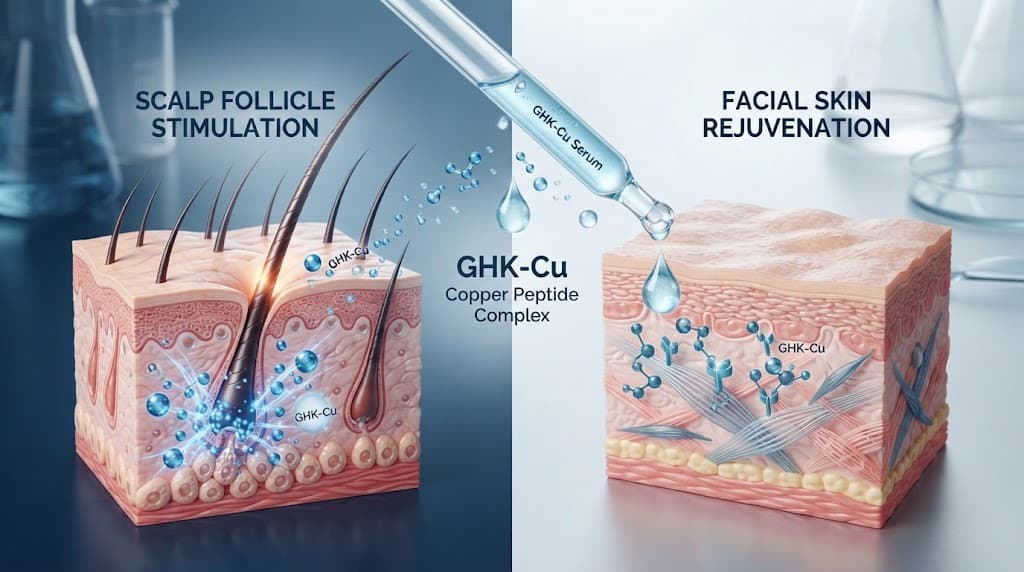
Copper has a branding problem. Most people know it as a wire in the wall or a coin in the drawer, not as something the body actively uses to rebuild itself. That is exactly what makes GHK-Cu such an odd entry point into peptide science. It is not a lab invention chasing a trend. It is a fragment the human body already makes. It is found in blood plasma, and it quietly does less of its job as people get older.
- One side calls it a copper-transport signal studied since the 1970s.
- The other calls it a shortcut to tighter skin. Both are describing the same fourteen atoms.
The gap between those two conversations is where most of the confusion lives. Some people assume GHK-Cu is an approved medical treatment because it shows up in serums at the pharmacy. Others assume the opposite. That is because it is sold as a research chemical online. It must be unregulated or untested. Neither is accurate, and the real picture sits in the middle, a molecule with a genuinely interesting research history, a regulatory status that shifted again in 2026, and a safety profile that depends heavily on how it is used.
This guide walks you through what GHK-Cu actually is, what the evidence supports at each research stage, and where the real risks sit.
At a Glance
| Category | Summary |
|---|---|
| What it is | A naturally occurring copper-binding tripeptide (glycyl-L-histidyl-L-lysine) |
| Approval status | Not FDA-approved as a drug for any condition |
| Cosmetic status | Widely used topically as copper tripeptide-1, regulated as a cosmetic ingredient, not a drug |
| Injectable status | Not approved; regulatory classification changed in April 2026 (details below) |
| Primary mechanism studied | Copper transport supporting lysyl oxidase activity in collagen and elastin crosslinking |
| Strongest evidence tier | In vitro (cell culture) and animal studies; human data is largely limited to topical cosmetic research |
| Human injectable trials | None published as of this writing |
What Is GHK-Cu?
GHK-Cu is the copper-bound form of a three-amino-acid chain, glycyl-L-histidyl-L-lysine, first isolated from human plasma by biochemist Loren Pickart in 1973. Plasma levels of this peptide are highest in young adulthood and decline steadily with age, which is part of why researchers became interested in it as a marker of, and potential lever for, tissue regeneration.
The "Cu" matters as much as the "GHK." On its own, the tripeptide has a strong chemical attraction to copper ions, and copper is not a passive passenger. It is a functional requirement for several enzymes the body uses to build and maintain connective tissue.
How Does GHK-Cu Work?
The mechanism researchers keep circling back to involves an enzyme called lysyl oxidase, which needs copper to function. Lysyl oxidase is responsible for crosslinking collagen and elastin fibers, the step that turns loose strands of protein into the structured, load-bearing matrix that gives skin, tendons, and blood vessels their strength. Without adequate copper delivery to this enzyme, that crosslinking process weakens, which is part of why copper deficiency is associated with fragile connective tissue.
GHK-Cu appears to act as a delivery vehicle, shuttling copper to where it is needed for this process. Beyond that structural role, laboratory research described in a widely cited review in the International Journal of Molecular Sciences has shown the peptide influencing a broad set of genes tied to tissue remodeling, antioxidant activity, and inflammatory response, which is a more recent and still-evolving area of the mechanism story beyond the original copper-transport explanation.
What Is It Used For?
Topical and cosmetic use. This is the form with the longest track record. Copper tripeptide-1 has been a skincare ingredient for years, formulated into serums and creams at low concentrations, generally in the 1 to 3 percent range in commercial products.
Injectable research use. This is the newer, far less established application, driven mostly by interest in systemic wound healing, hair density, and broader anti-aging effects beyond what topical delivery can reach. It is also the form with essentially no published human clinical trial data and the most regulatory uncertainty.
Potential Benefits According to Current Research
Framed honestly, GHK-Cu's benefit profile depends entirely on which evidence tier you are looking at.
In vitro research (cell cultures). Laboratory studies on human skin fibroblasts have repeatedly shown GHK-Cu stimulating collagen synthesis and increasing production of glycosaminoglycans and decorin, a small proteoglycan involved in organizing the skin's structural matrix.
Animal research. Rodent studies have extended the picture well beyond skin. One study found that GHK-Cu reduced inflammatory markers and lung tissue damage in mice with chemically induced acute lung injury, and separate rodent research has linked it to reduced markers of pulmonary fibrosis. These are legitimate, peer-reviewed findings, and they matter for understanding the mechanism, but they are animal data. A mouse lung is not a human lung, and none of these outcomes have been replicated in human injectable trials.
Human research. Here the evidence narrows considerably. Human data on GHK-Cu is concentrated almost entirely in topical, cosmetic-context studies measuring skin thickness, hydration, and fine line appearance after weeks of surface application. There is no published human clinical trial evaluating injectable GHK-Cu for any indication. That gap is not a technicality. It means claims about systemic anti-aging, hair regrowth, or internal tissue repair in humans are, at this point, extrapolated from animal and in vitro work rather than demonstrated in people.
Current Scientific Evidence Summary
| Evidence Type | What It Shows | Limitation |
|---|---|---|
| In vitro (fibroblast studies) | Increased collagen, glycosaminoglycan, decorin synthesis | Cell culture does not predict whole-body outcomes |
| Animal studies | Reduced inflammation in lung injury and fibrosis models | Different species physiology; not human-validated |
| Human topical studies | Improved skin thickness, hydration, texture over weeks | Topical absorption is not equivalent to systemic exposure |
| Human injectable studies | None published | Complete evidence gap for this route |
Regulatory & Safety Profile
This is the section where accuracy matters most, and where a lot of vendor content gets it wrong.
GHK-Cu is not an FDA-approved drug in any form. The topical, cosmetic version is regulated the way skincare ingredients generally are, which is a lighter framework than drug approval and does not involve FDA sign-off on efficacy claims.
The injectable form has had a genuinely unstable regulatory history. It was placed on the FDA's Category 2 list in 2023, the category reserved for compounding substances the agency considers to raise significant safety concerns, which effectively barred licensed compounding pharmacies from preparing it. In April 2026, the FDA published an update removing GHK-Cu's injectable form from that restricted list, alongside eleven other peptides, because the original nominators withdrew their submissions. According to the FDA's own bulk drug substances notice, the agency intends to consult its Pharmacy Compounding Advisory Committee before the end of February 2027 regarding GHK-Cu's future status.
It is important to be precise about what that removal does and does not mean. Coming off the "do not compound" list is not the same as gaining approval, and it does not place GHK-Cu on the list of substances pharmacies are affirmatively cleared to compound. It leaves the injectable form in a genuine regulatory gray zone while further review is pending. Anyone encountering claims that GHK-Cu injections are now "approved" or "cleared" is reading a mischaracterization of a procedural list update. Compounded injectable GHK-Cu products also carry a specific safety flag the agency has noted: risk of immunogenicity, meaning an unwanted immune response, tied to aggregation and impurities that can occur in peptide manufacturing.
Where GHK-Cu fits on the broader research compound spectrum, and how that compares to genuinely FDA-approved peptide drugs, is covered in more detail in our breakdown of what actually separates an approved peptide drug from an experimental research compound, which walks through the multi-phase trial requirements that compounds like GHK-Cu have not gone through.
Common Side Effects Reported in Studies
Topical use is generally well tolerated, with the most commonly reported issues being mild and localized:
- Redness or irritation at the application site
- Dryness or peeling
- Increased skin sensitivity, particularly alongside other active ingredients
- Occasional breakouts in acne-prone skin
Systemic or injectable use carries a different and less understood risk profile, precisely because human safety data for that route barely exists. Reported concerns in the limited available reporting include headache, nausea, and injection site reactions, alongside the immunogenicity concern noted by the FDA above. Because there are no completed human injectable trials, long-term safety data simply does not exist yet, and anyone considering that route should treat that absence of data as a real limitation, not a minor footnote.
Who Should Avoid It?
People with known copper metabolism disorders, such as Wilson's disease, should avoid GHK-Cu entirely, since it is specifically a copper-delivery molecule. Pregnant or breastfeeding individuals, and anyone with an unexplained skin condition, should not self-administer any research peptide without first speaking to a licensed physician. Because injectable GHK-Cu has no established human dosing or safety data, self-sourcing and self-injecting it outside clinical or research oversight carries higher risk than the topical form, including exposure to unverified purity and contamination in unregulated products.
Safety Considerations for Researchers
Anyone approaching GHK-Cu from a research standpoint should keep a few boundaries in mind. Purity and sourcing verification matter enormously with any compounded or research-grade peptide, since impurities are directly tied to the immunogenicity risk the FDA has flagged. Route of administration is not interchangeable. Evidence for topical use does not transfer to injectable use, and dosing or outcome data from one route cannot be assumed to apply to the other.
This is also a compound where the distinction between animal findings and confirmed human outcomes genuinely determines what conclusions are reasonable to draw, since so much of the systemic benefit story currently rests on rodent data alone.
How Is It Administered?
In documented research and cosmetic use, GHK-Cu appears in two forms: topical formulations applied directly to skin, typically at 1 to 3 percent concentration, and reconstituted solutions used in laboratory and animal research via injection. This article does not provide injectable dosing guidance, since no human clinical trial has established a safe or effective injectable protocol, and any specific dosing claims circulating online for that route are not backed by published human data.
Key Takeaways
GHK-Cu is a naturally occurring, copper-binding tripeptide with a genuinely interesting research story, not a marketing invention. Its topical, cosmetic use has real human data behind it. Its injectable use does not.
The peptide's real promise, particularly in wound healing and tissue signaling research, is worth taking seriously in the lab and in animal models. Whether that promise holds up in confirmed human trials for systemic use is still an open question, and treating it as already answered is the single biggest misconception surrounding this compound right now.
Frequently Asked Questions
Is GHK-Cu the same as copper peptide serum sold in skincare stores?
Yes, when a skincare label lists "copper tripeptide-1," that is GHK-Cu in topical form. This is the version with the most human research behind it, though that research is still limited to topical skin outcomes rather than systemic health claims.
Did the FDA approve GHK-Cu injections in 2026?
No. The FDA removed injectable GHK-Cu from its Category 2 restricted compounding list in April 2026 because the original nomination was withdrawn, but this is a procedural list change, not a drug approval, and further review through the Pharmacy Compounding Advisory Committee is still pending.
Why does GHK-Cu decline with age?
Researchers have observed that plasma concentrations of the naturally occurring GHK peptide are highest in young adulthood and drop substantially by later decades, though the precise biological trigger for that decline is still an area of active study rather than a settled mechanism.
Can GHK-Cu regrow hair or reverse aging systemically?
Animal and in vitro studies have shown effects relevant to hair follicle activity and tissue regeneration, but there is no published human clinical trial confirming these outcomes for injectable or oral use, so any such claim currently outpaces the human evidence.
Is GHK-Cu dangerous?
Topical use has a strong safety record with mostly mild skin-related side effects. Injectable use carries more uncertainty because human safety data for that route does not yet exist, which is a different risk category than "dangerous" but should not be treated as equivalent to "safe."
Disclaimer: This article is for informational and educational purposes only. It does not constitute medical advice, and it is not a recommendation to use, purchase, or self-administer GHK-Cu or any research peptide. GHK-Cu is not approved by the FDA for the treatment, diagnosis, cure, or prevention of any disease or condition. Research chemical forms of this compound are intended for laboratory research use only and not for human consumption. Anyone considering use of this or any peptide should consult a licensed healthcare provider first.
Related reading
Peptide science
What Are Peptides? A Beginner’s Guide to How They Work
What are peptides? Learn what peptides are, how amino acid chains form peptides, what peptides do in the body, how they differ from proteins, and why their safety depends on the compound.
Peptide science
Peptides vs Proteins: What Is the Difference?
Learn how peptides and proteins differ in amino acid chain length, 3D folding, function, digestion and absorption, with examples including insulin and collagen.
Peptide science
How Peptide Signalling Works in the Human Body
Learn how peptide signalling works in the human body, including receptor binding, GPCRs, second messengers, insulin signalling and cellular responses.