
This article is for general education and research information. It does not provide medical advice or instructions for personal use.
Collagen has become a word people use the way they use "protein" or "vitamins," a vague stamp of approval slapped on powders, creams, and drinks with very little explanation of what it actually does inside the body. Ask most people how collagen production works and the answer is usually a shrug. Ask them why a copper-based peptide would matter to that process, and the confusion deepens, because copper sits so far outside the everyday conversation about skin and aging that it barely registers as biologically relevant at all.
That disconnect is worth closing, because the mechanism behind GHK-Cu is not vague. It is one of the more specifically mapped pathways in peptide research, built around a single enzyme that needs copper to function and cannot do its job without it. Understanding that pathway also clears up a common misreading of the research: the assumption that because GHK-Cu shows up in skincare marketing, its effects on collagen must be a marketing invention rather than a documented biochemical process. The mechanism is real and well described in laboratory research. What is less settled is how far that mechanism extends once it leaves a petri dish or a mouse model and enters a human body outside a controlled topical study, and that distinction matters for anyone trying to separate the science from the sales pitch.
What Collagen Actually Requires to Form
Collagen does not simply appear once the body produces enough raw protein. Individual collagen strands, called tropocollagen, need to be chemically crosslinked into a stable, fibrous network before they provide any real structural strength. Without that crosslinking step, collagen stays loose and disorganized, more like a tangle of thread than a woven fabric. This is the step where GHK-Cu's mechanism becomes relevant, because crosslinking depends on an enzyme that cannot function without copper.
The Lysyl Oxidase Connection
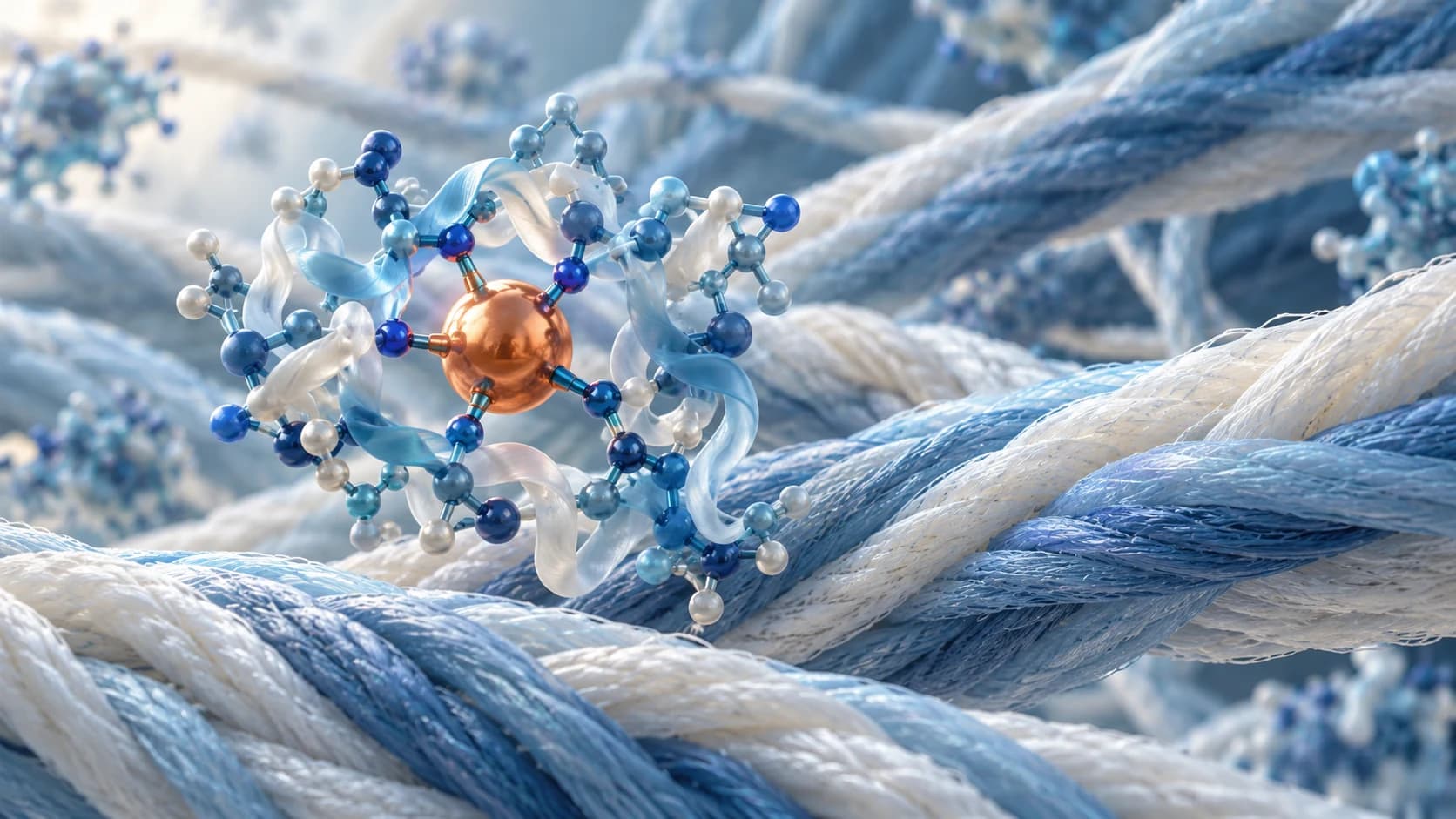
That enzyme is lysyl oxidase, and it is the center of the entire mechanism story. Lysyl oxidase oxidizes specific amino acid residues on collagen and elastin strands, a chemical step that allows adjacent strands to bond together into the crosslinked structure responsible for skin elasticity, tendon strength, and vascular integrity. Lysyl oxidase belongs to a category of enzymes called cuproenzymes, meaning copper sits directly in its active site as a required component, not an optional cofactor.
This is where GHK-Cu's chemistry becomes functionally important rather than incidental. The tripeptide has a strong binding affinity for copper ions, and research has proposed it functions as a transport and delivery mechanism, helping move copper to where enzymes like lysyl oxidase can use it. Without adequate copper delivery, this crosslinking pathway slows, and connective tissue that forms under those conditions is measurably weaker, a pattern that has also been observed in cases of dietary copper deficiency.
What Laboratory Research Shows
The clearest evidence for this mechanism comes from studies on human dermal fibroblasts, the cells primarily responsible for producing collagen in skin. In cell culture, GHK-Cu exposure has repeatedly been shown to increase collagen synthesis, along with production of glycosaminoglycans and decorin, a proteoglycan that helps organize collagen fibers into an orderly structural matrix rather than a disorganized mass.
Beyond that structural effect, a widely cited gene expression review published in the International Journal of Molecular Sciences found that GHK-Cu influences a broad set of genes tied to tissue remodeling, extracellular matrix organization, and antioxidant activity. This gene-level view is a more recent addition to the mechanism story, suggesting GHK-Cu's role may extend beyond simple copper delivery into signaling effects on how cells regulate repair processes more generally, though this is still an active area of research rather than a fully settled explanation.
What Animal Research Adds, and Where It Stops
Animal studies have extended this mechanism picture into tissue types well beyond skin. Rodent research on acute lung injury models found that GHK-Cu reduced inflammatory markers and tissue damage, findings that researchers have connected to the same tissue-remodeling and antioxidant gene activity observed in cell culture work. Separate rodent studies have linked it to reduced markers of pulmonary fibrosis through what appears to be a related mechanism.
These findings genuinely matter for understanding how far GHK-Cu's biological activity reaches. They do not, on their own, confirm that the same mechanism produces the same outcome in a human body. Mouse physiology and human physiology diverge in ways that frequently affect how a compound behaves once dosing, metabolism, and tissue architecture differ, which is precisely why researchers treat animal findings and confirmed human outcomes as separate categories of evidence rather than interchangeable proof of the same claim.
Where Human Evidence Currently Sits
Human data on this mechanism is concentrated in topical research, measuring outcomes like skin thickness, hydration, and fine line appearance after weeks of surface application of copper tripeptide formulations. This is consistent with the fibroblast-level mechanism described above, and it represents genuine, replicated human evidence, just confined to the topical route and to skin-level outcomes.
What does not currently exist is human trial data confirming this same collagen-crosslinking mechanism at a systemic level through injectable use. That gap sits alongside broader questions about GHK-Cu's regulatory status as an experimental compound rather than an approved therapeutic, and it is the reason claims about internal, whole-body collagen effects from injectable GHK-Cu currently rest on extrapolation from animal and cell culture data rather than direct human confirmation.
Why the Mechanism Still Matters
None of this means the mechanism is speculative science. Lysyl oxidase's dependence on copper is well established outside of GHK-Cu research entirely, and GHK-Cu's binding affinity for copper is a measured chemical property, not a marketing claim. What is genuinely uncertain is not whether this biochemical pathway exists, but how completely it translates into the range of outcomes attributed to GHK-Cu once claims move past topical skin research and into systemic, injectable use.
Frequently Asked Questions
Does GHK-Cu directly build collagen?
Not directly. The proposed mechanism is that GHK-Cu delivers copper to lysyl oxidase, an enzyme that crosslinks collagen strands into a stable structure. Cell culture studies also show increased collagen synthesis itself, so the peptide appears to influence both the raw production and the structural assembly stages.
Why does copper specifically matter for collagen?
Lysyl oxidase, the enzyme responsible for crosslinking collagen and elastin, requires copper in its active site to function. Without sufficient copper availability, this crosslinking process slows, which is why copper deficiency has been associated with weaker connective tissue in research settings.
Is this mechanism the same for skin and other tissue types?
The core lysyl oxidase pathway is common across connective tissue generally, which is part of why animal studies have shown effects in lung tissue and not just skin. However, most human confirmation of this mechanism specifically comes from skin-focused, topical research rather than other tissue types.
Does research on this mechanism apply to injectable GHK-Cu use?
The underlying biochemistry here is copper delivery, which supports lysyl oxidase activity. It is not route-specific in theory, but no human clinical trial has confirmed this mechanism's effects through injectable administration, so that extrapolation remains unverified in people.
Disclaimer: This article is for informational and educational purposes only and does not constitute medical advice. It does not recommend the use, purchase, or self-administration of GHK-Cu or any research peptide. GHK-Cu is not approved by the FDA for the treatment, diagnosis, cure, or prevention of any disease or condition. Research chemical forms of this compound are intended for laboratory research use only and not for human consumption. Anyone considering use of this or any peptide should consult a licensed healthcare provider first.
Related reading
Peptide science
What Are Peptides? A Beginner’s Guide to How They Work
What are peptides? Learn what peptides are, how amino acid chains form peptides, what peptides do in the body, how they differ from proteins, and why their safety depends on the compound.
Peptide science
Peptides vs Proteins: What Is the Difference?
Learn how peptides and proteins differ in amino acid chain length, 3D folding, function, digestion and absorption, with examples including insulin and collagen.
Peptide science
How Peptide Signalling Works in the Human Body
Learn how peptide signalling works in the human body, including receptor binding, GPCRs, second messengers, insulin signalling and cellular responses.