
This article is for general education and research information. It does not provide medical advice or instructions for personal use.
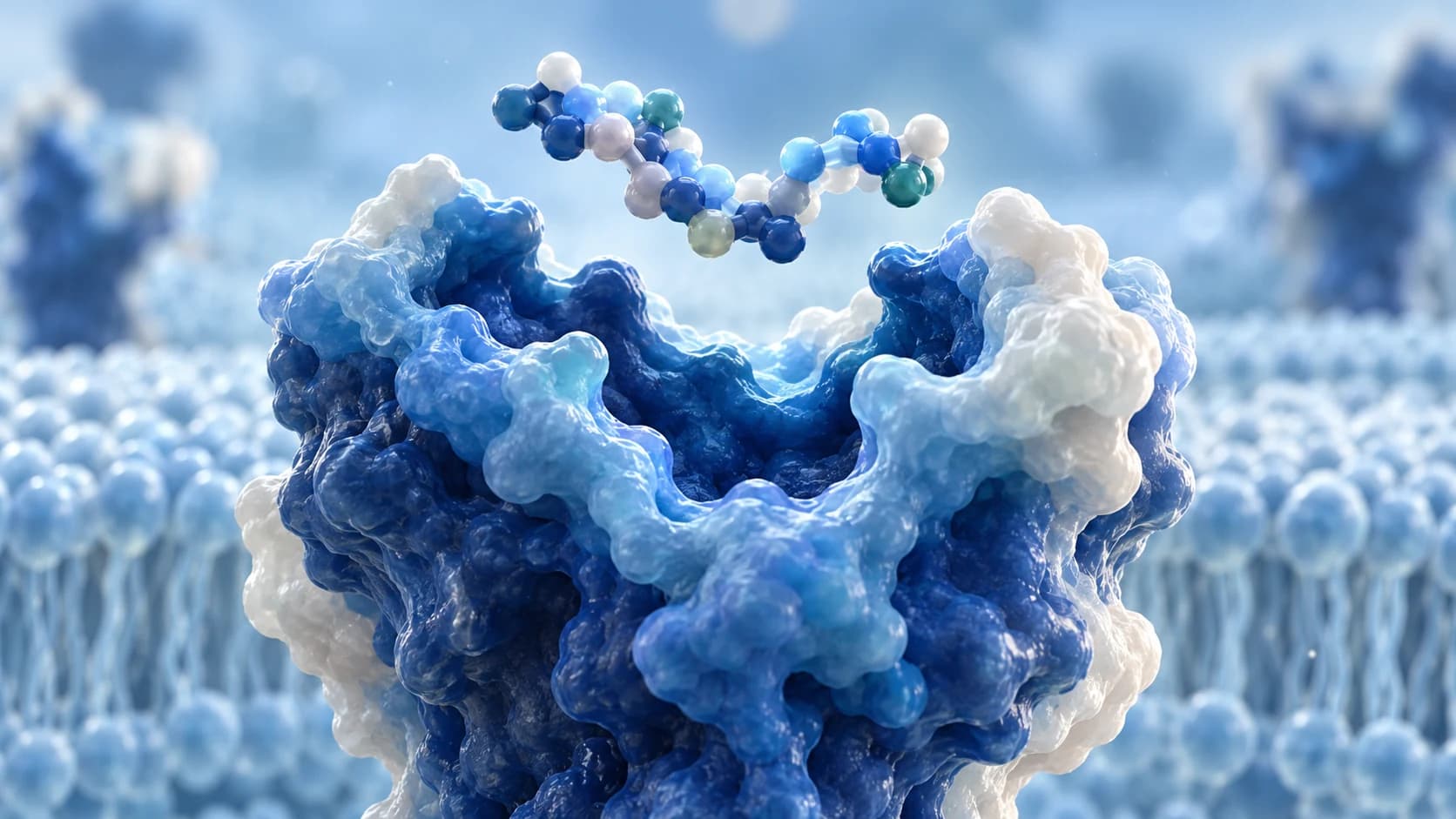
A peptide can carry a biological message, but a cell needs a way to recognise that message. A peptide receptor provides that recognition.
The U.S. National Library of Medicine defines peptide receptors as cell-surface receptors that bind peptide messengers and regulate intracellular signals that influence cell behaviour. In simple terms, a peptide receptor is a receptor protein that recognises a compatible peptide and allows a cell to respond to it.
That definition explains why peptide receptors matter. A peptide may be present around many cells, but only cells with suitable receptors can recognise that particular molecular signal directly.
If you first need the basic biology of peptides themselves, learn What Are Peptides?
What Does a Peptide Receptor Do?
A peptide receptor acts as a molecular recognition site.
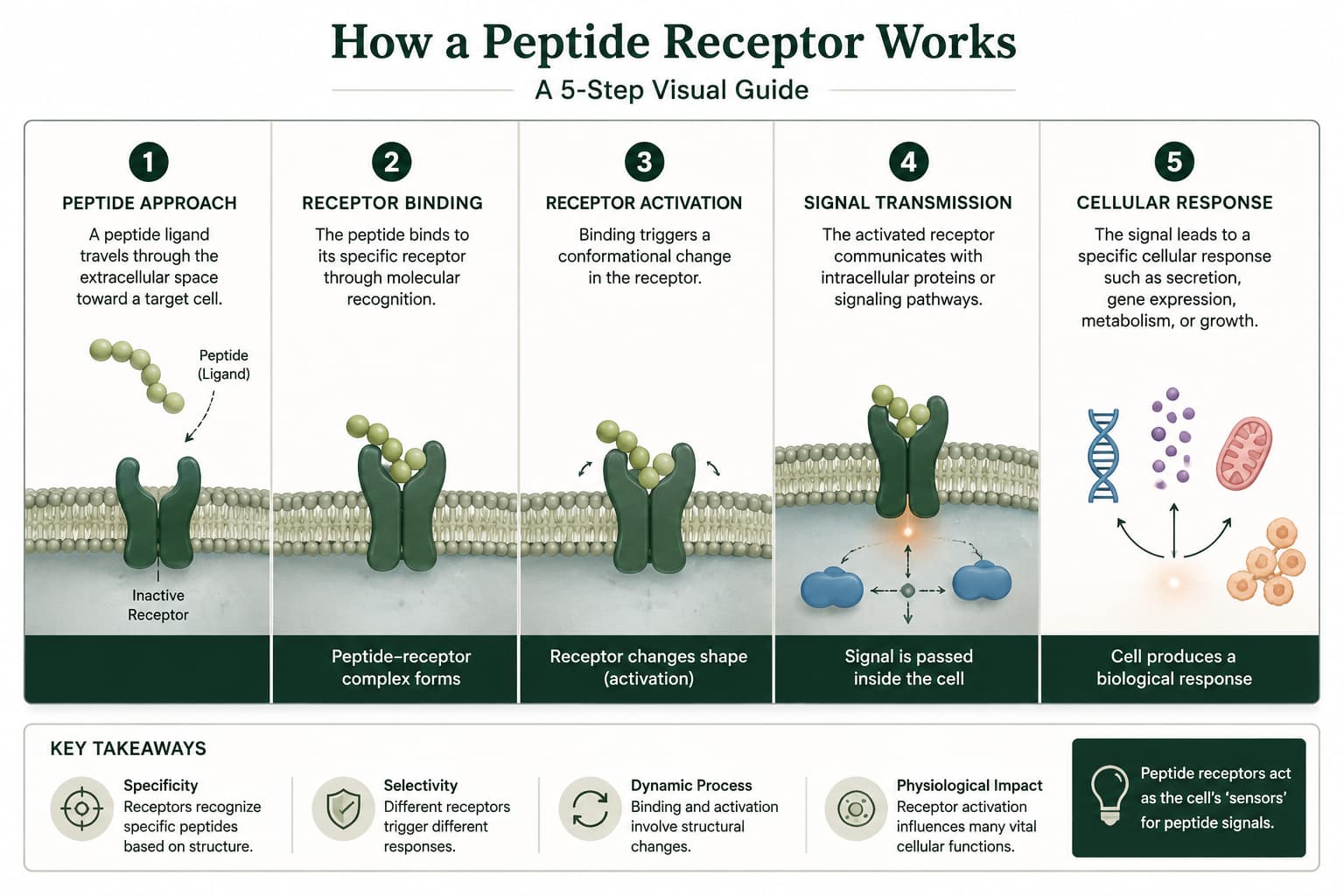
Figure 1: How a peptide receptor recognizes a peptide ligand, binds it at the cell surface, and begins a cellular response.
The peptide that interacts with the receptor is called a ligand. When a compatible ligand reaches its receptor, the two molecules can form a temporary peptide-receptor complex.
The receptor is not simply an attachment point. Its structure allows it to distinguish between molecules based on features such as shape, amino-acid arrangement, electrical charge and the position of chemical groups.
Once the correct peptide binds, the receptor may change its structure or activity. That change allows information from outside the cell to influence processes within the cell.
This creates a basic sequence:
Peptide reaches a responsive cell → peptide binds its receptor → receptor becomes activated or otherwise altered → the cell receives the signal
The later steps can involve several intracellular pathways depending on the receptor involved. Those pathways are covered separately in How Peptide Signalling Works in the Human Body. Here, the focus is the receptor itself: what it is, how it recognises peptides and why that recognition is selective.
Where Are Peptide Receptors Found?
Peptide receptors involved in classical cell-to-cell communication are generally located at the cell surface.
This location is important because many signalling peptides communicate with cells from the extracellular environment. A membrane receptor can recognise the peptide outside the cell while connecting that interaction to molecular machinery on the inside.
The National Library of Medicine classification specifically places peptide receptors among cell-surface receptors. It also includes related terms such as “peptide hormone receptor” and “peptide receptor.”
A peptide receptor therefore often has regions exposed outside the cell for ligand recognition, membrane-spanning regions that anchor it, and intracellular regions that participate in the cellular response.
The exact architecture varies considerably between receptor families.
How Does a Peptide Bind to Its Receptor?
Receptor binding depends on molecular compatibility between the peptide and the receptor’s binding region.
Peptides are chains of amino acids, and those amino acids determine more than the peptide’s sequence. They influence its three-dimensional shape, charge distribution, flexibility and the chemical groups exposed on its surface.
The receptor has its own three-dimensional structure. Particular amino acids within its binding site can interact with selected regions of a peptide through non-covalent forces such as:
- hydrogen bonding
- electrostatic attraction
- hydrophobic interactions
- van der Waals contacts
A useful example comes from the glucagon-like peptide-1 receptor, or GLP-1 receptor. A structural study published in Nature showed the peptide GLP-1 positioned between the receptor’s extracellular domain and transmembrane core, with additional contacts from extracellular loops. The receptor therefore recognises the peptide through several coordinated contact points rather than a single attachment site.
Another structural analysis found a peptide agonist sitting deep within the GLP-1 receptor binding pocket while maintaining an α-helical configuration. That study provides a detailed view of the peptide-binding site.
These structures also show why the traditional “lock and key” description has limits. Receptors and peptides are not rigid objects. Their structures can adjust during binding.
Why Are Peptide Receptors Selective?
A receptor usually does not respond equally to every peptide.
Receptor specificity comes from the molecular requirements of the binding site. A peptide needs the right combination of structural and chemical features to interact productively with the receptor.
Several factors can affect peptide-receptor recognition:
- amino-acid sequence
- peptide shape
- orientation of key side chains
- charge
- flexibility
- receptor-binding pocket structure
- interactions with extracellular receptor regions
Small molecular changes can therefore alter how a peptide interacts with a receptor.
A 2026 Nature Chemistry study provides a recent example. Researchers modified glucagon- and parathyroid-hormone-derived peptides by replacing selected amino acids with different stereochemical forms. Some modified peptides still activated their respective receptors strongly despite substantial changes in the peptides' preferred structures outside the receptor. This demonstrates that receptor recognition depends on the complete molecular interaction rather than sequence alone. Read the 2026 study in Nature Chemistry.
Specificity is not always absolute. Related receptors can recognise related ligands, and some peptides can interact with more than one receptor subtype. Scientists therefore test receptor selectivity experimentally instead of assuming that one peptide corresponds to only one receptor.
Are Peptide Receptors the Same as Hormone Receptors?
Not exactly.
Some peptide receptors are hormone receptors because their natural ligands are peptide hormones. The insulin receptor, GLP-1 receptor, and natriuretic peptide receptors are examples.
But “hormone receptor” is a broader term.
Hormones include chemically different molecules. Steroid hormones, for example, interact with intracellular nuclear receptors rather than the typical cell-surface receptors used by peptide hormones.
A peptide hormone receptor is therefore a type of hormone receptor specifically associated with a peptide ligand.
This distinction matters because “peptide receptor,” “hormone receptor” and “cell receptor” describe overlapping but non-identical categories.
What Are the Main Types of Peptide Receptors?
Peptide receptors do not belong to one structural family. Different receptor proteins can recognise peptide ligands while using very different molecular architectures.
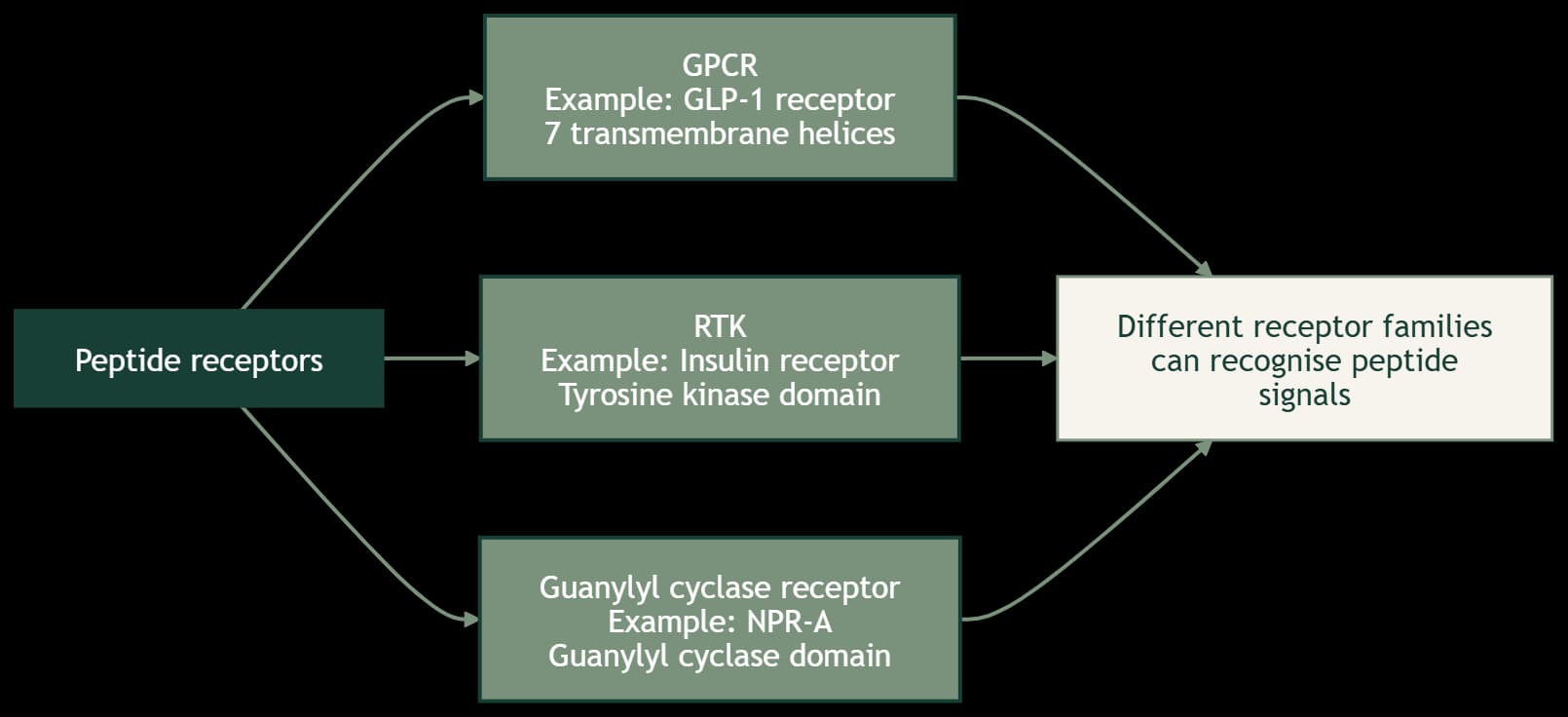
Figure 2: Main types of peptide receptors, including GPCRs, receptor tyrosine kinases, and guanylyl cyclase receptors, with examples of the peptide signals they recognize.
Three well-established examples illustrate this diversity.
| Receptor family | Peptide example | Receptor characteristic |
|---|---|---|
| G protein-coupled receptor | GLP-1 receptor | Seven membrane-spanning helices |
| Receptor tyrosine kinase | Insulin receptor | Intracellular tyrosine kinase domains |
| Receptor guanylyl cyclase | Natriuretic peptide receptor-A | Intracellular guanylyl cyclase domain |
G Protein-Coupled Peptide Receptors
Many peptide hormones and neuropeptides interact with G protein-coupled receptors, usually shortened to GPCRs.
GPCRs have seven membrane-spanning helices. Their extracellular regions recognise ligands, while structural changes within the receptor allow information to pass across the membrane.
GLP-1R is a well-studied peptide-responsive GPCR. Cryo-electron microscopy has shown how GLP-1 binding is associated with structural rearrangement of the receptor’s transmembrane region.
Parathyroid hormone receptor 1, glucagon receptor, angiotensin receptors and several neuropeptide receptors provide other examples of peptide-responsive GPCRs.
GPCRs are important peptide receptors, but peptide receptor is not another name for GPCR.
The Insulin Receptor
Insulin demonstrates a different receptor design.
Insulin is a peptide hormone, while the insulin receptor is a receptor tyrosine kinase.
A cryo-electron microscopy study published in Nature directly visualised insulin bound to the extracellular portion of its receptor. The work helped define the structural arrangement of the insulin-receptor complex and how ligand binding relates to receptor activation.
Later structural studies have shown that peptide ligands other than insulin can also engage the insulin receptor in distinct ways, further demonstrating that peptide-receptor recognition can involve more than one binding configuration.
Natriuretic Peptide Receptors
Natriuretic peptides provide a third receptor architecture.
Natriuretic peptide receptor-A, also known as NPR-A, NPR1 or guanylyl cyclase-A, is a single-pass membrane receptor with an extracellular ligand-binding region and an intracellular guanylyl cyclase domain.
Research published in Nature Communications in 2026 examined different active structures of human GC-A/NPR1. Cryo-EM showed that its conformation can be altered by different activating molecules and by the presence of its peptide ligand, atrial natriuretic peptide (ANP).
These receptor families show why defining a peptide receptor by its ligand is more useful than assuming all peptide receptors have the same structure.
What Happens When a Peptide Binds its Receptor?
Binding can alter the receptor, but binding and activation are not identical concepts.
An agonist is a ligand that binds a receptor and promotes an active receptor state.
An antagonist binds to a receptor but prevents or reduces activation by an agonist.
This distinction means that detecting receptor binding alone does not establish what biological response will occur.
Researchers therefore distinguish between:
- Binding: Does the peptide physically interact with the receptor?
- Activation: Does that interaction change receptor function?
- Cellular response: What happens in the cell after receptor activation?
Keeping these questions separate is essential when interpreting peptide research.
The molecular pathways following receptor activation belong to the wider topic of peptide signalling rather than the definition of the receptor itself.
What do Affinity and Selectivity Mean for Peptide Receptors?
Two related terms frequently appear in receptor research.
- Affinity describes how strongly a ligand tends to associate with a receptor under defined experimental conditions.
- Selectivity describes whether that ligand favours one receptor over other possible receptors.
They are not interchangeable.
A peptide could show strong binding to a receptor but still interact with several related receptor subtypes. Conversely, a ligand can be comparatively selective for one receptor without having exceptionally high affinity.
These measurements help researchers describe a peptide-receptor relationship more precisely than simply saying that a peptide “targets” a receptor.
Why Do Some Cells Respond to a Peptide While Others Do Not?
One major reason is receptor expression.
Different cells contain different sets and amounts of receptor proteins. A peptide cannot directly activate a receptor that the cell does not express.
This means receptor distribution helps determine which tissues can recognise a peptide signal.
Even cells that express the same receptor may not respond identically because their receptor abundance and intracellular machinery can differ.
The receptor therefore contributes to biological specificity at two levels: the peptide must be compatible with the receptor, and the receptor must be present on an appropriate cell.
How Do Researchers Identify a Peptide Receptor?
Scientists cannot establish a peptide-receptor relationship from sequence similarity or computer modelling alone.
Several experimental methods can contribute different pieces of evidence.
- Binding assays test whether a peptide physically associates with a receptor.
- Functional assays measure whether receptor activity changes after exposure to the peptide.
- Receptor-expression experiments can test whether introducing a suspected receptor makes previously unresponsive cells responsive to a peptide.
- Mutational studies alter specific amino acids in the peptide or receptor to identify regions required for recognition.
- Structural biology can show how the molecules physically interact. X-ray crystallography and cryo-electron microscopy have produced detailed structures of peptide-receptor complexes, including GLP-1R, insulin receptor and natriuretic peptide receptors.
Computational modelling can help researchers generate receptor candidates or predict binding configurations, but experimental validation remains necessary before a proposed peptide-receptor interaction can be treated as established.
Why Does Knowing the Receptor Matter?
Identifying a receptor gives a proposed peptide mechanism a defined molecular target.
Researchers can then ask more precise questions:
- Which cells express the receptor?
- How strongly does the peptide bind?
- Which parts of the peptide are required for recognition?
- Does binding activate or block the receptor?
- Are other receptors also involved?
Receptor evidence does not, however, prove that a peptide is safe or clinically effective.
A peptide may show clear receptor activity in a laboratory experiment without having established benefits in humans. Clinical effectiveness and safety require evidence beyond receptor biology.
For that distinction, see Are All Peptides Safe? and FDA-Approved Peptides vs Experimental Peptides.
Peptide receptors are also proteins, while their peptide ligands are amino-acid chains with different structural roles. Peptides vs Proteins explains that distinction in more detail.
FAQs
What is a peptide receptor in simple terms?
A peptide receptor is a receptor protein that recognises a compatible peptide messenger. The interaction allows the cell to detect that peptide and, when appropriate, initiate a response.
Are peptide receptors proteins?
Yes. Peptide receptors are receptor proteins. Their amino-acid sequences fold into structures that allow them to recognise particular peptide ligands.
Are peptide receptors located on the cell surface?
Classical peptide receptors are primarily cell-surface receptors. This positioning allows them to recognise extracellular peptide messengers and communicate that information across the cell membrane.
Do all peptides have receptors?
Not every peptide sequence should automatically be assumed to have a specific biological receptor. Many naturally occurring signalling peptides have identified receptors, while researchers continue to investigate ligand-receptor relationships experimentally.
Can one peptide bind more than one receptor?
Yes. Some peptides can interact with multiple receptor subtypes, particularly when those receptors have related ligand-binding regions. The strength and functional consequences of those interactions can differ.
Are all peptide receptors GPCRs?
No. GPCRs form an important group of peptide receptors, but other receptor families also bind peptides. Insulin uses a receptor tyrosine kinase, while natriuretic peptides can act through membrane guanylyl cyclase receptors.
What is the difference between a peptide and a peptide receptor?
A peptide is an amino-acid chain that may act as a biological messenger. A peptide receptor is a protein capable of recognising a compatible peptide and participating in the cellular response.
Does receptor binding prove that a peptide has a health benefit?
No. Receptor binding provides evidence about molecular interaction. It does not establish clinical effectiveness, safety or an appropriate medical use. Those questions require suitable preclinical and human research.
A peptide receptor is therefore best understood as the cellular recognition point for a peptide message. Its structure determines which peptides it can recognise, its location helps determine which cells can receive the message, and its receptor family influences what can happen after binding. Understanding the receptor gives peptide biology a specific molecular target instead of treating peptide effects as general or automatic.
Related reading
Peptide science
What Are Peptides? A Beginner’s Guide to How They Work
What are peptides? Learn what peptides are, how amino acid chains form peptides, what peptides do in the body, how they differ from proteins, and why their safety depends on the compound.
Peptide science
Peptides vs Proteins: What Is the Difference?
Learn how peptides and proteins differ in amino acid chain length, 3D folding, function, digestion and absorption, with examples including insulin and collagen.
Peptide science
How Peptide Signalling Works in the Human Body
Learn how peptide signalling works in the human body, including receptor binding, GPCRs, second messengers, insulin signalling and cellular responses.